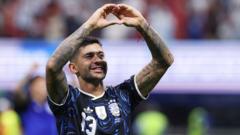
The human chest is not designed to hold that much oxygen.
On December 18, 2022, inside the cavernous bowl of the Lusail Stadium in Qatar, Lionel Scaloni stood on the edge of the technical area and felt his ribs constricting. The air in Doha was cool, but his suit was soaked in sweat. For seventy-nine minutes, his Argentina side had not just played football; they had painted a masterpiece. They were leading France 2-0. The World Cup was theirs. The decades of waiting, the ghost of Diego Maradona, the crushing weight on Lionel Messi’s shoulders—all of it was dissolving into the desert night.
Then, the world split open.
Within ninety seconds, Kylian Mbappé scored twice. Just like that, the masterpiece was smeared with grease and ash.
To understand what Scaloni called "epic squared" in the aftermath of that winter, you have to understand the specific, agonizing torture of losing something you have already touched. It is one thing to be beaten soundly. It is quite another to have your fingers wrapped around the gold, only for the earth to swallow you whole.
Most teams do not recover from that. They fold. They turn on each other.
Argentina did not. They did it twice.
The First Death in the Desert
To appreciate the final in Lusail, we have to travel back nine days to the quarter-final against the Netherlands.
Consider a hypothetical spectator named Mateo. He is a third-generation Argentinian living in Buenos Aires, who sold his aging Volkswagen just to afford a nosebleed ticket to Qatar. In the seventy-third minute, when Messi slipped a penalty past Andries Noppert to make it 2-0, Mateo was crying. He was hugging strangers. The game was over. The Dutch were lifeless.
But football has a cruel way of rewriting obituaries.
Louis van Gaal, the towering Dutch master, abandoned his philosophy and started throwing giants into the penalty box. Wout Weghorst entered the pitch like a wrecking ball. In the eighty-third minute, a header. 2-1. The stadium grew quiet. The air grew heavy.
Then came the tenth minute of added time. A free-kick on the edge of the box. Everyone expected a shot. Instead, a clever, low pass slipped through the wall. Weghorst again. 2-2.
Collapse.
The psychological blow of a late equalizer is a physical weight. Your legs turn to lead. The tactical plan you spent a week drilling evaporates. Scaloni looked at his players as they prepared for extra time. They were staring at the grass, hollowed out.
Imagine the silence in that huddle. The Dutch were laughing, riding a wave of emotional euphoria. Argentina felt like they had been dragged to the gallows.
"We were dead," Scaloni admitted later, his voice raspy. "But these boys, they have this strange habit of refusing to stay buried."
What followed was thirty minutes of pure, unadulterated violence. Argentina did not retreat. They did not mourn. They attacked. They rattled the post. They forced saves. When the whistle blew for penalties, Emiliano Martínez stood on the line, smiling a madman’s smile. They won. They survived.
But survival leaves scars.
The Script is Rewritten, and Doubled
Nine days later, the monster returned.
Argentina’s performance against France for the first eighty minutes was a tactical clinic. Scaloni had surprised Didier Deschamps by starting Ángel Di María on the left wing. It was a masterstroke. France was suffocated. Messi was orchestrating.
Then, the eighties arrived.
A penalty for France. Mbappé scored.
A minute later, a volley. Mbappé again.
2-2.
The ghost of the Netherlands match did not just whisper in the ears of the Argentinian players; it screamed. It was happening again. The exact same script, only on a stage ten times larger, with the entire planet watching.
Football tactics are built on structures, but football matches are won on the emotional tightrope of the human mind. When France equalized, Argentina’s tactical structure did not fail. Their nervous systems did.
Scaloni stood on the touchline, watching his life’s work crumble in real-time. He did not yell. He did not throw his hands up. He looked at his bench. He looked at Messi.
In those moments, a coach is no longer a tactician. They are a grief counselor.
The Anatomy of the Huddle
What do you say to men who feel cursed?
During the brief respite before extra time began against France, Scaloni gathered his players in a tight circle. The television cameras zoomed in, but they could not capture the heat of the moment.
"We are going to win this," Scaloni told them. He did not offer a tactical lecture. He did not point out why Mbappé was suddenly finding space. He spoke to their pride. He reminded them of the streets of Rosario, of the sacrifices of their families, of the sheer absurdity of coming this far just to let a bad ninety seconds define their lives.
Messi stood in the center, silent, his chest heaving, his eyes locked on his manager.
In extra time, Argentina found their pulse again. Messi scrambled the ball over the line to make it 3-3 after Mbappé had completed his hat-trick. Then came the ultimate test: the penalty shootout.
This is where the concept of "epic squared" truly lives. To win a World Cup shootout once is a miracle of nerve. To do it twice, in the span of nine days, against the two most clinical teams in Europe, is something else entirely. It requires a collective refusal to accept tragedy.
When Gonzalo Montiel stepped up to take the final penalty, Scaloni did not watch. He turned his back to the pitch.
The roar of eighty thousand people told him everything he needed to know.
Why We Cannot Look Away
We live in an era of sanitized sports.
We analyze pass completion rates, expected goals, and heat maps. We treat players like chess pieces on a board, moving them with algorithmic precision. But Scaloni’s Argentina reminded us that under the jerseys, there are only fragile human beings trying to keep their knees from shaking.
The beauty of their triumph was not in its perfection, but in its profound messiness. They did not cruise to victory. They crawled through broken glass.
When Scaloni finally spoke to the press, his eyes were red, his face lined with the exhaustion of a man who had aged a decade in a month. He did not talk about his tactical switches or his selection of Di María.
He talked about the suffering.
"If you have to win like this," he said, "the victory is twice as beautiful."
Perhaps that is the real lesson of Qatar. The greatest teams are not those that never fall. They are the ones that, when the sky falls on their heads, simply wipe the dust from their eyes, stand up, and ask for the ball.