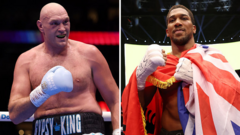
Tyson Fury and Anthony Joshua will finally settle a decade of bitter rivalry on Friday, December 11, 2026, inside an 80,000-capacity Principality Stadium in Cardiff, Wales. This long-awaited all-British heavyweight encounter, broadcast live globally on Netflix, marks a watershed moment for a sport historically fractured by promotional rivalries, television network barriers, and endless contractual stalemates. For years, fans argued in pubs across the United Kingdom while promoters bickered behind closed doors. Now, the rhetoric ends under the bright lights of Cardiff.
The anatomy of this delay stretches back nearly ten years. Back when both men held undisputed ambitions and undefeated records, a match between them would have unified every major belt in the division. Opportunities slipped through fingers. Mandatory challengers intervened. Promotional empires clashed. Ego and conflicting broadcasting exclusivity deals built an impenetrable wall between the two camps. Time eroded their peaks. Both fighters suffered devastating setbacks, rebuilt their careers through grueling redemption arcs, and navigated the treacherous waters of heavyweight boxing losses. Yet, public appetite never waned. The cultural gravity of an all-British collision proved too strong to extinguish, surviving consecutive promotional civil wars and shifting global media platforms.
Behind the scenes, the structural economics of elite boxing experienced a radical transformation. Traditional pay-per-view models, which squeezed domestic consumers for exorbitant fees while limiting global reach, gave way to subscription-backed tech platforms with massive international footprints. Netflix stepping into live fight sports changed the calculus entirely. Traditional boxing gatekeepers found themselves sidelined as sovereign wealth investments and tech streaming budgets rewrote the financial rules. The December 11 date in Cardiff is not merely a sports fixture; it represents a distribution experiment for how major combat sports will reach audiences for the next generation. By removing the paywall hurdle for existing subscribers, the event guarantees unprecedented global viewership numbers that traditional boxing promoters could only dream of achieving through standard cable operators.
Historical precedent suggests that British boxing matches of this magnitude carry a unique sociological weight. Think back to the tribal split of Nigel Benn and Chris Eubank, or the packed stadiums of Carl Froch and George Groves. Those domestic clashes captured the public imagination because they represented more than athletic competition; they mirrored cultural and regional divides within the country. Fury versus Joshua dwarfs them all in commercial scale and global visibility. Every sports bar, barbershop, and office building in the United Kingdom has spent a decade debating who would walk out of the ring with their hand raised. The airwaves and digital forums have hummed with endless tactical breakdowns, emotional arguments, and cynical predictions about whether the fight would ever actually materialize.
The venue itself carries heavy historical significance. Cardiff's Principality Stadium offers a unique cauldron for combat sports. Its retractable roof traps sound, creating a wall of noise from eighty thousand partisan fans that few arenas on earth can replicate. Joshua previously experienced this amphitheater when he stopped Carlos Takam and later defeated Joseph Parker. For Fury, stepping into Cardiff means walking into hostile territory where the vast majority of the stadium will lean heavily toward his opponent. Yet, Fury thrives on external hostility. His career was built on conquering foreign fortresses and silencing hostile crowds. The atmosphere on December 11 will match the magnitude of the occasion, creating a sensory overload from the moment the fighters walk down the aisle.
Examining the stylistic matchup reveals a fascinating chess match disguised as a brawl. Fury enters the ring boasting unorthodox movement, exceptional ring IQ, and a deceptive natural resilience for a man standing six feet six inches with an eighty-five-inch reach. He can switch stances, smother opponents on the inside, or use his jab to dictate distance from the outside. However, his recent outings showed signs of vulnerability, particularly against opponents who pressured him aggressively and forced him into deep waters. Joshua, possessing textbook mechanics, explosive hand speed, and concussive power in both hands, represents a distinct danger if he can close the distance and land clean hooks. Under the tutelage of his coaching staff, Joshua has learned to balance his natural athleticism with calculated patience, though his durability remains a variable that elite punchers can exploit.
The physical dimensions of both athletes tell a story of modern heavyweight evolution. Gone are the days when heavyweights tipped the scales at sluggish weights without athletic conditioning. Both men stand identical at six feet six inches tall, yet their athletic profiles diverge sharply. Joshua carries an imposing, muscular physique built for explosive early round output and crushing combinations. Fury relies on a more fluid, loose composition that allows him twelve rounds of continuous motion and awkward spatial manipulation. This contrast in physical architecture means the opening three rounds will dictate the strategic trajectory of the entire encounter. If Joshua fails to establish his right hand early, Fury will begin asserting his rhythm, turning the fight into a frustrating exercise in shadow-chasing for the challenger.
The undercard assembled for the Cardiff card further underscores the magnitude of the event. Pairing Fury and Joshua with high-stakes supporting bouts demonstrates an intent to deliver a complete entertainment package rather than relying solely on a single main event. Former heavyweight world champion Deontay Wilder locking horns with undefeated cruiserweight star Jai Opetaia introduces a compelling layer of danger to the preliminary billing. Opetaia moving up in weight to test his skills against a devastating puncher like Wilder highlights the willingness of modern matchmakers to take calculated risks when the financial backing justifies the danger. Additional bouts featuring rising contenders ensure that the action inside the stadium starts early and maintains a relentless pace throughout the evening.
Negotiating this fight into reality required an unprecedented alignment of global forces. Turki Al-Sheikh and international promotional entities collaborated to bridge gaps that had remained wide for years. Promoters who spent decades refusing to work with one another found themselves seated at the same table as streaming executives dictated terms. Money talks, but scale speaks louder. When a tech titan with hundreds of millions of subscribers decides to broadcast heavyweight boxing directly to homes without an additional surcharge, traditional boxing politics bend to the reality of the balance sheet.
For Joshua, this fight offers a chance at ultimate redemption. His career trajectory reads like a dramatic script. Rebuilding after defeats requires a mental fortitude that few athletes possess. Every time observers wrote him off, he returned with restructured fundamentals and renewed focus. A victory over Fury erases every prior stumble and cements his status as one of the defining fighters of his era. It transforms his legacy from that of an exceptional champion who fell short against the elite to that of a conqueror who slayed the ultimate dragon in his own backyard.
For Fury, the stakes are equally monumental. He has long claimed to be the greatest heavyweight of his generation, pointing to his unblemished championship reigns and legendary victories on foreign soil. Yet, critics whispered that his resume lacked an encounter with his greatest domestic rival. Leaving the sport without facing Joshua would have left an asterisk next to his name. This December night gives him the opportunity to remove all doubt. A decisive win solidifies his claim to historical greatness, proving that his reign was built on substance rather than clever matchmaking.
Training camps for both men have been shrouded in intense secrecy. Whispers from sparring partners indicate that both fighters are leaving nothing to chance. Fury understands that a sluggish start against an explosive finisher like Joshua could prove fatal. Joshua knows that allowing Fury to dictate the psychological and physical pace of the fight will lead to a frustrating, humiliating night under the Cardiff lights. Expect both men to enter the ring in peak physical condition, carrying the weight of a nation's expectations on their shoulders.
The commercial fallout from this event will ripple across the sports industry for years. If Netflix succeeds in capturing tens of millions of simultaneous live viewers for a boxing card, traditional sports networks will face an existential threat. Boxing promotion will no longer depend on regional cable deals or fragmented pay-per-view buys. The blueprint for future mega-fights has been rewritten in real time, shifting power away from traditional promoters and toward global platforms capable of funding nine-figure purses while absorbing distribution costs.
As the calendar ticks down toward December 11, the sporting world holds its collective breath. Years of internet trash talk, broken promises, and promotional posturing culminate in twenty-four feet of canvas in Wales. The tickets are sold, the broadcast infrastructure is locked in place, and the fighters are deep in grueling training regimens. When the first bell rings inside the Principality Stadium, millions will tune in to witness the collision of two titans whose paths crossed at the exact right moment in history.
The final bell will not just declare a winner. It will close a defining chapter of British boxing history, leaving an indelible mark on how elite sports are promoted, distributed, and consumed across the globe.