Four hundred thousand years ago, a woman stood at the mouth of a cave in what is now modern-day Israel. Let us call her Aya. The air was thick with the scent of pine and damp earth. She was watching a hunter approach from the valley below. He did not walk quite like the men of her clan. His brow was heavier, his shoulders wider, his stride carrying the distinct rhythm of a traveler from a far-off northern lineage. Aya’s people were different. They were part of a mysterious, emerging population that anthropologists would centuries later struggle to categorize.
When these two lineages met, they did not wage a war of extinction. They looked at each other, shared a fire, and made a choice. They crossed the invisible lines of their own biology.
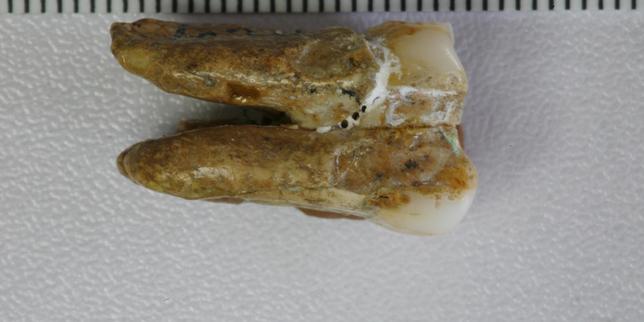
We know this happened because Aya left behind a diary. It wasn't written in ink, nor was it carved into the stone walls of Qesem Cave. It was locked inside the microscopic crystalline structure of her teeth.
For decades, the story of human evolution was told as a clean, orderly family tree. We drew straight lines from Homo erectus to Neanderthals, with Homo sapiens emerging at the very top like a triumphant crown jewel. It was a comforting narrative of linear progress. It was also entirely wrong.
The deeper we dig into the earth, the more we realize that our ancient past was not a lonely march. It was a crowded, chaotic room.
The Hardest Archive in the Human Body
To understand how we unlocked Aya’s secrets, you have to understand the brutal reality of archaeology. Flesh rots. Bones crumble into dust under the weight of millennia. DNA, that fragile blueprint of life, has a strict expiration date. In the hot, humid environment of the Levant, ancient DNA degrades rapidly, often leaving scientists with nothing but blank chemical pages after just a few thousand years.
But nature left us a loophole. Enamel.
Tooth enamel is the hardest substance in the human body. It is a dense fortress of calcium and phosphate, built to survive a lifetime of crushing food and, as it turns out, hundreds of thousands of years in the dirt. While the rest of a skeleton dissolves into the landscape, teeth remain. They are tiny time capsules, sealing in the proteins that were floating through a child’s body while those teeth were forming.
A team of determined researchers recently turned their attention to the Middle Pleistocene teeth found in Qesem Cave. They weren't looking at the shape of the jaw or the wear and tear of the bite. They went smaller. They utilized a cutting-edge technique called paleoproteomics, extracting ancient proteins locked deep within the enamel matrix.
Proteins are the direct expression of DNA. By reading the sequence of amino acids in these 400,000-year-old teeth, the scientists were able to do something that sounded like science fiction a decade ago: they mapped the genetic identity of a creature that lived before the dawn of modern humanity.
What they found shattered the neat boxes we built for our ancestors.
The teeth from Qesem Cave did not belong to Neanderthals. They did not belong to Homo sapiens. Instead, they revealed a highly complex, genetically fluid population that carried traits of both lineages, alongside unique features of their own. The enamel proved that this region was a massive, ancient melting pot. It was a biological crossroads where different human species met, mingled, and traded genetic secrets for millennia.
The Illusion of Separation
We have an obsession with categorization. We love to draw boundaries, to say where one species ends and another begins. It gives us a sense of order. But nature laughs at our filing cabinets.
Consider what happens when a population of hominins gets separated by a shifting climate or a rising mountain range. Over generations, they adapt to their new homes. One group grows stocky and cold-resistant in Europe; another develops different traits in the arid expanses of Africa. If you look at them after 100,000 years, they look like entirely different species.
But evolution is a slow, messy conversation.
When the glaciers melted or the rains returned, these populations moved. They followed the game. They sought shelter. And inevitably, their paths crossed in the Levant—the narrow geographic corridor connecting Africa, Europe, and Asia.
The Qesem teeth prove that these groups did not view each other as alien monsters. The genetic markers in the enamel reveal a history of repeated, successful interbreeding. The boundaries we thought were written in stone were actually highly permeable.
This realization brings a strange, unsettling vulnerability to the field of anthropology. It means the search for the "First Human" or the "Pure Neanderthal" is a ghost hunt. We are looking for static definitions in a world that was defined by constant motion.
Reading the Chemical Diary
How does a microscopic protein tell a story that large?
Think of tooth enamel like the rings of a tree, or the layers of ice in a glacier. As a child grows, their body lays down enamel in microscopic increments. Whatever nutrients, stresses, or genetic instructions are present at that exact moment become permanently fossilized.
By analyzing these specific enamel proteins, researchers can determine the sex of the individual, their general health, and their evolutionary distance from other known hominins. When the Qesem proteins were compared to the profiles of classic Neanderthals from Europe and early Homo sapiens from Africa, the results were an ambiguous, beautiful blur.
The individuals at Qesem were a bridge. They were living evidence that human evolution did not happen in isolated silos.
This changes the stakes of how we view our own survival. For a long time, the dominant theory of human history was one of replacement. We assumed that Homo sapiens survived because we were smarter, faster, or more ruthless than the others—that we wiped out the Neanderthals and the Denisovans as we conquered the globe.
But the teeth whisper a different story.
They suggest that our survival was not a matter of eradication, but of absorption. We didn't just replace them. We became them, and they became us. The Neanderthals didn't completely vanish; a fraction of their genome still walks the earth today inside your own immune system, your skin, and your hair. The Qesem population was an early chapter in this long, complicated romance.
The Fire in the Cave
It is easy to get lost in the data. We talk about amino acid sequences, mass spectrometry, and phylogenetic trees until the words lose their weight. But strip away the laboratory terminology, and you are left with something deeply intimate.
Step back into Qesem Cave. Look at the artifacts found alongside those teeth.
These weren't primitive beasts operating on raw instinct. The archaeological record shows that the people of Qesem were remarkably sophisticated. They systematically used fire to roast meat. They organized their living spaces, dedicating specific areas to butchery, others to tool-making, and others to social gathering. They were recycling flint tools, displaying a level of forward-thinking and resource management that we once thought belonged exclusively to modern humans.
When you look at the teeth through this lens, the science ceases to be abstract.
You realize that Aya and the traveler from the north shared more than just a genetic compatibility. They shared a culture. They sat around a structured hearth, utilizing the same complex technology to survive a harsh world. They looked at the stars from the same cave mouth and felt the same creeping dread of the dark.
The true magic of the Qesem discovery isn't just that it rewrites our textbooks. It’s that it stretches a hand across 400,000 years to remind us of our shared humanity. It forces us to confront the fact that our ancestors were navigating a world just as complicated, diverse, and interconnected as our own.
We are not the lonely survivors of a broken lineage. We are the continuation of a vibrant, ancient tapestry that refused to be divided by species, geography, or time. The evidence has been waiting for us all along, buried in the dirt, locked inside a bite.