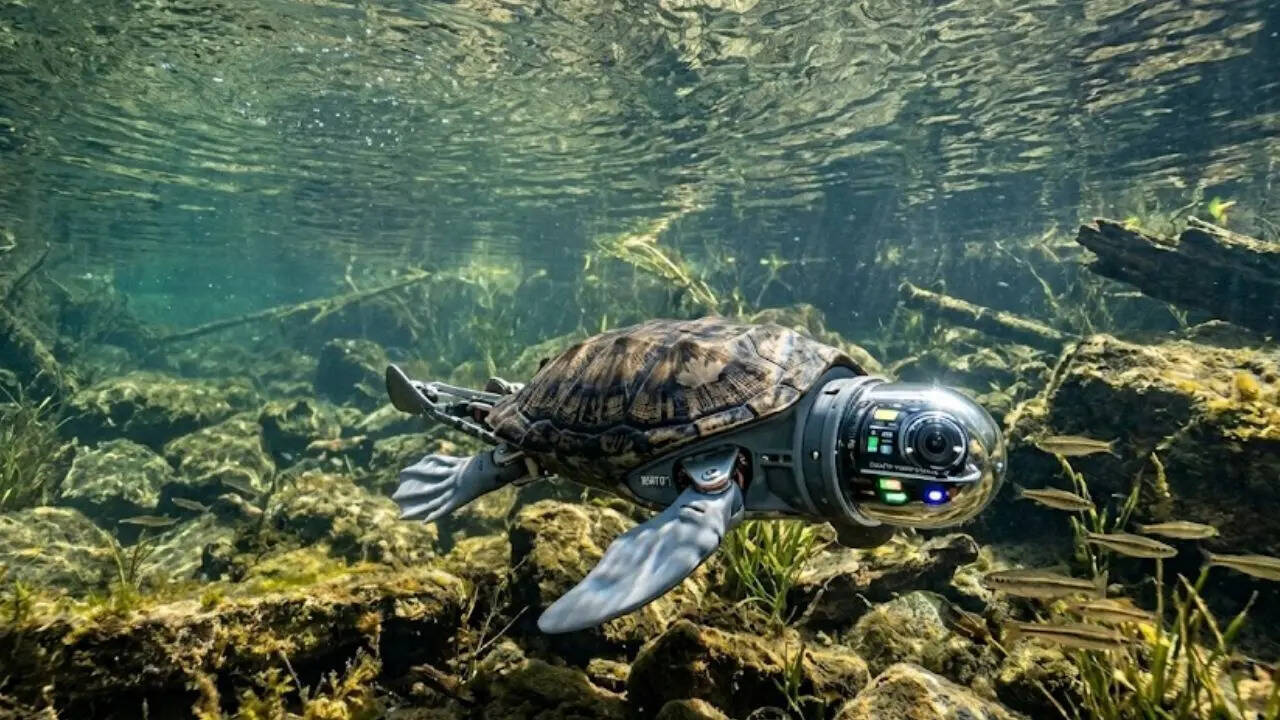
A fifteen-year-old Canadian student recently built a turtle-shaped robot designed to detect underwater environmental threats, claiming a 96 percent accuracy rate. It is a heartwarming narrative that has predictably rocketed across viral news feeds. The public loves a wunderkind story, especially when it promises a cheap, elegant solution to the catastrophic degradation of our oceans.
The uncomfortable reality is that the 96 percent accuracy claim is functionally meaningless outside of a controlled laboratory tank.
Designing a localized machine-learning algorithm to identify specific chemical signatures or visual anomalies in stagnant water is a standard high school science fair achievement. Deploying that same architecture into the brutal, unpredictable environment of real-world oceans is an entirely different operational problem. The viral celebration of amateur robotics frequently obscures a systemic failure in environmental monitoring. We do not lack clever prototypes. We lack the industrial willpower and foundational infrastructure to scale underwater sensing technology where it actually matters.
The Friction of the Real Ocean
To understand why a 96 percent success rate in a test environment fails on the open water, one must look at the physical physics of aquatic deployment.
The ocean is an actively hostile environment for electronics. Biofouling begins within hours of submersion. Microorganisms, algae, and barnacles attach themselves to sensors, obscuring camera lenses and distorting the chemical intake valves needed for accurate readings. A pristine laboratory sensor quickly becomes an expensive piece of blinded plastic.
Then there is the issue of data transmission. Radio waves do not travel well through water.
An aerial drone can transmit gigabytes of high-definition telemetry back to a base station via standard Wi-Fi or cellular networks. An underwater autonomous vehicle (AUV) must rely on acoustic telemetry, which is excruciatingly slow and highly susceptible to thermal layers and salinity changes. If a drone identifies a spike in toxicity five miles off the coast, it cannot simply upload that data to the cloud in real-time. It must either surface to find a satellite signal, or store the data locally until it is manually retrieved.
The Delusion of High Accuracy Metrics
When an inventor claims a 96 percent accuracy rate for an environmental sensor, an experienced engineer asks a immediate follow-up question. What was the false positive rate?
In a controlled simulation, a neural network can easily distinguish between a clean bucket of water and a bucket laced with heavy metals. In a real-world estuary, the water is a chaotic soup of churned sediment, decomposing organic matter, agricultural runoff, and varying salt concentrations.
Consider a hypothetical example. A sensor is calibrated to flag industrial chemical spills based on water turbidity and specific light absorption rates. In a lab, it works flawlessly. When dropped into a real river mouth after a heavy rainstorm, the natural silt kicked up by the storm triggers the exact same optical response as a chemical plume. The sensor floods the system with false alarms. Conversely, if the sensitivity is dialed back to avoid these false positives, the device becomes blind to actual low-level toxic leaks.
The Hardware Bottleneck No One Wants to Fund
The venture capital world and tech media are addicted to software. Software scales rapidly and offers high profit margins. Hardware requires factories, supply chains, and physical maintenance.
This bias has created a massive bottleneck in environmental tech. It is relatively easy to write a sophisticated machine-learning algorithm that can analyze ocean data. It is extraordinarily difficult to build the physical housing that protects that sensor from the crushing pressure of the deep sea for six months at a time.
The market is flooded with software platforms promising to map ocean health using advanced analytics. Yet, these platforms are all competing for data from the same handful of aging, expensive, government-funded research buoys. We have built magnificent digital engines to process information, but we are feeding them through a straw.
The Cost of Survival at Sea
Industrial-grade underwater sensors are expensive for a reason. They require specialized materials like titanium and synthetic sapphire glass to withstand corrosion and pressure. A single professional-grade dissolved oxygen sensor can cost thousands of dollars.
When a low-cost hobbyist drone is introduced as a viable alternative to these industrial systems, it ignores the economics of operational lifespan. A hundred-dollar plastic drone might survive three days in salt water before its seals fail and its lithium batteries short-circuit. Replacing cheap drones every week is far more expensive than deploying a single, robust platform built to last a decade.
The Missing Link in Ocean Governance
Even if someone successfully deploys a fleet of cheap, accurate underwater sensors, a larger structural barrier remains. Who owns the data, and who is legally obligated to act on it?
The majority of severe underwater environmental threats occur in international waters or within complex maritime jurisdictions where enforcement is notoriously toothless. If an autonomous drone detects illegal bilge water dumping from a cargo ship flying a flag of convenience, the path from detection to prosecution is non-existent.
- Sovereign blind spots: Nations are hesitant to allow independent, autonomous sensing fleets near their territorial waters due to espionage concerns.
- Liability loopholes: Commercial shipping lanes are vast, and proving which specific vessel caused a diffused chemical spike is legally impossible without direct, eyewitness evidence.
- Data siloing: The environmental data collected by oil and gas companies during routine offshore drilling operations is treated as proprietary corporate property, kept hidden from public scientific scrutiny.
This lack of clear regulatory framework means that enhanced detection capabilities rarely translate into environmental protection. We are tracking our own decline with increasing precision, but the data simply sits on servers, unutilized by regulatory bodies that lack the power or the political will to enforce compliance.
Shifting Focus from Prototypes to Infrastructure
The romanticization of the solo inventor obscures the true nature of modern technological breakthroughs. Significant environmental monitoring will not be achieved by a decentralized army of hobbyist robotic turtles. It will require massive, boring investments in public maritime infrastructure.
We need to treat ocean sensing the same way we treat weather monitoring. The global weather forecasting system does not rely on crowdsourced backyard weather stations. It relies on a highly coordinated, multi-billion-dollar network of government satellites, standardized oceanic buoys, and international data-sharing treaties.
The focus must shift away from creating more novelty prototypes and toward standardizing the sensor payloads on existing commercial maritime fleets. Thousands of cargo ships, fishing vessels, and cruise liners traverse the globe daily. By mandating the integration of standardized, modular environmental sensors into the hulls of these commercial vessels, we could create a global ocean monitoring network without needing to build a single new autonomous drone.
The technical challenge of underwater sensing is ultimately secondary to the logistical and political challenge. Celebrating teenage ingenuity is a harmless distraction, but it becomes harmful when it allows governments and polluting industries to pretend that the solution to ocean degradation is just around the corner, waiting to be solved by the next generation's science fair projects. True systemic change requires capital, regulation, and a collective refusal to accept superficial metrics as real progress.