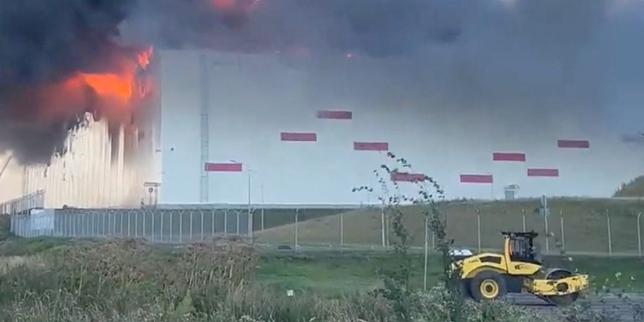
Every time headlines flash with news of a mass drone strike hitting a massive e-commerce fulfillment center or a regional distribution nexus deep inside Russian territory, the internet erupts with predictable applause. The narrative writes itself: heroic drone operators dismantling the economic backbone of an aggressor, one automated warehouse at a time. Wildberries takes hits across multiple logistics nodes, the media declares a turning point in supply chain warfare, and armchair strategists celebrate the death of modern retail infrastructure.
It is clean, cinematic, and fundamentally detached from how large-scale supply chains actually function.
I have spent years watching executives and military planners alike fall into the trap of confusing asset destruction with structural paralysis. When Kiev targets fifteen logistics installations belonging to a retail titan like Wildberries, the immediate emotional satisfaction masks a structural delusion. Warehouses are not high-value manufacturing plants. They are concrete boxes filled with consumer goods, cheap shelving, and basic sorting conveyors. They are built for redundancy, low margins, and infinite replaceability.
Blowing up a distribution center does not starve a war machine. It barely inconveniences the consumer buying socks on a mobile app three days later.
The Fallacy of the High-Value Target
Let us define what an e-commerce logistics hub actually is. A facility like the ones operated by Wildberries is not a silicon foundry. It is not an enrichment centrifuge or an armored vehicle assembly line. It is a high-throughput cross-docking station. Inventory flows in, sits for twelve hours, and flows out.
The lazy consensus in modern conflict reporting assumes that because a building is massive, its destruction creates a systemic void. That logic belongs in a video game, not operational reality. Modern supply chains are designed like resilient mesh networks, not fragile linear pipelines. If node A goes up in flames, the routing algorithm simply reroutes incoming freight to nodes B, C, and D.
Imagine a scenario where a regional distribution hub suffers a catastrophic fire from a drone strike. The retail giant loses inventory, writes off some metal siding, and files an insurance claim or absorbs the localized hit. Within forty-eight hours, third-party sellers adjust their shipping labels, algorithms recalculate fulfillment radiuses, and the consumer experiences a two-day delivery delay instead of a one-day delay. The economic friction is negligible at a macro level.
Yet, commentators treat these strikes as crippling blows to the adversary's economy. This is economic illiteracy disguised as military analysis. Wildberries is a private retail platform. Smashing its sorting facilities hurts third-party merchants and everyday shoppers. It does not disrupt military supply lines, fuel depots, or heavy manufacturing zones where tanks and artillery shells are welded together.
Why Retail Infrastructure is a Distraction
There is a deeper strategic error at play here: misallocating high-tech kinetic assets against low-value civilian targets for the sake of public relations victories.
Long-range drones are scarce, expensive, and difficult to manufacture under sanctions. Every airframe expended on a commercial fulfillment center is an airframe not hitting a power substation, a railway junction, or a petrochemical refinery. Retail warehouses are soft targets. They are easy to find on satellite imagery, they lack heavy air defense coverage because they are civilian structures, and they make great videos for social media.
Optics dictate strategy far too often. Striking a military barracks or a defense contractor yields a classified report and a terse denial. Striking a massive commercial distribution warehouse yields a viral video of secondary explosions among stacks of household goods and winter coats. It feeds the information war, but it starves the attritional war.
The military reality is brutal and unglamorous. Wars of attrition are won by destroying things that take years and billions of dollars to replace. A high-bay warehouse can be rebuilt with tilt-up concrete panels and basic electrical wiring in six months. A specialized machine tool for manufacturing turbine blades takes three years to import and commission.
When planners celebrate the burning of consumer goods distribution centers, they are mistaking the retail facade for the industrial engine.
The Resilience of Distributed Commerce
To understand why these strikes fail to achieve strategic depth, look at how modern commerce adapted to the pandemic and localized disruptions. Resilience is baked into the DNA of digital retail.
Decentralization is the shield of the modern enterprise. Wildberries and similar giants do not rely on a single choke point. Their entire business model depends on hyper-distributed inventory pools. When you spread inventory across dozens of regional hubs, regionalizing risk becomes second nature.
- Inventory Redundancy: High-velocity items exist in multiple warehouses simultaneously.
- Dynamic Routing: Software instantly shifts order fulfillment away from compromised zones.
- Elastic Labor: Contract-heavy workforces scale up or down based on operational capacity without permanent overhead.
When an external shock hits one part of this network, the system heals itself before external observers even finish writing their commentary. The vulnerability analysts think they are exploiting is actually an illusion created by the sheer scale of the company. A billion-dollar enterprise absorbs local shocks the way a rubber tire absorbs a pebble on the highway.
The Uncomfortable Downside of Contrarian Logistics
My perspective here carries its own blind spots, and intellectual honesty demands acknowledging them. By arguing that these strikes are strategically minor, I run the risk of dismissing the psychological and localized financial damage they inflict.
For the regional suppliers who stored their entire seasonal inventory in that single targeted warehouse, the strike is an existential catastrophe. Small businesses go bankrupt overnight when their stock turns to ash. Furthermore, cumulative insurance premiums, supply chain anxiety, and rising security costs do impose a slow, grinding tax on the domestic economy of the target nation.
It is also true that forcing an adversary to divert resources toward defending civilian supply chains creates a defensive tax. If millions are spent building mobile air defense units to protect commercial warehouses, those units are not on the front lines.
Even so, a defensive tax is a far cry from a strategic defeat. It is a rounding error in a war consuming billions of dollars and hundreds of thousands of lives daily.
Stop Falling for the Spectacle
We need to elevate our standard for what constitutes a meaningful military development. A fireball in a commercial warehouse looks impressive on a phone screen, but it is a tactical distraction.
If you want to evaluate the economic health of a belligerent nation, stop counting burning Amazon clones. Look at capital flight, raw material access, semiconductor imports, and heavy industrial output. Those are the metrics that matter.
As long as analysts mistake retail convenience for state capacity, we will continue to cheer for pyrotechnics while missing the actual mechanics of modern survival. The next time a headline screams about a logistics empire taking a hit, look past the smoke and ask a simple question: did this move the needle on the war, or did it just ruin someone's shipping schedule?
Usually, it is just the shipping schedule.

.png?itok=1mb05mKJ)

