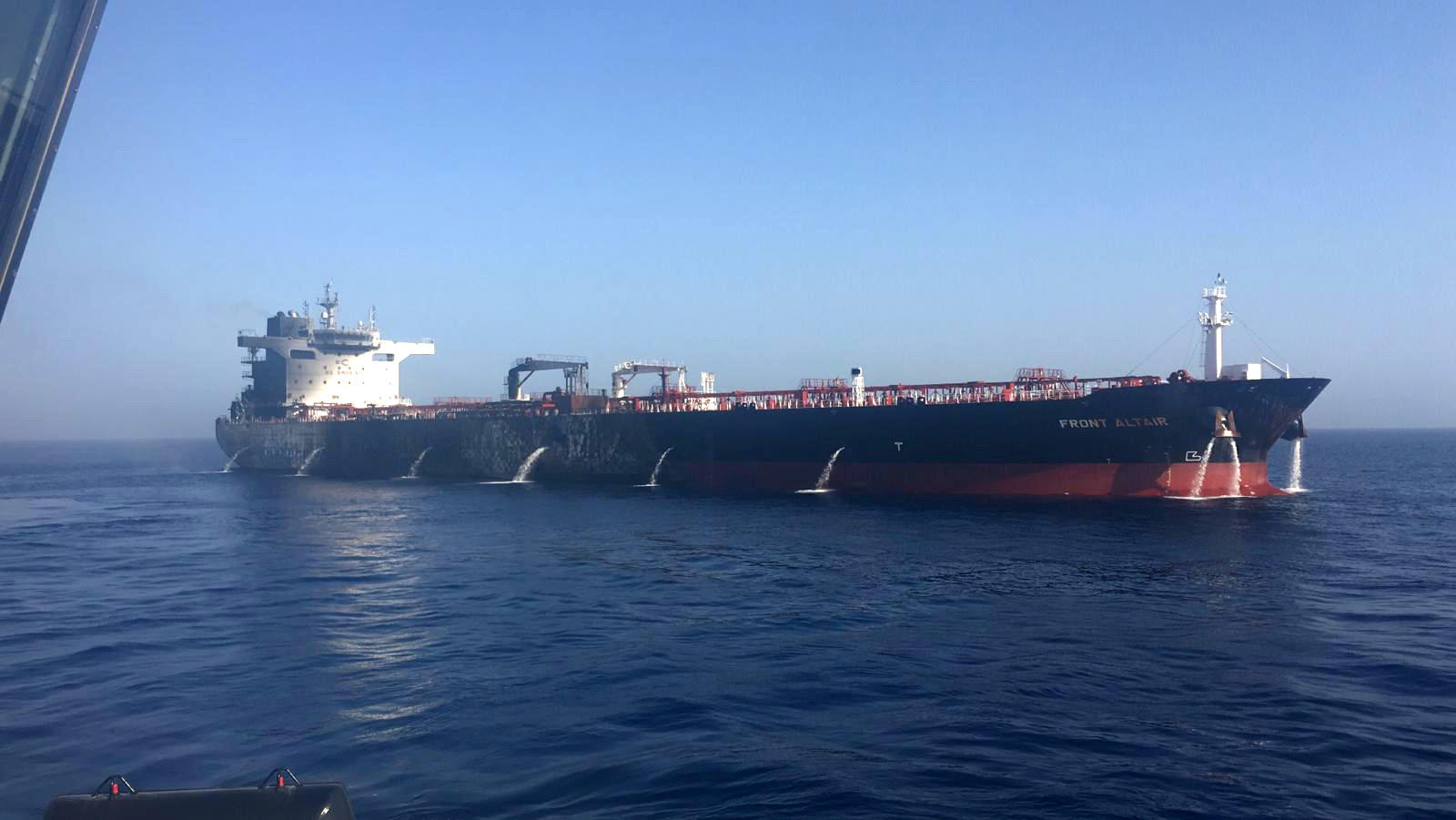
The Strait of Hormuz isn't just a stretch of water. It's the world's most important choke point. If you look at a map, it's a tiny sliver between Oman and Iran, barely 21 miles wide at its narrowest. Yet, every single day, tankers exit the Gulf via the Strait of Hormuz carrying roughly 20 percent of the world's total oil consumption. That’s millions of barrels of crude, condensate, and petroleum products moving through a corridor where the actual shipping lanes are only two miles wide in each direction.
When these massive ships move, the world breathes. When they stop, or even slow down, your gas prices at home spike within hours. It’s that simple. Market analysts spend their entire careers watching satellite feeds of these vessels because a single maritime "hiccup" here can trigger a global recession. You aren't just looking at ships; you're looking at the heartbeat of the global economy.
The Reality of Navigating the Narrowest Choke Point
Oil tankers don't just sail through the Strait. They dance through it. Because the water is relatively shallow and the traffic is incredibly dense, ships must follow a Traffic Separation Scheme. This keeps inbound and outbound tankers from colliding. If a captain veers off course by even a small margin, they risk hitting a mine, a submerged reef, or another vessel.
The sheer volume is staggering. According to data from the U.S. Energy Information Administration (EIA), about 20.5 million barrels of oil per day pass through this transit. Most of that crude is headed for Asian markets—China, India, Japan, and South Korea. However, the global nature of oil pricing means that even if a drop of that oil never reaches US shores, the price of West Texas Intermediate (WTI) will still react to what happens in the Strait. It’s a interconnected web that nobody can escape.
The logistical pressure is intense. Tankers exiting the Gulf often carry hundreds of millions of dollars in cargo. They face constant surveillance. Iranian patrol boats frequently monitor the traffic, and international naval coalitions, like the International Maritime Security Construct, provide an overwatch. It’s a high-stakes environment where every mile matters.
Why Alternate Routes Just Don't Cut It
People often ask why we don't just pipe the oil around the Strait. It seems like a logical fix. Saudi Arabia has the East-West Pipeline, and the United Arab Emirates has the Habshan-Fujairah pipeline. These projects were built specifically to bypass the Strait of Hormuz in case of a blockade or conflict.
Here is the problem. They can't handle the volume.
The combined capacity of these bypass pipelines is only a fraction of what moves by sea. The East-West Pipeline can move about 5 million barrels a day. The Habshan-Fujairah line handles maybe 1.5 million. Even if you maxed out every single pipeline in the region, you’d still have over 10 million barrels a day with nowhere to go. You cannot replace the efficiency of a Very Large Crude Carrier (VLCC) with a pipe.
Moving oil by land is expensive. It requires massive infrastructure maintenance and is vulnerable to different kinds of sabotage. Ships are flexible. They are floating warehouses. When a tanker exits the Gulf, it can be diverted to Europe, Asia, or the Americas based on who is paying the most that afternoon. A pipeline is a fixed asset. It goes where it goes, and that’s it.
The Geopolitical Shadow Over Every Barrel
You can't talk about the Strait of Hormuz without talking about Iran. Tehran knows exactly how much power it holds by sitting on the northern coast of the waterway. Historically, every time tensions rise between Iran and the West, the threat to close the Strait is brandished like a weapon.
Technically, under the UN Convention on the Law of the Sea, ships have the right of "transit passage." This means as long as they are moving continuously and expeditiously, they can pass through the territorial waters of the coastal states. But laws are only as good as the power to enforce them. We’ve seen "tanker wars" before, most notably in the 1980s, where hundreds of ships were attacked.
Today, the tactics are more subtle but equally effective. We see "shadow fleet" tankers—ships with obscured ownership and turned-off transponders—moving through the Strait to avoid sanctions. This creates a massive safety risk. These older vessels often lack the proper insurance or maintenance standards of the major commercial fleets. If one of these shadow tankers has an engine failure or an oil spill in the middle of the shipping lane, the entire Strait could be blocked by an accident rather than an act of war.
The Economic Ripples of a Delayed Departure
Markets hate uncertainty. If a tanker is delayed leaving the Gulf for even 24 hours, insurance premiums for every other ship in the region skyrocket. This is called a "War Risk" surcharge. Shipowners pass these costs directly to the buyers, who pass them to the consumers.
Think about the math. A standard VLCC carries 2 million barrels. If the price of oil is $80 a barrel, that's $160 million in one hull. If that ship is stuck, the interest alone on the financing for that cargo starts eating into margins.
The ripple effect hits the LNG (Liquefied Natural Gas) market too. Qatar is one of the world's top LNG exporters, and almost all its gas must pass through the Strait. If the flow of tankers is interrupted, power plants in the UK or manufacturing hubs in Germany start feeling the pinch within weeks. It isn’t just about cars and gasoline; it’s about the electricity that runs cities.
Safety and Technology in the Modern Strait
Modern tankers are marvels of engineering. They use sophisticated Electronic Chart Display and Information Systems (ECDIS) and AIS (Automatic Identification System) to track every other vessel in the vicinity. This tech is designed to prevent the kind of human error that leads to disasters.
However, we are seeing a rise in GPS jamming and "spoofing" in the region. Ships have reported their navigation systems showing them in locations miles away from their actual position. This is a deliberate tactic used by regional actors to confuse crews or lure ships into territorial waters where they can be legally seized.
Captains now have to go "old school." They’re training crews to use visual sightings and radar more than the digital maps that have become the industry standard. It’s a strange irony. The most advanced ships in history are being forced to rely on 20th-century navigation techniques because the 21st-century tech is being weaponized against them.
Realities for the Crew on Board
Working on a tanker exiting the Gulf is stressful. Beyond the navigation hazards, there's the heat. In the summer, deck temperatures can hit 140 degrees Fahrenheit. The humidity is suffocating. The crew has to maintain strict security watches, looking for small boats that might be carrying boarding parties or explosives.
It’s a grueling job that keeps the global lights on. These sailors aren't just moving cargo; they’re navigating a geopolitical minefield every time they ring the engine room for full ahead. Most people never think about the person standing on the bridge of a tanker at 3:00 AM in the Strait of Hormuz, but that person's performance determines what you pay at the pump next Tuesday.
What to Watch in the Coming Months
If you want to understand where the energy market is going, stop looking at the stock tickers and start looking at the vessel tracking maps. Watch the "turnaround time" for tankers in ports like Ras Tanura or Das Island. If ships start bunching up or if the "exit rate" through the Strait slows down, something is wrong.
Keep an eye on the insurance markets in London. When Lloyd’s of London adjusts its risk rating for the Persian Gulf, the world follows. We are entering a period where regional stability is fragile, and the Strait remains the most sensitive pressure point on the planet.
Monitor the following indicators to stay ahead of the curve.
- The daily volume of VLCCs passing through the Strait compared to the five-year average.
- Changes in the "War Risk" insurance premiums for Suezmax and Aframax vessels.
- The frequency of "dark" ships—those with AIS turned off—in the northern Gulf.
- Direct statements from the Iranian Revolutionary Guard regarding maritime "exercises" in the shipping lanes.
The Strait of Hormuz is the world's most vital artery. It's narrow, it's crowded, and it's dangerous. But as long as the world runs on oil, it remains the most important piece of water on the map. Every time a tanker exits the Gulf, the global economy gets another day of life. Don't take that movement for granted.