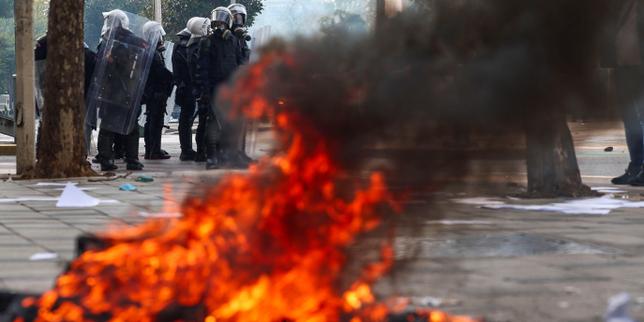
Political stability in transitional democracies functions on a fragile equilibrium between institutional legitimacy and elite resource capture. When localized friction points—such as controversial coastal development initiatives on Sazan Island—interlock with systemic grievances regarding corruption and economic stagnation, the state apparatus faces a severe calibration crisis. The ongoing civil unrest in Tirana targeting the administration of Prime Minister Edi Rama illustrates how single-issue environmental mobilization transitions into a generalized structural rejection of governance models.
The Vector of Escalation
The mechanics of the Tirana protests reveal a distinct three-stage vector that shifts from localized opposition to broad institutional confrontation.
- The Trigger Event: Discontent initially crystallized around capital allocation and real estate development concessions affecting protected ecological zones. This created an immediate coalition of environmental advocates and localized stakeholders.
- The Aggregation Phase: As state responses relied on administrative inertia rather than transparent negotiation, secondary actors—specifically student bodies and urban youth—infused the movement with structural grievances regarding higher education costs, employment scarcity, and perceptions of entrenched kleptocracy.
- The Direct Action Threshold: The movement crossed from passive dissent to kinetic disruption when institutional facades, including ministerial entry points and municipal infrastructure, became focal points for physical clashes with police forces deploying water cannons and tear gas.
The Institutional Response Loop
Faced with escalating crowd density and coordinated street-level resistance, incumbent leadership typically deploys a standard playbook of counter-measures. In the Albanian context, this response loop relies on three primary variables.
- Rhetorical Dismissal: Characterizing opposition movements as instruments of external influence or dismissing underlying policy protests as manufactured outrage. This strategy aims to delegitimize the leadership vacuum of decentralized movements but frequently backfires by hardening protest resolve.
- Conditional Dialogue: Offering structured engagement formats, such as town halls or symbolic public spaces for negotiation, which are systematically rejected by decentralized activist factions seeking unconditional resignation rather than procedural concessions.
- State Coercion: Utilizing riot control units to secure administrative perimeters. The reliance on physical containment creates a predictable casualty metric—hundreds of injured protestors and law enforcement personnel—which further raises the political cost of maintaining the status quo.
The Cost Function of Executive Intransigence
The persistence of Edi Rama's administration hinges on a risk calculation where the cost of stepping down outweighs the immediate destabilization cost of street violence. However, this calculus ignores the compounding erosion of administrative efficacy. When state infrastructure requires continuous kinetic defense against domestic populations, routine governance halts. Legislative priorities stall, foreign direct investment parameters shift to high-risk assessments, and the executive branch becomes entirely occupied with crisis containment rather than macroeconomic management.
To break this dynamic, the administration must transition from tactical deterrence to verifiable structural reform, decoupling public sector administration from concentrated patronage networks. Absent this pivot, the frequency of street mobilization will continue to outpace the state's capacity for containment, leading to an inevitable terminal crisis of executive authority.