Naval power in the Western Pacific is governed by the mathematics of mass production, sensor aperture placement, and vertical launch system cell density. The operational expansion of the People's Liberation Army Navy rests heavily on the sustained manufacturing output of the Type 052D guided-missile destroyer class. Evaluating how these platforms alter regional strategic geometry requires stripping away geopolitical rhetoric to examine three structural components: industrial build rates, sensor-shooter integration, and geographic bottleneck enforcement.
The Industrial Capacity Function
The primary driver of the naval balance shift is not individual ship capability, but the asymmetry of replacement and construction economics. Industrial capacity dictates operational endurance. Shipyards in Dalian and Jiangnan have institutionalized modular shipbuilding techniques, reducing hull completion intervals significantly below historical benchmarks for comparable tonnage.
While Western naval procurement relies on protracted, highly customized acquisition cycles, the Type 052D baseline and its stretched variant, the Type 052DL, benefit from serial production lines. With over thirty-three hulls commissioned or launched across successive batches, the class provides a predictable multiplier for surface action groups. This production velocity solves a fundamental problem of naval attrition: it ensures that peacetime training losses, maintenance rotations, and wartime damage contingencies can be absorbed without degrading the baseline operational posture in first-island-chain approaches.
Sensor Apertures and Missile Cell Economics
Displacing roughly 7,500 to 7,700 tons, the Type 052D platform acts as a densely packed node within a broader network-centric warfare architecture. The integration of the Type 346A active electronically scanned array radar system provides persistent volumetric search and fire-control tracking capabilities. This radar configuration anchors the ship's air-defense network, allowing simultaneous tracking of multiple high-velocity threats across complex electromagnetic environments.
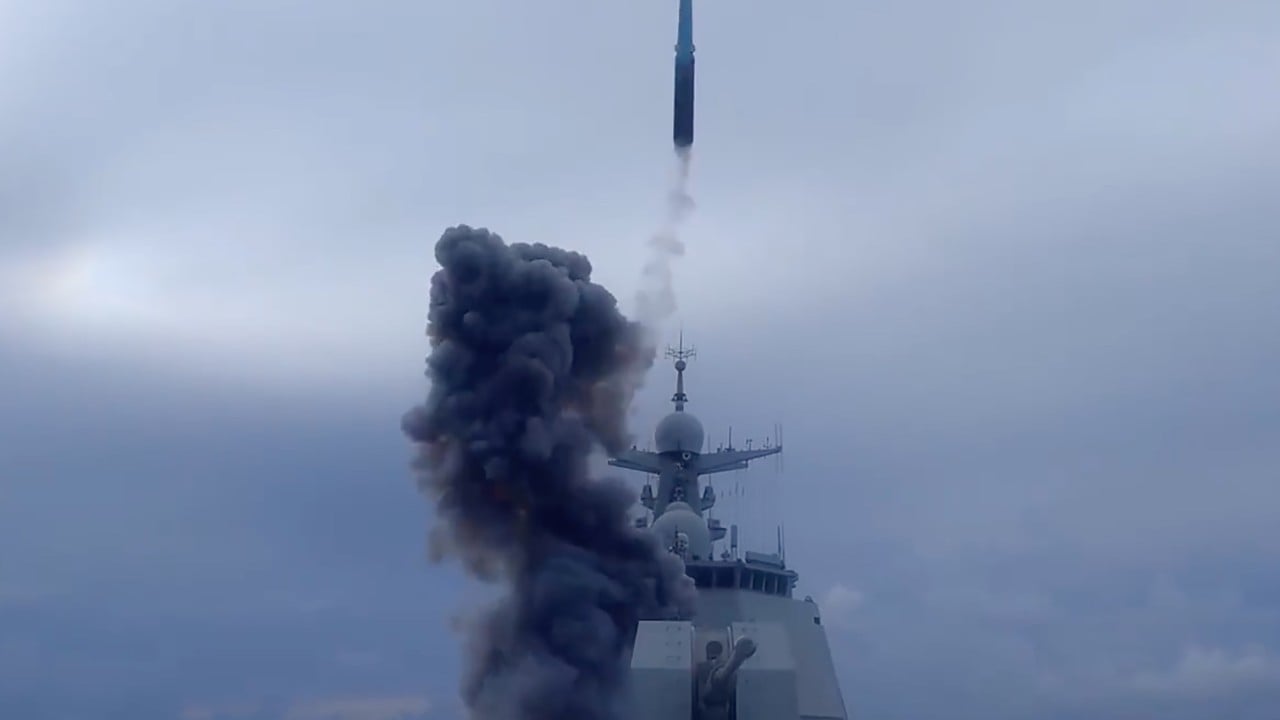
Firepower density is quantified by the universal vertical launch system, which features 64 canister-based cells configured in forward and aft modules. Unlike earlier coaxial revolver-style systems, this universal architecture accommodates a mixed loadout optimized for specific mission profiles:
- Air Defense Interceptors: HHQ-9B surface-to-air missile variants provide wide-area fleet defense against tactical aircraft and cruise missiles, extending protection bubbles beyond the immediate hull footprint.
- Anti-Ship Strike Munitions: Subsonic and supersonic anti-ship cruise missiles, such as the YJ-18 family, create layered surface-strike vectors.
- Strategic and Ballistic Extensions: Emerging integration milestones, including observed test firings of advanced hypersonic systems like the YJ-20, demonstrate a structural shift toward multi-domain strike options from standard surface platforms.
This mix allows a single destroyer to dynamically reallocate its cell inventory between defensive screening and offensive surface action based on real-time tasking from theater command nodes.
Chokepoint Geometry and Regional Power Projections
The strategic utility of the Type 052D class is maximized when analyzed through geographic choke points such as the Miyako Strait and the Bashi Channel. Routine transits by these destroyers, accompanied by specialized replenishment ships like the Fuyu-class and Fuchi-class auxiliaries, signal an operational transition from coastal defense to blue-water expeditionary presence.
Auxiliary vessel pairing is the limiting reagent of naval power projection. A destroyer's combat radius is bounded by fuel burn rates, ammunition expenditure, and crew fatigue. By systematically integrating fast combat support ships into routine transits near the Ryukyu Islands, fleet logistics planners mitigate the tyranny of distance. These transits force opposing intelligence, surveillance, and reconnaissance networks to maintain continuous tracking loops, straining regional maritime patrol assets and compelling allied forces to reallocate surface and air defense resources to outer island chains.
The concentration of these platforms within the Southern and Eastern Theater Commands alters the defensive perimeter calculations of rival states. As cumulative missile cell counts exceed regional thresholds, surface action groups centered around these destroyers establish contested zones where air superiority and sea control cannot be assumed by external actors without high-attrition engagements.
Strategic Allocation of Surface Assets
Naval balance is ultimately a function of sustained presence combined with escalation dominance. The integration of high-density missile platforms into regular tactical patrols creates a persistent friction point for opposing defense architectures. Planners must assume that every deployed hull carries a reconfigurable, multi-mission payload capable of shifting from anti-air defense to long-range anti-surface strike instantaneously. The objective moving forward is to manage this distributed lethality while securing supply chains against asymmetric disruption in contested sea lanes.