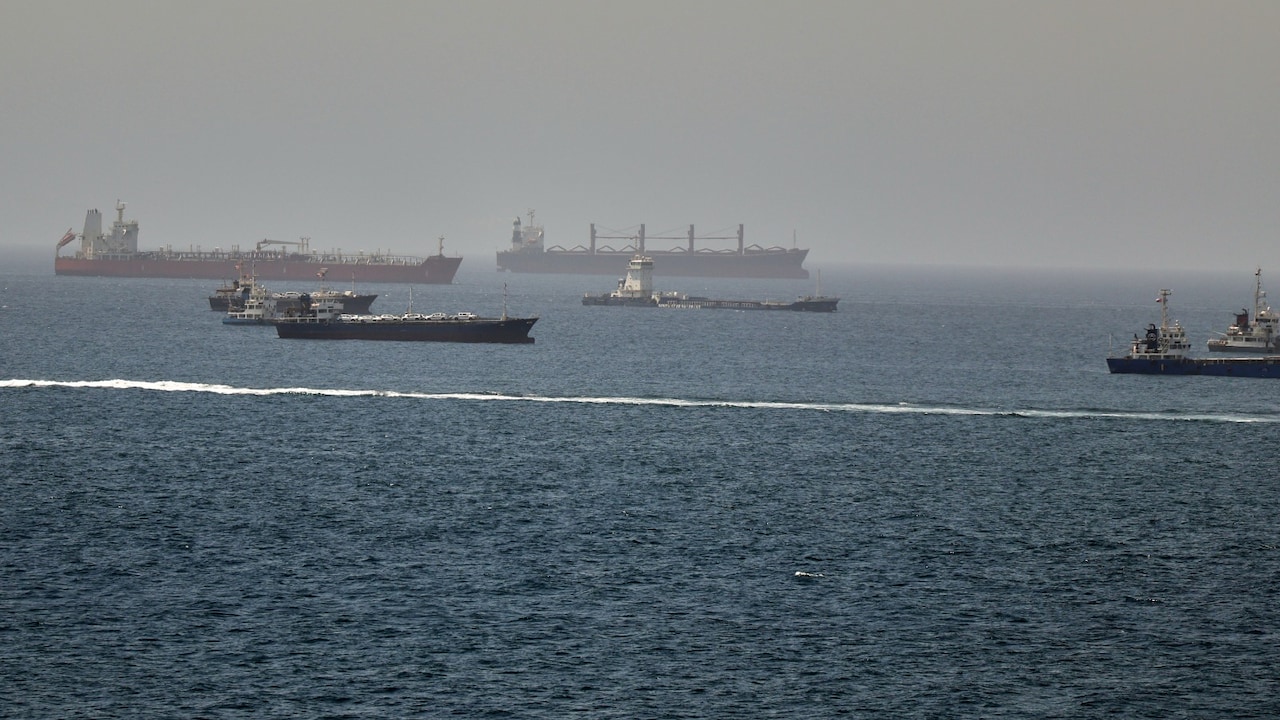
Commercial shipping operating through the Strait of Hormuz faces a persistent operational hazard profile defined by asymmetrical vectors rather than conventional naval combat. When the United Kingdom Maritime Trade Operations reported that an outbound oil tanker had sustained impacts from three unidentified projectiles seventeen nautical miles east of Khasab, Oman, media reporting defaulted to descriptive summaries of regional flashpoints. That approach obscures the underlying systemic failure modes governing maritime transit in contested chokepoints. Evaluating maritime security incidents requires shifting away from episodic accounts of explosions and toward the structural economics of energy logistics, the physics of localized projectile deployment, and the tactical vulnerabilities of the Traffic Separation Scheme within the Musandam Peninsula corridor.
The geographic architecture of the Strait of Hormuz dictates the tactical realities of maritime interdiction. The shipping lane narrows significantly, forcing high-tonnage crude and product carriers into tightly defined inbound and outbound transit corridors. The northern half falls primarily within Iranian territorial waters, while the southern transit lanes hug the territorial boundary of Oman near Khasab. Commercial operators attempting to minimize exposure to direct Iranian shore-based batteries routinely favor the southern Omani traffic lane. However, this geometric constraint transforms the southern corridor into a predictable spatial funnel. Any actor deploying uncrewed aerial systems, loitering munitions, or short-range direct-fire weapons targets a static, mathematically calculable coordinate grid where vessels must maintain predictable speeds and headings.
Understanding why a vessel absorbs three discrete impacts requires analyzing the ballistic signature and weapon delivery mechanisms typical of modern regional skirmishes. Single-projectile impacts often indicate opportunistic engagement or warning shots, but a three-projectile salvo implies a concentrated firing solution designed to test point-defense readiness or inflict structural degradation. Because maritime authorities frequently lack immediate forensic access to telemetry data or ordnance fragments, classification defaults to unknown projectiles. This classification ambiguity serves a strategic purpose for hostile or non-state actors, maintaining plausible deniability while injecting maximum friction into the insurance and underwriting markets.
The immediate financial consequence of such strikes manifests not in hull penetration or environmental loss, but in the rapid repricing of maritime risk. War risk insurance premiums for the Persian Gulf operate on a dynamic feedback loop tied directly to incident frequency reported by monitoring bodies like the UKMTO. When cumulative strikes accumulate within a forty-eight-hour window—such as concurrent inbound and outbound attacks near the Musandam Peninsula—underwriters adjust hull and machinery war-risk endorsements upward. For a Very Large Crude Carrier moving two million barrels of crude, even a fractional percentage increase in premium adds hundreds of thousands of dollars to a single voyage cost function. This dynamic creates a de facto economic blockade that requires zero physical closure of the waterway.
Compounding this risk environment is the interaction between unilateral enforcement actions and localized kinetic retaliation. Strategic enforcement measures, such as the naval blockades deployed to intercept vessels conducting trade with sanctioned entities, alter the behavioral baseline of all regional traffic. When naval forces board tankers or establish exclusionary zones in the broader Arabian Sea and Gulf of Oman, commercial masters experience heightened cognitive load and navigational stress. Navigating dense traffic while executing evasive maneuvers or adhering to conflicting directives from multiple military authorities increases human error margins and compresses reaction times when projectiles enter the flight path.
Vessels transiting these waters must transition from passive adherence to international maritime safety standards toward active tactical hardening. Standard bridge teams remain underprepared for multi-vector drone or projectile attacks because commercial architecture prioritizes efficiency and regulatory compliance over ballistic survivability. Ship operators must implement hardening protocols that include citadel procedures, enhanced optical and thermal watchkeeping to detect low-radar-cross-section threats early, and dynamic route variance within allowable traffic separation boundaries to disrupt pre-calculated targeting solutions used by shore-based or sea-based launch platforms.
Maritime security analysts monitoring the Hormuz corridor must abandon reactive incident tracking in favor of predictive supply chain elasticity modeling. Insurers, shipowners, and energy conglomerates should immediately decouple their routing decisions from fixed navigational corridors by establishing flexible staging zones outside the Persian Gulf, forcing hostile actors to absorb the prohibitive logistical cost of extending projectile range rather than relying on the predictable geometry of the Khasab transit lane.

