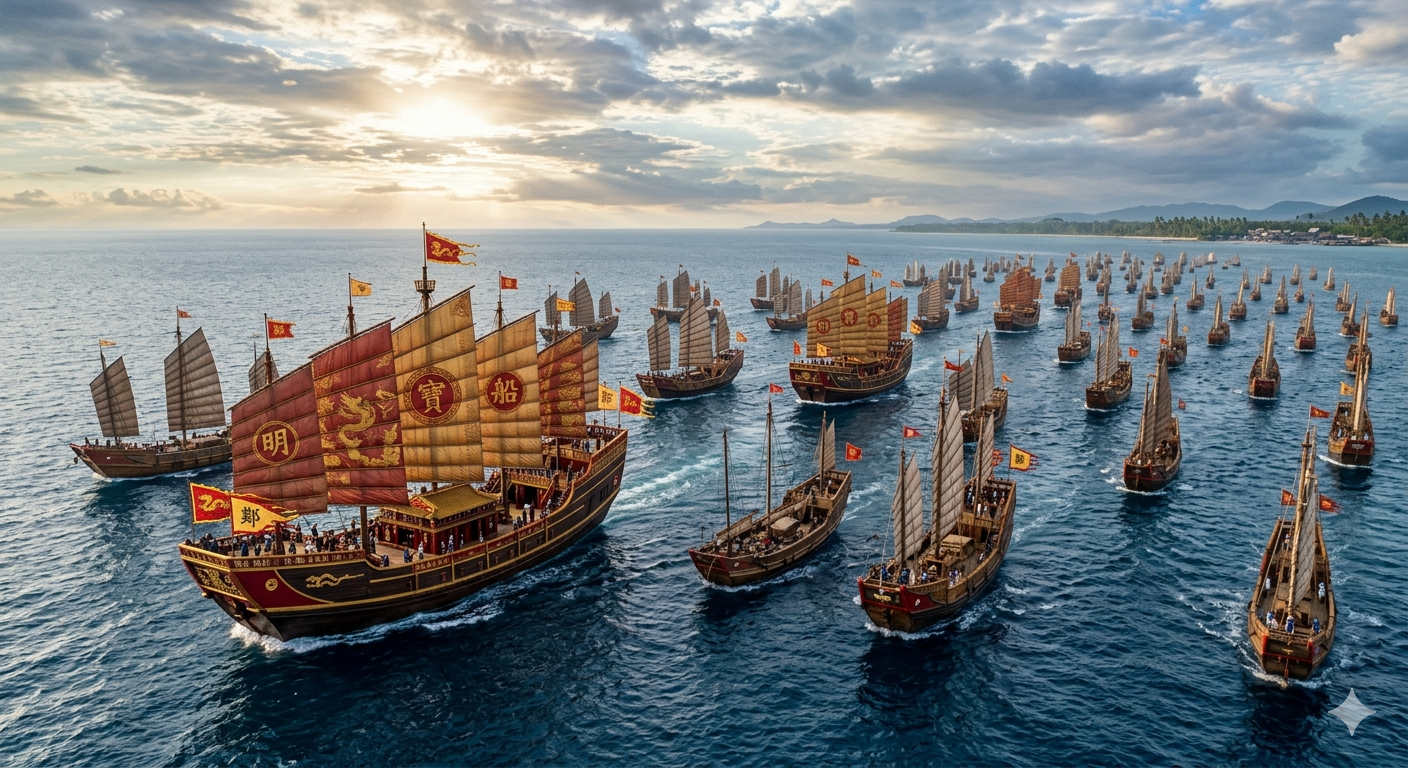
The destruction of the Ming Dynasty’s "Treasure Fleet" and the subsequent 1525 edict making the construction of multi-masted ships a capital offense represents history’s most profound case study in strategic asset liquidation. While popular narratives frame this as a cultural retreat into isolationism, a cold-eyed structural analysis reveals it was a forced response to a cascading failure in fiscal sustainability, internal logistical competition, and a misaligned power projection model. The Ming state did not just stop exploring; it dismantled a high-functioning technological vertical because it could no longer solve the Cost-to-Utility Paradox of maritime hegemony.
The Unit Economics of the Treasure Fleet
To understand the 1525 collapse, one must quantify the sheer scale of the overhead. The "Treasure Ships" (Baochuan) were not mere vessels; they were floating administrative capitals. Estimates suggest the largest ships exceeded 120 meters in length, requiring a timber supply chain that devastated regional forests.
The fleet’s operational model relied on a negative-sum trade cycle:
- Fixed Costs: The construction of a single fleet required the mobilization of 30,000+ personnel, including soldiers, sailors, and specialized craftsmen. This created a massive labor diversion from the agricultural tax base.
- Variable Costs: The "Tribute System" functioned as a state-sponsored subsidy. Foreign entities brought symbolic gifts to the Emperor; in exchange, the Ming state provided return gifts of vastly higher market value (silks, porcelains, and precious metals) to signal dominance.
- Revenue Gap: Unlike the later European joint-stock models (VOC or East India Company), the Ming fleet was prohibited from engaging in market-driven mercantilism. It was a tool of prestige, not profit. Every mile sailed increased the state’s fiscal deficit.
By the mid-1400s, the Ming treasury faced a liquidity crisis. The paper currency (Da Ming Baochao) suffered from hyperinflation because it lacked a metallic standard. When the state could no longer pay its shipwrights in stable value, the technical knowledge base began to erode long before the 1525 ban.
The Grand Canal as a Disruptive Technology
The pivot from sea to land was not an emotional choice but a shift in logistical infrastructure. The restoration of the Grand Canal in 1415 created a more efficient, weather-resistant, and internal supply chain for moving grain from the productive South to the administrative North (Beijing).
This created a "Resource Competition" bottleneck:
- Internal vs. External Focus: The Grand Canal required constant dredging and a fleet of 15,000 shallow-draft barges. The state had to choose between maintaining the blue-water navy or the inland grain artery.
- Risk Mitigation: Maritime routes were subject to typhoons and the Wokou (pirates). The Canal offered a controlled environment where the state could extract taxes with near-total visibility.
The Grand Canal became the "Minimum Viable Product" for imperial survival. Once the Canal was fully operational, the Treasure Fleet's primary utility—moving goods and showing force—became redundant and prohibitively expensive.
The Tumu Crisis and the Reallocation of Defense Spend
The 1449 Tumu Crisis, where the Emperor was captured by Mongol forces, fundamentally altered the Ming risk profile. Strategy shifted from "Expansionist Prestige" to "Existential Defense."
The fiscal implications were immediate:
- Capital Expenditure (CapEx) Shift: Funds previously allocated to the Ministry of Works for shipbuilding were redirected to the Ministry of War for the fortification of the Great Wall.
- Personnel Reallocation: The veteran officer corps, previously focused on maritime navigation, was purged or transferred to the northern frontiers.
The 1525 decree to destroy all multi-masted ships was the final stage of this transition. It was an institutional "burn notice" designed to prevent the resurgence of a maritime faction that could compete for the Emperor's shrinking budget.
The Technology Debt of the 16th Century
By banning the construction of sea-going vessels, the Ming state effectively deleted its maritime R&D pipeline. This created a legacy of technical debt that would be called in when European powers arrived in the South China Sea.
The technical regressions included:
- Navigational Atrophy: The loss of star-charting and deep-sea hydrography skills.
- Structural Engineering Decay: The inability to construct hulls capable of mounting heavy gunpowder artillery. While Ming ships had used cannons, they were not optimized for the recoil of the heavy broadsides being developed in the West.
- Scale Disruption: The transition from 100-meter hulls to small coastal junks meant that Chinese maritime interests could no longer achieve the "Force Concentration" necessary to repel organized foreign fleets.
The 1525 policy did not just stop progress; it forced a reversal. When the ban was eventually relaxed decades later, the Chinese merchant class had to rebuild their fleet from a lower technological baseline, relying on smaller, less capable vessels that could not compete with the maturing galleons of the Spanish and Portuguese.
The Silo Effect: Why the Private Sector Couldn't Save the Fleet
In a modern market, a government’s exit from a sector often allows private players to fill the vacuum. In the Ming context, this was impossible due to the Legal Monopoly on High-Seas Trade.
The Ming state viewed any unmanaged trade as "piracy." This led to a "Black Market Divergence":
- State Policy: Zero-tolerance for maritime trade.
- Economic Reality: High demand for Chinese goods in Japan and Southeast Asia.
- Outcome: Legitimate merchants were forced into criminal syndicates. Instead of a merchant marine that could be taxed and conscripted, the state faced a militarized smuggling class.
The 1525 policy turned a potential strategic asset (the merchant class) into a permanent domestic security threat. The state was then forced to spend even more on coastal defenses to fight the very people who should have been its economic engine.
The Strategic Play: Lessons in Asset Mismanagement
The collapse of the Ming maritime program provides a definitive framework for identifying Strategic Dead Ends.
The failure was not in the technology—the ships were the most advanced in the world—but in the Governance Model. The fleet was a "Vanity Vertical" with no path to self-sustainability. For an organization to maintain a technological lead, it must translate that lead into a revenue stream that outpaces its maintenance costs.
The Ming state failed to transition from a "Command and Control" maritime model to a "Regulatory and Tax" model. By insisting on absolute ownership of the seas, they ensured they would eventually own nothing.
The strategic takeaway for any high-level entity is clear: When an expensive, high-tech initiative is divorced from a viable economic feedback loop, it becomes a liability that the system will eventually purge to save itself. The 1525 edict was not a mistake of the Ming; it was the inevitable conclusion of a flawed financial architecture.
Final Strategic Assessment: To avoid a "1525 Event," an organization must decentralize the cost of its grandest projects. Had the Ming permitted a private-public partnership for maritime trade, the Treasure Fleet’s descendants would have likely dominated global trade routes for centuries. Instead, they chose total control, which led to total obsolescence.