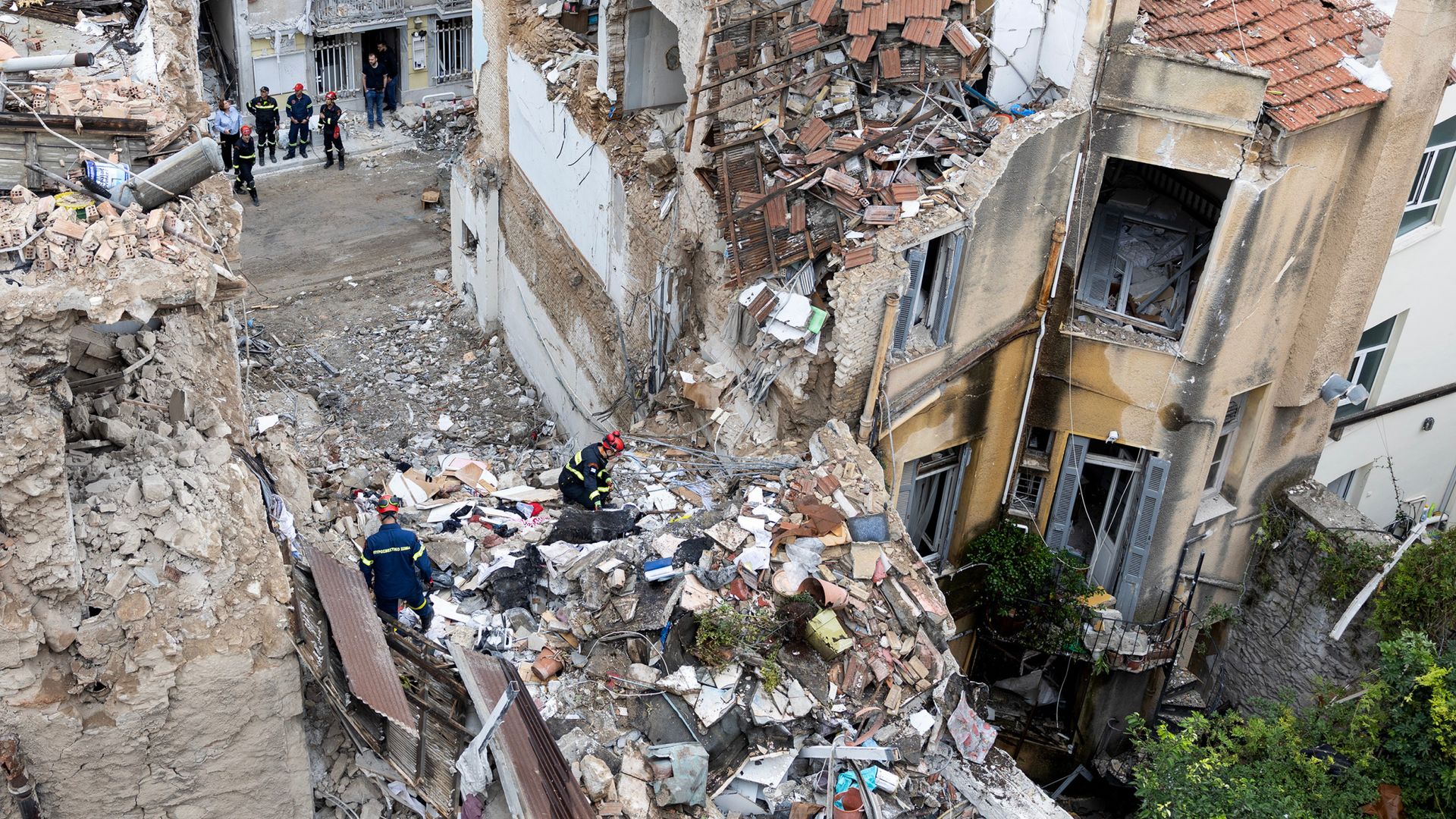
Urban infrastructure failures involving volatile gas distribution networks present severe public safety hazards, as demonstrated by the catastrophic building collapse in the Plaka district of Athens. Understanding the systemic vulnerabilities that lead to such events requires analyzing the mechanical, regulatory, and criminal risk vectors inherent in dense municipal environments.
The Mechanics of Urban Gas Accumulation
When a gas leak occurs within a multi-story residential structure, the severity of the resulting event is governed by a precise thermodynamic and fluid-dynamic equation. Natural gas or liquefied petroleum gas escaping from compromised piping systems accumulates based on vapor density relative to ambient air and the rate of structural ventilation.
- Source Compromise: Piping degradation, mechanical fracture, or unauthorized physical interference (such as the illicit extraction of copper infrastructure) breaches containment.
- Volumetric Dispersion: The gas diffuses through confined cavities, wall voids, and interstitial spaces rather than immediately venting externally.
- Stoichiometric Threshold: An explosion requires the fuel-air mixture to reach a specific explosive limit. Once this concentration is achieved within a confined volume, any localized ignition source—ranging from electrical switches to standard household appliances—triggers rapid deflagration transitioning to detonation.
The velocity of the pressure wave generated in such an event exceeds the structural load-bearing capacity of typical masonry and concrete frame buildings, leading to total progressive collapse rather than localized damage.
Regulatory Oversight and Asset Integrity Management
Municipal gas distribution relies on continuous asset integrity management. The regulatory frameworks governing urban residential buildings mandate strict safety protocols, yet enforcement gaps frequently expose critical vulnerabilities.
Municipal authorities face a persistent monitoring deficit. Aging pipeline networks, particularly in historic urban cores where retrofitting modern monitoring equipment is physically and economically constrained, exhibit higher failure probabilities. The lack of remote telemetry and automated shut-off valves in older residential blocks delays emergency response times. By the pressure drop is detected manually or reported via secondary effects, the volume of leaked gas has often surpassed critical safety thresholds.
Criminal Vulnerabilities and Infrastructure Tampering
Beyond structural aging and mechanical fatigue, municipal networks face threats from illicit interference. The economic value of raw materials embedded within utility lines, such as copper piping, creates an illicit market incentive for opportunistic theft and vandalism.
When unauthorized individuals tamper with active or dormant gas lines to extract metal components, the risk profile of the building changes immediately. Even minor structural shifts during extraction can compromise threaded joints, seals, or valves. Investigations into major urban explosions frequently reveal that human intervention, rather than spontaneous material failure alone, serves as the primary catalyst for containment loss.
Strategic Frameworks for Mitigation
Mitigating the risk of catastrophic urban gas explosions requires a shift from reactive emergency management to predictive structural defense. Municipalities must implement three core operational countermeasures:
- Automated Isolation Valves: Deploying smart sensor grids capable of detecting abnormal flow rates or pressure differentials and automatically isolating individual building feeds within seconds.
- Non-Destructive Material Audits: Mandating periodic thermal imaging and acoustic emission testing for gas distribution infrastructure in high-density historic districts to identify thinning walls or stress fractures before containment fails.
- Physical Security Hardening: Encasing vulnerable utility entry points and internal distribution risers in tamper-evident or reinforced housings to deter unauthorized physical access and infrastructure stripping.
The intersection of aging architecture, dense habitation, and utility vulnerability demands continuous structural surveillance to prevent catastrophic loss of life in metropolitan environments.