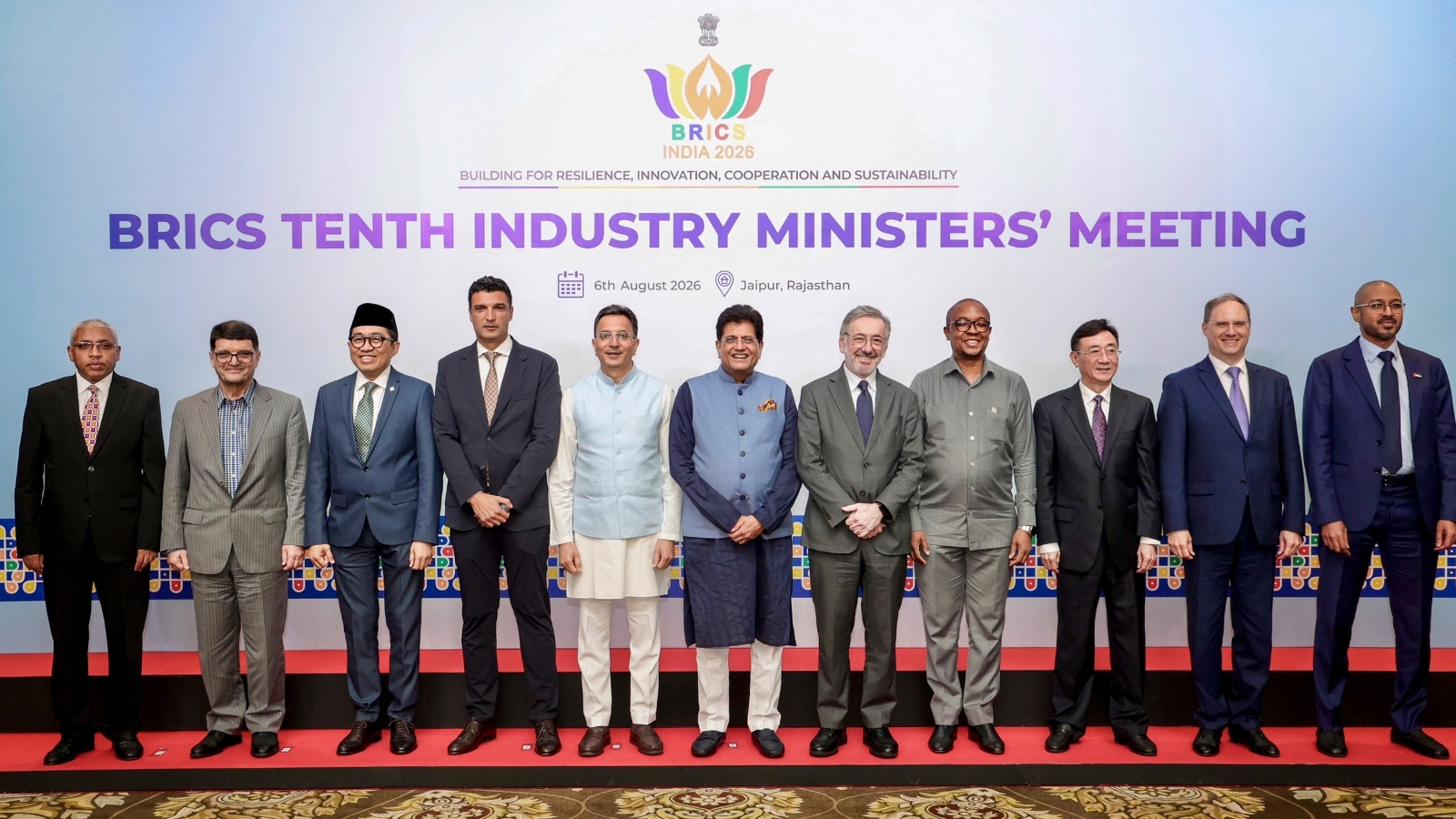
International declarations often obscure operational realities through diplomatic syntax. When BRICS industry ministers gathered in Jaipur to adopt a joint declaration focused on manufacturing competitiveness, supply chain resilience, and digital transformation, the public discourse defaulted to standard geopolitical tropes about multipolar balancing. This misses the mechanical engine of the event. The Jaipur ministerial meeting represented an attempt to transition BRICS from a loose rhetorical counterweight into an institutionalized economic bloc capable of managing industrial policy synchronization across structurally divergent economies.
Decoding the Jaipur Declaration requires stripping away the communique language to examine the underlying economic incentives, structural frictions, and resource allocation mechanisms. Industrial policy coordination among nations with asymmetric developmental stages, conflicting trade philosophies, and divergent currency exposures generates predictable friction points. Analyzing this document through a strategic lens reveals why multilateral industrial alignment between major emerging markets remains bounded by domestic protectionism and competitive export strategies.
The Trilemma of BRICS Industrial Coordination
Multilateral industrial cooperation among emerging economic powers operates under a strict trilemma. A bloc cannot simultaneously maximize domestic industry protection, achieve deep supply chain integration, and maintain absolute national autonomy over industrial subsidies.
When ministers in Jaipur committed to enhancing manufacturing competitiveness and micro, small, and medium enterprise integration, they addressed the symptom while ignoring the structural trade-off. Each member state protects strategic sectors through domestic content requirements, preferential procurement, and state-backed capital allocation.
[Domestic Market Protection]
       /\
      /  \
     /    \
    /      \
[Supply Chain Integration] ---- [National Industrial Autonomy]
This trilemma dictates the limits of the Jaipur commitments. For India, industrial policy centers on domestic manufacturing incentives like production-linked incentives aimed at capturing global value chains. For China, industrial strategy relies on state-directed capital deployment in advanced manufacturing and green technologies. Russia operates under heavy sanctions constraints, prioritizing import substitution over multilateral optimization. South Africa faces severe domestic infrastructure bottlenecks that restrict manufacturing scale regardless of multilateral agreements.
When these four systemic approaches intersect in a joint declaration, the resulting text must use abstract terminology to mask operational contradictions. The core mechanism proposed in Jaipur—information sharing and joint research on supply chain vulnerabilities—acts as a low-cost confidence-building measure rather than a binding regulatory harmonization. True supply chain resilience requires redundant capacity and shared inventory buffers, yet none of the member states are willing to cede control of domestic industrial subsidies to a multilateral steering committee.
Digital Transformation and the Productivity Paradox
A central pillar of the Jaipur meeting involved accelerating digital transformation within the industrial sector, specifically targeting small and medium enterprises. Policymakers frequently conflate digital adoption with productivity growth, assuming that deploying enterprise resource planning software or cloud infrastructure automatically translates to manufacturing efficiency.
Empirical data across emerging markets demonstrates a persistent productivity paradox. Technology adoption without process re-engineering and workforce skill upgrading yields marginal output gains. The Jaipur Declaration encourages digital connectivity among industrial parks and digital infrastructure sharing, but it avoids addressing the capital expenditure deficit facing smaller enterprises.
Micro and small enterprises in these economies face three primary barriers to effective digital integration:
- High cost of capital for technology upgrades relative to projected cash flow improvements.
- Acute deficits in specialized digital skills required to manage automated production lines and data-driven supply chains.
- Fragmented regulatory frameworks governing cross-border industrial data flows and intellectual property protection.
Without addressing these structural inputs, ministerial frameworks regarding digital transformation remain declarative. To outpace legacy manufacturing models, industrial clusters require targeted credit facilities and standardized interoperability protocols, not high-level commitments to cooperation.
Supply Chain Mapping Versus Strategic Autonomy
The Jaipur text emphasizes monitoring supply chain vulnerabilities and reducing reliance on single-source inputs. This objective mirrors initiatives in Western economies, yet the execution path within BRICS diverges significantly due to internal trade imbalances and bilateral friction.
A primary structural impediment to internal BRICS supply chain integration is the asymmetric trade relationship between members, particularly the trade imbalance centered on manufactured goods versus raw commodities. Industrial integration requires multilateral trade in intermediate goods. However, domestic manufacturers in several member states frequently lobby for import tariffs against intermediate goods from partner nations to protect domestic producers of raw inputs.
Raw Material Exporters ---> Intermediate Processing ---> Finished Goods
      (Member A)                  (Member B)               (Member C)
         \                           |                         /
          \-----------------> Tariff Frictions <--------------/
When supply chain disruptions occur, national self-preservation consistently overrides multilateral solidarity. Export restrictions on critical minerals, agricultural products, or industrial components deployed during past crises demonstrate that trust alone cannot substitute for legally binding enforcement mechanisms. The Jaipur Declaration introduces no binding dispute resolution mechanism or enforcement penalty for non-compliance with supply chain transparency goals. Consequently, member states retain full sovereign discretion to implement beggar-thy-neighbor policies whenever domestic macroeconomic pressures rise.
Resource Allocation and Capital Constraints
Industrial strategy is fundamentally an exercise in capital allocation. The ambitions outlined in Jaipur—ranging from green manufacturing transitions to infrastructure modernization—require trillions of dollars in capital expenditure.
The primary institutional vehicle for financing infrastructure and industrial capacity within the bloc remains the New Development Bank. While the bank has scaled its lending operations, its capitalization relative to the total infrastructure deficit of the developing world is modest. Furthermore, the bank operates under strict risk management frameworks that mirror traditional multilateral lenders, requiring sovereign guarantees and limiting its ability to absorb high-risk industrial restructuring costs.
When member states commit to sustainable industrialization, they encounter a dual-cost burden: financing the green transition of legacy heavy industries while simultaneously expanding baseline energy generation to support manufacturing growth. Coal-dependent energy grids in key member states cannot rapidly transition to renewable inputs without risking industrial output contraction. The Jaipur communique acknowledges these developmental differentials, but acknowledging a constraint does not eliminate its economic cost.
The Strategic Reality of Ministerial Declarations
Joint declarations function as political signaling devices aimed at domestic constituencies and external competitors. For the host nation, orchestrating a consensus among major developing economies demonstrates diplomatic capacity and leadership in framing the Global South economic agenda. For the broader bloc, these meetings maintain institutional momentum between annual summits.
However, treating a ministerial declaration as an operational roadmap invites analytical error. The distance between a signed communiqué in Jaipur and measurable shifts in manufacturing output, supply chain redundancy, or digital maturity is vast. The former requires linguistic compromise; the latter requires structural reform, capital deployment, and the difficult political choice of dismantling domestic protectionist cartels.
Future economic performance will not be determined by the frequency of ministerial meetings or the breadth of joint declarations. It will be decided at the firm level through capital efficiency, workforce productivity, and the speed at0 which enterprises can adapt to shifting global trade architectures. Policymakers can facilitate this transition by removing internal regulatory friction and streamlining cross-border capital flows, rather than issuing broad statements on industrial competitiveness.
Focus capital deployment on building interoperable digital infrastructure for logistics corridors, establish transparent bilateral dispute mechanisms for critical intermediate goods before seeking multilateral consensus, and eliminate internal tariff barriers on industrial inputs to lower baseline manufacturing costs across the bloc.