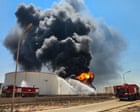
Political settlements in fractured states collapse not from a lack of ideological alignment, but from the degradation of critical infrastructure that sustains state capacity. When diplomatic architecture in Tripoli attempts to unify a fragmented governance model, the introduction of strategic disruptions—such as drone strikes on petroleum facilities—acts as a stress test that exposes the structural fragility of the entire framework. Understanding why peace talks disintegrate requires examining the economic incentives of armed non-state actors, the operational mechanics of asymmetric warfare against logistics nodes, and the systemic feedback loops connecting energy supply to state survival.
The political economy of conflict in North Africa relies heavily on resource extraction and distribution monopolies. To comprehend the impact of kinetic operations against fuel infrastructure, one must analyze the resource curse operating under conditions of institutional vacuum.
The Economic Vector of Armed Leverage
Control over refined fuel imports, distribution networks, and subsidized petroleum products forms the bedrock of militia finance and political extortion. The National Oil Corporation and associated downstream facilities are not merely economic assets; they are the primary liquidity engines for competing authorities. When kinetic assets are deployed against storage depots, refineries, or supply pipelines, the objective is rarely catastrophic destruction. Instead, it is targeted disruption calculated to alter the bargaining space.
- Liquidity Deprivation: Halting refinery operations or fuel terminals forces rival factions into emergency procurement cycles, depleting foreign currency reserves.
- Distribution Monopoly Reinforcement: Scarcity artificially inflates black market prices for diesel and gasoline, allowing dominant armed groups to capture high-margin rents through parallel distribution networks.
- Institutional Paralysis: Centralized governance structures fail when basic municipal services collapse due to fuel shortages, compelling international mediators to recalibrate legitimacy toward whichever faction maintains operational security.
This creates a perverse incentive structure where the threat of infrastructure degradation yields higher political and financial returns than actual compromise at the negotiating table.
Asymmetric Warfare Mechanics and Command Attribution
The introduction of unmanned aerial vehicles into regional conflicts shifts the cost-benefit analysis of power projection. Traditional air superiority requires massive maintenance budgets, specialized training infrastructure, and vulnerable airbases. Commercial or state-backed drone platforms lower the barrier to entry for localized actors seeking strategic leverage.
Attributing these strikes involves navigating a deliberate fog of war characterized by plausible deniability. When junior commanders, warlords' relatives, or autonomous proxy networks operate drone assets, central leadership can disavow operational control while reaping the tactical benefits. This architecture of command ambiguity protects political leaders from direct international sanctions while signaling resolve to domestic adversaries.
The tactical execution of fuel facility targeting follows a precise logic of minimum viable damage. Precision munitions or loitering munitions do not need to obliterate an entire complex to achieve strategic objectives. Damaging a single cracking unit, storage tank manifold, or power substation creates cascading failures across the regional grid. The repair timeline for specialized industrial components in a sanctions-ridden, conflict-torn environment often extends across months, maximizing the duration of the political leverage gained.
Systemic Feedback Loops in Peace Architecture
Diplomatic mediation efforts in fragmented polities frequently fail because they treat negotiations as a purely legal or political exercise, ignoring the underlying material incentives of the participants. When talks advance toward a power-sharing agreement, threatened factions calculate their prospective share of state revenues against their current capacity to extract rents through force.
If an impending unity government threatens to centralize oil revenues under a rival administration, the incentive to sabotage the diplomatic track via kinetic escalation increases exponentially. The sequence unfolds through predictable phases:
- Pre-Negotiation Signaling: Factions posture through political declarations while positioning forces near strategic logistics corridors.
- Diplomatic Threshold Breach: As negotiations approach a binding agreement that disadvantages a specific coalition, the probability of asymmetric disruption spikes.
- Infrastructure Interdiction: Precision strikes on fuel or power nodes shift public frustration away from negotiators and toward the immediate operational failures of the state, buying time for the aggrieved faction to renegotiate terms.
- International Intervention Realignment: External mediators respond to humanitarian and economic pressures by offering concessions to the disruptive party to restore baseline stability, inadvertently rewarding the kinetic strategy.
Strategic Outlook and Institutional Resilience
Resolving the vulnerability of critical assets to asymmetric disruption requires moving beyond conventional diplomatic frameworks that rely on the goodwill of armed actors. Sustainable stability depends on decoupling basic resource distribution from political patronage networks through independent oversight mechanisms and localized redundancy.
Without structural reforms that alter the cost function of kinetic disruption—such as enforceable automated sanctions targeting the supply chains of drone technology and freezing illicit revenue streams derived from black-market fuel—unity talks will remain susceptible to strategic sabotage. The durability of any political settlement is inversely proportional to the ease with which a single armed faction can weaponize the nation's energy infrastructure for political extortion.