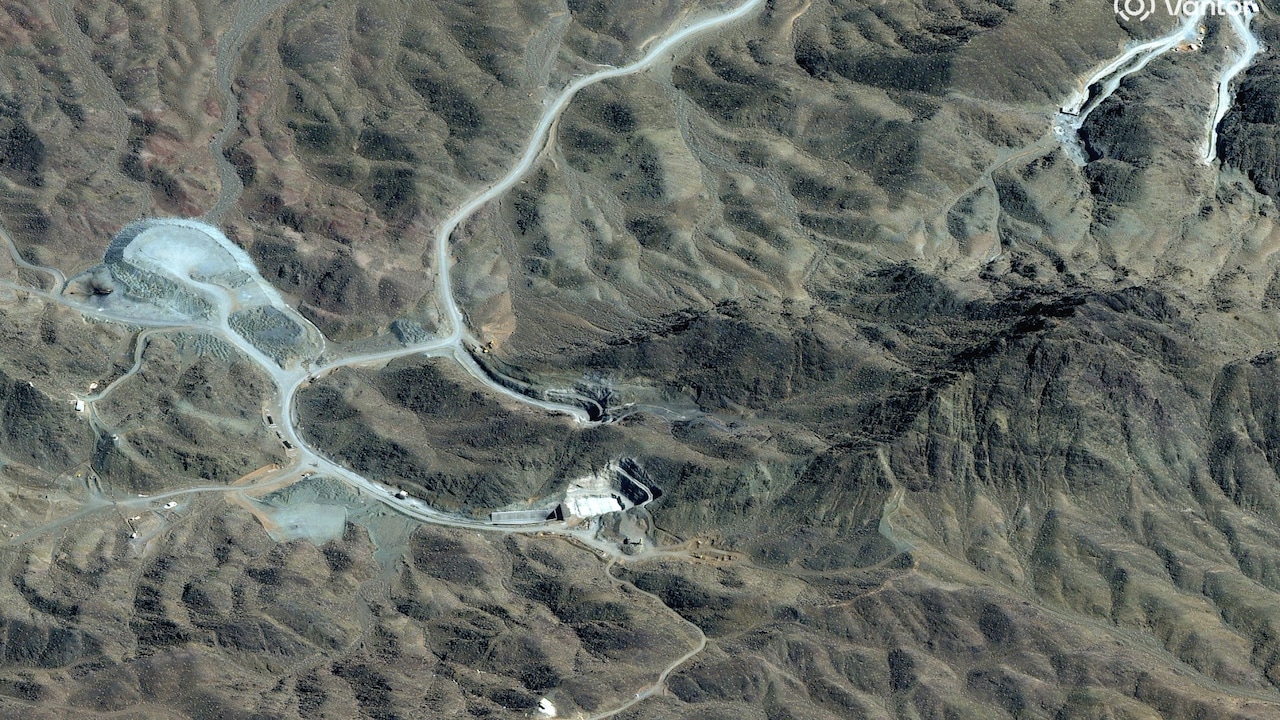
The media is currently hyperventilating over satellite imagery of Pickaxe Mountain. According to intelligence leaks and breathless headlines, Tehran moved thousands of advanced centrifuges into a subterranean bunker carved 300 to 450 feet into solid granite near Natanz. The mainstream consensus treats this as a terrifying strategic checkmate—a covert breakout fortress immune to Western bunker-buster munitions.
This consensus is fundamentally flawed.
Burying centrifuges under hundreds of feet of granite does not make a nuclear program invulnerable. It turns a dispersed, adaptable technological network into a static, fragile bottleneck. The narrative that Pickaxe Mountain—known locally as Kuh-e Kolang Gaz La—represents an unshakeable shield for uranium enrichment reveals a deep misunderstanding of centrifuge physics, military logistics, and modern target geometry.
Tehran did not construct an indestructible breakout site. They built a subterranean cage that simplifies the West's targeting problem.
The Bedrock Illusion
Media outlets love depth figures. Hearing that a facility sits 100 meters below bedrock makes for dramatic reporting, leading commentators to assume the facility is invincible simply because a GBU-57 Massive Ordnance Penetrator cannot crack the ceiling in a single drop.
This perspective misunderstands how industrial enrichment functions.
An enrichment plant is not a static vault where material is placed and forgotten. It is a high-speed, precision-engineered thermodynamic process. Uranium hexafluoride ($UF_6$) gas must be fed continuously through interconnected cascades of centrifuges spinning at speeds exceeding 1,000 revolutions per second. At these velocity levels, the rotor tips of an IR-6 or IR-4 centrifuge approach the physical limits of tensile strength for carbon-fiber composites.
These machines are exceptionally fragile. They do not require a direct kinetic hit on their chassis to be destroyed.
Imagine a scenario where a high-explosive strike hits the concrete portals of a tunnel complex rather than penetrating the mountain overhead. The kinetic shockwave alone, traveling through rigid granite, imparts severe physical vibration directly into the bedrock floor. For high-speed centrifuges operating under high vacuum conditions, micro-vibrations cause the rotor to destabilize, strike the casing wall, and shatter instantly.
A sudden shockwave does not just halt enrichment; it triggers a catastrophic cascade failure. When one rotor disintegrates at 90,000 RPM, the kinetic energy rips through neighboring housing units, destroying entire cascades in milliseconds. You do not need to shatter 400 feet of granite when the mountain itself acts as a conductor for kinetic energy.
The Tyranny of Subterranean Infrastructure
Every underground complex remains bound to the physical surface. The deeper a facility is buried, the more dependent it becomes on exposed surface support systems.
To maintain nuclear enrichment operations deep inside Pickaxe Mountain, Tehran must continuously provide four critical external inputs:
- Continuous High-Voltage Electricity: Centrifuge cascades cannot tolerate power flickers. A sudden loss of electrical frequency synchronization causes rotor instability. While underground facilities rely on backup diesel generators, generators require enormous air intake systems and exhaust vents.
- Industrial HVAC and Heat Dissipation: Thousands of centrifuges spinning simultaneously generate massive thermal loads. Without industrial-scale chillers and air handling units continuously exhausting hot air out of the mountain, ambient temperatures inside the tunnels rise within hours, causing $UF_6$ gas to desublimate and wreck the centrifuges.
- Gas Pipeline and Material Supply Logistics: Raw $UF_6$ feed material must be trucked in, and enriched product must be transported out. Heavy logistics trucks cannot drive through solid rock; they must use two narrow, paved access roads leading to hardened tunnel portals.
- Positive Pressure Air Filtration: Operating an enrichment plant requires cleanroom environmental controls to prevent particulate contamination from entering delicate vacuum pumps and bearing systems.
This reality completely changes the military dynamic. You do not need to penetrate 100 meters of granite to render Pickaxe Mountain completely useless.
[ Surface Infrastructure ] -> (Transformers / HVAC Vents / Access Roads)
                                           |
                                [ Portal Shock / Collapse ]
                                           |
[ Bedrock Granitic Core ] -> (Kinetic Shock Transmission) -> [ Cascade Collapse ]
A concentrated strike on the two primary tunnel portals, paired with the destruction of external electrical transformers and cooling vents, transforms an underground fortress into a tomb. Once the entrances are sealed with thousands of tons of collapsed concrete and rock, the facility is functionally eliminated. The centrifuges inside are trapped without power, ventilation, or operational access.
Why Dispersal Beats Burial
The obsession with Pickaxe Mountain obscures a fundamental truth about non-proliferation strategy: centralization is the enemy of survivability.
In the early days of Iran’s nuclear program, the threat to Western intelligence was distribution. A dispersed network of small, clandestine pilot plants tucked away in industrial parks across Isfahan, Tehran, and Qom presented a complex intelligence target. Finding and tracking dozens of small workshops assembling parts or running isolated cascades was an ongoing challenge.
By consolidating thousands of centrifuges inside a single, high-profile mountain facility, Iran has simplified the intelligence equation.
I have watched defense agencies spend hundreds of millions attempting to map dispersed supply chains, only for adversaries to voluntarily concentrate their critical assets in a single, well-known target zone. Pickaxe Mountain has been under continuous, high-resolution satellite surveillance by Western and Israeli intelligence since ground was broken in 2020. Every cement mixer, every security fence installation, and every transport truck entering the perimeter is logged in real time.
When an adversary moves its most valuable technical assets into a single geographical location, it creates a self-imposed choke point.
The Breakout Paradox
Commentators frequently argue that Pickaxe Mountain provides Iran with a path to a covert nuclear breakout. The logic sounds simple: hide the machines deep enough, enrich uranium to 90% weapons-grade purity, and present the world with a nuclear fait accompli before anyone can react.
This argument ignores the operational reality of nuclear weapons development.
Producing highly enriched uranium (HEU) is only the first step in constructing an operational weaponized deterrent. To turn enriched $UF_6$ gas into a functional warhead, the gas must undergo a complex series of chemical and metallurgical transformations:
- Deconversion: Converting $UF_6$ gas into uranium tetrafluoride ($UF_4$) and then into pure uranium metal.
- Metallurgical Casting: Machining uranium metal into precise hemispherical cores under strict environmental controls.
- Explosive Lens Integration: Integrating the metallic core with high-explosive lenses, detonators, and neutron initiators.
- Miniaturization and Telemetry Testing: Fitting the physics package into a re-entry vehicle capable of surviving atmospheric re-entry on a ballistic missile.
Pickaxe Mountain is designed—at best—to house centrifuge cascades and assembly lines. It is not a fully integrated nuclear weapons manufacturing plant. Even if Tehran successfully enriched weapons-grade material deep beneath the mountain, that material must eventually leave the mountain to be converted, cast, and integrated into a delivery system.
The moment that material moves from the subterranean vault to a surface conversion laboratory, it becomes vulnerable. A nuclear breakout cannot occur entirely inside a tunnel; the industrial tail required to produce a deliverable weapon remains exposed to conventional interdiction.
The Real Risk: Miscalculating Strategic Leverages
If Pickaxe Mountain is so tactically vulnerable to portal interdiction, why did Iran build it?
The answer is political leverage, not tactical invincibility.
Pickaxe Mountain was commissioned after a July 2020 explosion destroyed the above-ground centrifuge assembly hall at Natanz. Tehran needed to demonstrate to its domestic audience and foreign adversaries that its nuclear program could not be derailed by sabotage. Building a deep underground facility sends a psychological signal: We are moving beyond your reach.
The primary danger of Pickaxe Mountain is not that it is immune to military strikes, but that Western powers will fall for the theater and miscalculate their strategic response.
Treating Pickaxe Mountain as an untouchable stronghold creates unnecessary political panic. It tempts hawks into advocating for immediate, escalation-heavy military interventions under the false assumption that time is running out before the mountain becomes permanently sealed off. Conversely, it tempts foreign policy realists to throw up their hands and concede that Iran's nuclearization is inevitable.
Both positions are wrong.
Pickaxe Mountain is a high-maintenance, fragile industrial bottleneck. It offers Iran a powerful psychological deterrent against low-level sabotage while exposing them to complete operational paralysis in any serious military conflict.
Rethinking Subterranean Warfare
The debate surrounding Iran's nuclear infrastructure relies on an outdated model of destruction. Success does not require vaporizing an asset; it requires denying the enemy the ability to use it.
When assessing the threat posed by Pickaxe Mountain, stop focusing on the thickness of the granite roof. Start looking at the physics of centrifuge stability, the vulnerability of surface infrastructure, and the inescapable logistical constraints of running an industrial enterprise underground.
Iran has not built an indestructible nuclear fortress. They have built the world's most expensive target bottleneck—and all it takes to close it is shutting the door.