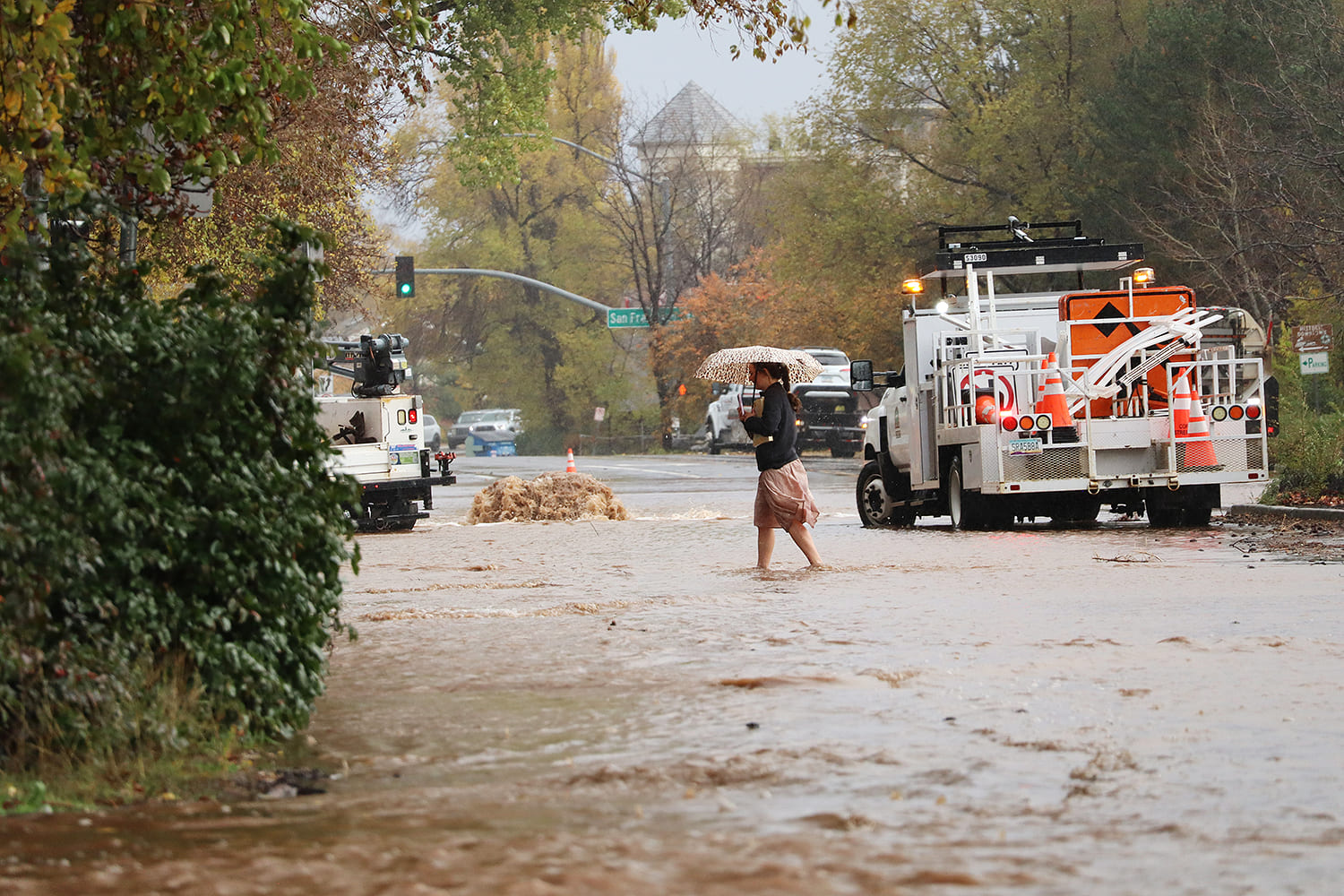
Every two years, political pundits dust off the exact same meteorological excuse. Dark clouds gather over Dallas or Wichita, and suddenly the cable news chyrons scream about how severe weather is about to tank voter turnout and swing close races.
It is lazy journalism. Worse, it is flat-out wrong. Don't miss our recent post on this related article.
The standard Election Day weather story relies on a comforting fiction: that millions of motivated citizens are standing by their front doors, keys in hand, ready to shape democracy until a cold front and two inches of rain ruin their plans. If you actually look at political science data, field operations, and modern voting mechanics in states like Texas and Kansas, that narrative falls apart completely.
Storms do not decide elections in the modern era. Weak ground games, poor ballot access infrastructure, and uninspiring candidates do. Blaming the barometer is just an easy way for losing campaign managers to keep their jobs. If you want more about the history here, The Washington Post provides an in-depth breakdown.
The Myth of the Weather-Beaten Voter
Let us dismantle the core premise first. Political scientists have studied the relationship between precipitation and turnout for decades. The landmark 2007 study by Brad Gomez, Thomas Hansford, and George Krause—published in The Journal of Politics—found that rain reduces voter turnout by less than one percentage point per inch, and snow reduces it by about half a percentage point.
That study looked at data from 1948 to 2000. Think about how people voted back then. Almost everyone had to show up in person on a single Tuesday in November.
Today, that reality is dead.
In Texas, early voting runs for nearly two weeks before Election Day. In major counties like Harris, Travis, Dallas, and Tarrant, well over half of all ballots are routinely cast before a single cloud forms on Tuesday morning. Kansas has offered no-excuse advance voting—both by mail and in person—since 1995. By the time the first Tuesday in November arrives, the vast majority of high-propensity voters in Overland Park, Topeka, and Wichita have already locked in their choices.
When a storm rolls across the Plains on Election Day, it is not hitting the entire electorate. It is hitting a shrinking fraction of procrastinators and low-propensity voters who waited until the final twelve hours to participate.
Why Campaign Operatives Love a Good Thunderstorm
I have watched campaign consultants burn millions of dollars on ineffective television ads while completely neglecting basic voter contact, only to blame a Tuesday afternoon squall when their candidate loses by three points.
The weather narrative survives because it serves everyone in the political ecosystem except the voter:
- Cable news producers get dramatic radar maps and live shots of reporters holding umbrellas outside quiet suburban high schools.
- Losing strategists get an act of God to explain away terrible polling and missed field targets.
- Lazy commentators get to write the exact same 600-word article every cycle without doing a shred of original reporting.
If a campaign’s entire path to victory depends on the last 15 percent of their target universe driving through a hailstorm at 6:30 PM on a Tuesday, that campaign already failed in September and October. Competent field operations treat Election Day as a cleanup operation, not a Hail Mary pass. They bank their votes early. They track daily early-vote returns by precinct. They adjust their ad spend and canvassing routes in real time based on who has already turned in a ballot.
When you see a campaign manager publicly fretting about Texas thunderstorms on Monday night, you are watching someone prepare their post-mortem alibi.
The Real Threat Is Not the Rain—It Is the Infrastructure
Does severe weather ever cause genuine chaos on Election Day? Yes, though not in the way standard weather reports describe.
The real danger of a November storm system in Texas or Kansas is not that voters are afraid of getting their shoes wet. The danger is physical infrastructure failure at under-resourced polling sites.
High winds and lightning knock out power grids. Texas, in particular, has a well-documented history of grid fragility during extreme weather events. When a transformer blows in a densely populated precinct, electronic poll books go dark. Voting machines lose backup battery power. Poll workers—many of whom are elderly volunteers—struggle to pivot to emergency paper ballots without causing two-hour bottlenecks.
In Kansas, where rural counties cover massive geographic footprints, severe storms can flood low-water crossings or knock down power lines across county roads, physically severing small communities from their consolidated polling locations.
Notice the difference. The problem is not voter apathy triggered by drizzle. The problem is an election administration system that still relies on fragile single-day choke points instead of universal mail ballots and resilient backup power systems.
Dismantling the "Partisan Weather" Fallacy
Another piece of conventional wisdom that refuses to die is the idea that bad weather automatically hurts Democrats and helps Republicans.
The theory goes like this: Republican voters are older, more reliable, and more likely to own trucks that can handle rough roads, whereas Democratic coalitions rely on younger, lower-income, and transit-dependent voters who are easily deterred by a downpour.
This model is completely outdated.
Over the last decade, educational polarization has flipped the behavioral patterns of both parties. College-educated suburban voters—who now form the backbone of the modern Democratic coalition—are among the highest-propensity, earliest-voting demographics in the country. They request mail ballots the day applications open. They show up on day one of early voting.
Meanwhile, the modern Republican coalition relies heavily on working-class, rural, and non-college-educated voters who increasingly distrust mail-in ballots and intentionally wait until Election Day to vote in person. Because conservative media and political leaders spent years demonizing early and mail voting, Republican turnout has become disproportionately concentrated on that single Tuesday in November.
If a severe squall line tears through rural West Texas or central Kansas on Election Day afternoon, it is no longer hitting a predominantly blue demographic. It is hitting the exact precincts that conservative candidates need to run up their margins.
What Actually Moves Turnout When Storms Hit
To understand what really happens when severe weather collides with an election, you have to separate inconvenience from displacement.
- Routine rain and wind (Inconvenience): Temperatures drop, umbrellas come out, and lines move slightly slower because people take longer to park and walk inside. Net impact on the final margin? Almost zero. Voters who care enough to vote on Tuesday will put on a jacket.
- Tornado warnings and flash flooding (Displacement): Roads close, emergency alerts blare on every smartphone, and county officials have to evacuate polling sites. Here, turnout actually drops—not because voters lost interest, but because law enforcement literally tells them to shelter in place.
Even in displacement scenarios, the impact is hyper-localized. A tornado warning in Hays, Kansas, or Waco, Texas, does not depress turnout statewide. It creates a localized drop in specific precincts, which only matters in razor-thin county commissions, state house districts, or municipal bond measures.
Where Conventional Wisdom Gets It Right (And Where It Still Fails)
To be completely transparent, there is one scenario where a Tuesday storm genuinely alters an election outcome: low-salience, off-year, or primary elections.
In a presidential or high-profile Senate year, voter motivation is maxed out. People will wade through ankle-deep water to cast a ballot. But in a May municipal election in Texas, or an August primary in Kansas where overall turnout is already hovering around 18 percent, friction matters enormously. When voters barely know who is on the ballot, a severe thunderstorm is all the excuse they need to stay home and watch Netflix.
Yet even there, the weather is merely an accelerant, not the root cause. Turnout in off-cycle local elections is abysmal on sunny, 72-degree days because local governments deliberately schedule those elections when nobody is paying attention.
How Smart Voters and Campaigns Actually Handle Stormy Election Days
If you live in Texas or Kansas and a severe weather warning is flashing across your phone on Election Day, ignore the pundits telling you that your vote is doomed. Use basic operational discipline instead:
- Verify your polling place status before driving. In Texas counties using countywide voting centers, you are not locked into a single precinct location. If the elementary school down the street loses power, pull up your county elections website and drive ten minutes to a library or community center with a functioning generator.
- Know your provisional ballot rights. If a storm delays your commute and you arrive at the polling place at 6:59 PM only to find confusion over extended hours, stay in line. Under federal and state law, anyone in line when the polls officially close must be allowed to cast a ballot. If a judge orders polls to stay open late due to a weather emergency, ask specifically how those late ballots are being segregated and counted.
- Stop waiting until Tuesday. The ultimate hedge against Kansas blizzards and Texas severe thunderstorms is eliminating Tuesday from your personal calendar altogether. Two weeks of early voting exist specifically so a single afternoon of bad weather cannot strip you of your voice.
Stop Watching the Radar
The next time a news anchor points to a bright red blob of thunderstorms over Fort Worth or Topeka and declares that Mother Nature is about to rewrite the political map, change the channel.
Weather forecasts make for great television drama, but they are terrible political analysis. Democracies do not rise and fall on barometric pressure. If a candidate loses in Texas or Kansas this November, it will not be because it rained—it will be because they failed to give voters a reason to show up before the clouds rolled in.