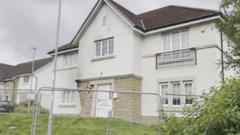
Another car has ploughed into a residential property in a quiet Scottish suburb, and the local news cycle is predictably sleepwalking through the exact same script.
Police cordons go up. Neighbors step outside to tell reporters they thought a bomb went off. Pious columnists pen dreary op-eds about driver distraction, speeding, and the urgent need for local traffic calming measures or bollards. Everyone nods along to the comforting fiction that this was just another isolated accident caused by a motorist's momentary lapse in judgment.
It is a comforting lie. And it is completely wrong.
When vehicles routinely mount curbs and demolish living room brickwork, blaming the person behind the wheel is like blaming the gravity when an overloaded shelf collapses. We are looking at a systemic failure of spatial design, vehicular mass inflation, and municipal cowardice.
The Physics Problem Nobody Wants to Discuss
Let us look at the data governing modern roadways and residential zones. The average weight of consumer passenger vehicles has ballooned drastically over the last two decades. We are no longer putting drivers behind lightweight hatchbacks; we are handing them heavy crossover SUVs and electric tanks with instantaneous torque delivery that outweigh older models by thousands of pounds.
When a driver loses control—whether through medical emergencies, mechanical failure, or simple human error—the kinetic energy transferred into the built environment is exponentially higher than it was thirty years ago.
Standard residential layouts across British suburbs were engineered decades before modern vehicular bloat. Roads are straight enough to encourage speed, yet narrow enough to leave zero margin for error. Combine this with parked cars lining both sides of suburban streets, and you create a claustrophobic funnel.
Yet local authorities respond by sticking up a flimsy 20-mph speed limit sign and calling it safety policy. That is not policy; that is municipal theater. A sign does not alter the laws of momentum when a two-ton vehicle suffers a steering failure or a driver blacks out at the wheel.
The Myth of the Individual Driver Error
The lazy consensus in every local news report relies on treating each car-into-house incident as a unique moral failing of the operator.
Imagine a scenario where dozens of people keep slipping on the exact same patch of untended ice outside a public building. If you respond by lecturing every single victim on their footwear choices instead of salting the pavement, you are incompetent. Yet that is precisely how we treat suburban car crashes.
We treat the built environment as a neutral backdrop where human perfection is mandatory. If a driver makes a mistake, the penalty should ideally be contained within the roadway or absorbed by proper safety infrastructure. Instead, our suburban architecture treats front bedrooms and living room walls as the primary crash barrier for the public highway.
Houses sitting mere yards from active asphalt without physical barriers, deep setbacks, or reinforced masonry are ticking time bombs.
What Real Urban Defense Looks Like
If we are serious about stopping cars from destroying homes, we need to stop relying on driver education campaigns and start redesigning our geography.
First, we need mandatory impact-resistant barriers for properties identified as high-risk nodes—such as those situated at the terminus of long straightaways or T-junctions. Sturdy retaining walls, mature reinforced landscaping beds, and heavy bollards should be standard municipal investments, not homeowner DIY projects.
Second, we need to penalize vehicle weight through taxation and zoning. If a vehicle requires commercial-grade mass, its operation should be restricted or heavily mitigated in dense residential pockets.
Stop accepting the premise that suburban chaos is an unavoidable tax on modern mobility. The cars are not crashing into houses by accident; they are following the precise trajectory of a poorly engineered system that refuses to evolve.
Fix the roads, protect the foundations, and stop blaming the physics on the driver.