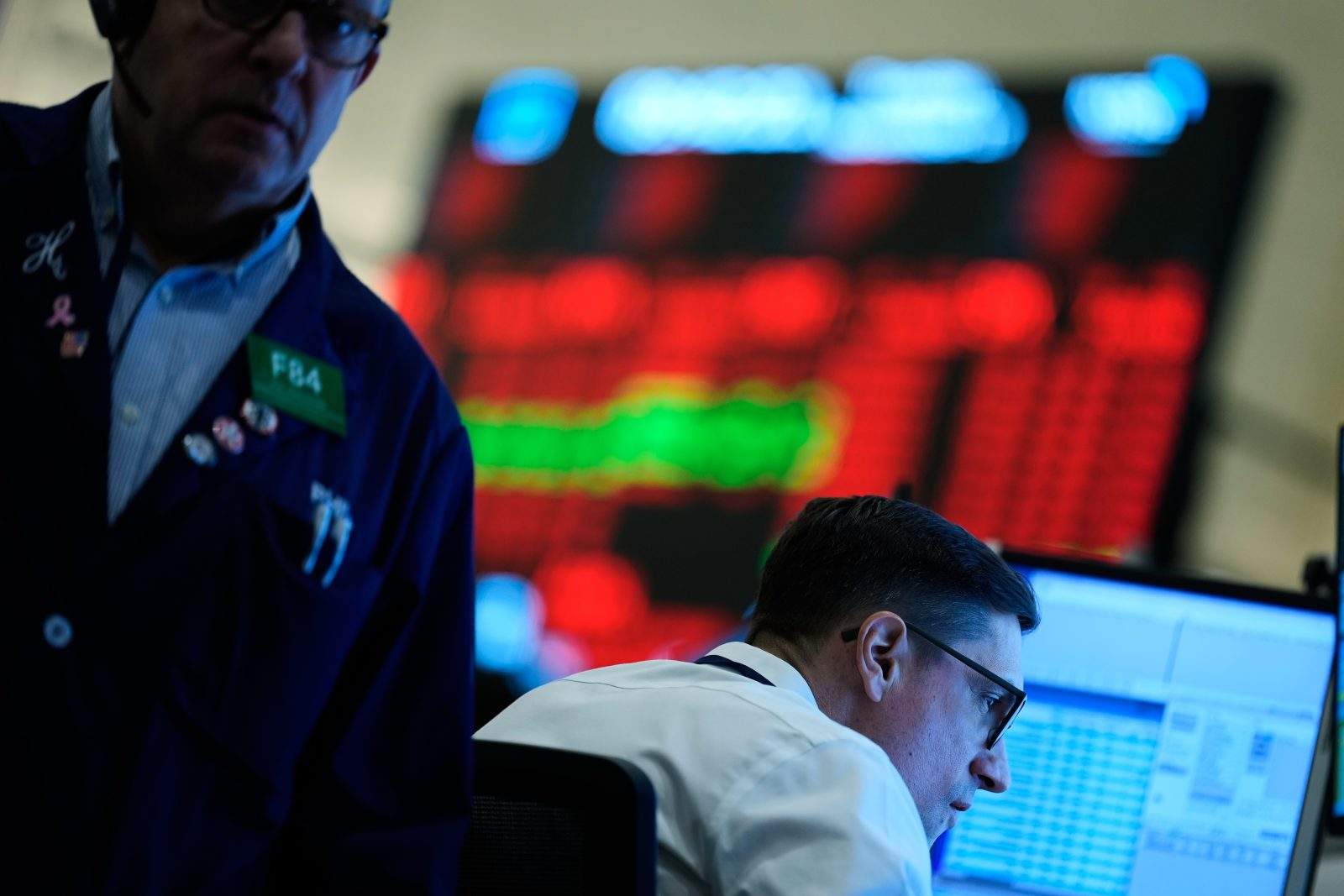
The financial press loves a tidy villain. When the S&P 500 and the Dow Jones Industrial Average slide toward a 10 percent correction, headline writers immediately hunt for a single domino to blame. This week, they pointed straight at Anthropic. A strategic retreat, a delayed model rollout, or a valuation reset at one frontier lab gets framed as an existential crisis for the entire artificial intelligence sector.
That narrative is lazy, comforting, and completely backwards.
If you sell your equities because a single private foundation model company adjusted its roadmap, you are misreading the mechanics of both capital markets and enterprise software. The broad market is not pulling back because artificial intelligence failed. The market is correcting because Wall Street finally realized that foundation models are becoming a commodity, while the real capital expenditures—and the actual profits—are migrating somewhere else entirely.
The Lazy Consensus of Single-Point Failure
Mainstream financial coverage treats the AI trade like a monolithic bloc. In this simplistic view, Nvidia, Microsoft, Alphabet, Meta, and private labs like Anthropic and OpenAI are tied together by an invisible string. When one stumbles, the logic goes, the entire thesis collapses.
This ignores how enterprise technology cycles actually function. I have watched institutional desks dump millions in semiconductor and cloud equities over a single headline about model scaling plateaus, only to buy those exact shares back forty dollars higher six months later. They confuse the health of a single vendor with the viability of an entire compute architecture.
Let’s define what a market correction actually is before panicking. A technical correction is a decline of 10 percent or more from a recent peak. It is a routine, healthy repricing of risk multiples, not a systemic collapse. When the S&P 500 and the Dow pull back after an extended run-up, they are shedding excess speculative leverage. Blaming Anthropic’s internal strategy for a multi-trillion-dollar index adjustment is like blaming a single rainstorm for changing the ocean tide.
The real culprit behind the equity sell-off is basic macroeconomics combined with a brutal reality check on return on invested capital. Interest rate expectations remain sticky, the equity risk premium has compressed to multi-decade lows, and institutional allocators are demanding to see immediate free cash flow from hyperscalers spending tens of billions of dollars per quarter on data centers.
Why Model Retreats Are Bullish for the Broader Market
Here is the nuance the financial pundits missed: a slowdown or retreat at a frontier AI lab is actually good news for the S&P 500.
For the past three years, corporate boards across the Fortune 500 have been paralyzed by capital expenditure anxiety. Every chief information officer faced an impossible dilemma. If they spent fifty million dollars building custom workflows on top of a frontier model today, a newer, cheaper, dramatically smarter model would render that architecture obsolete within six months. That rapid obsolescence froze enterprise adoption. Companies ran endless pilot programs, burned cash on consulting fees, and delayed actual production deployments.
When frontier model progress decelerates, or when a major lab pulls back from brute-force scaling to focus on efficiency and unit economics, that paralysis breaks.
- Software margins recover. Enterprise software companies no longer have to bleed gross margin paying exorbitant token fees to API providers just to keep pace with weekly model releases.
- Integration beats invention. Corporate IT teams can finally build durable, profitable applications on stable architectures without worrying that their entire stack will break next Tuesday.
- Capital rotates down the stack. Investors stop overpaying for speculative foundation labs and start buying the boring, cash-generative businesses that actually deploy automation to cut labor costs and expand operating margins.
Consider a simple thought experiment. Imagine a scenario where frontier AI models stopped improving entirely tomorrow morning. Would the S&P 500 go to zero? No. Businesses already have access to reasoning engines capable of automating massive swaths of legal review, customer support, supply chain logistics, and code generation. A pause in raw capability growth would give the global economy five years just to digest and monetize the technology that already exists.
Dismantling the Wrong Questions
Retail and institutional investors alike are flooding search engines with the wrong questions right now. If you ask flawed questions, you get expensive answers.
Should I sell all my AI stocks during a market correction?
You are treating "AI stocks" as a single asset class, which is a fatal portfolio error. A company designing custom silicon for data centers has completely different unit economics, supply chain constraints, and margin profiles than a legacy software vendor slapping a chatbot onto a CRM dashboard. Selling everything indiscriminately means dumping high-moat infrastructure monopolies alongside overvalued wrapper companies that deserve to go to zero.
Is the AI bubble finally bursting like the dot-com crash?
This comparison fails basic financial literacy. In 1999, the Nasdaq was dominated by unprofitable companies burning venture capital on Super Bowl ads with zero revenue and dial-up infrastructure that barely worked. Today, the companies driving the S&P 500—Alphabet, Microsoft, Amazon, Meta, Nvidia—are among the most profitable cash-generating machines in human history. They are funding their AI capital expenditures out of massive operating cash flows, not junk bonds. Valuations can compress sharply without the underlying businesses being insolvent.
Why does a private company like Anthropic move the Dow Jones Industrial Average?
It doesn’t, except through algorithmic sentiment contagion. High-frequency trading desks scrape financial news feeds for keywords like "AI retreat," "model delay," and "capex cut." When those phrases hit the wire simultaneously, quantitative momentum funds automatically de-risk across correlated technology baskets. The Dow, which is price-weighted rather than market-cap-weighted, experiences exaggerated point swings whenever high-priced tech or industrial components get caught in automated cross-asset selling. You are watching machines react to headlines, not humans evaluating discounted cash flows.
The Brutal Truth About Foundation Model Economics
To understand why Anthropic or any other pure-play lab faces strategic headwinds, you have to look at the unit economics of training and serving large language models.
Training frontier models requires astronomical upfront capital with zero guaranteed intellectual property moat. The moment one lab proves a new architectural breakthrough—whether it is mixture-of-experts routing, reinforcement learning for reasoning, or synthetic data generation—rival labs replicate it within months. Meanwhile, open-weights models from Meta and independent researchers relentlessly drive the price of intelligence toward the marginal cost of electricity and compute.
As Sequoia Capital and various Silicon Valley analysts have repeatedly pointed out, there is a massive gap between the hundreds of billions of dollars spent on AI infrastructure and the actual end-user software revenue generated to pay for it.
Pure-play model labs are trapped in a pincer movement:
- From below: Open-source models offer 90 percent of the performance at a fraction of the inference cost, stripping away pricing power.
- From above: Hyperscalers own the cloud distribution channels, the enterprise customer relationships, and the balance sheets required to subsidize inference at a loss until competitors run out of cash.
When a frontier lab retreats, pivots, or slows down its burn rate, it is not signaling that artificial intelligence is a dead end. It is simply bowing to the laws of microeconomics. You cannot lose money on every API call and make it up on volume forever.
The Contrarian Playbook That Actually Works
If you want to survive—and profit from—a tech-led correction without getting whipsawed by daily financial media hysteria, stop watching foundation lab gossip and reallocate your attention to where money actually changes hands.
1. Audit the Capex Beneficiaries vs. The Capex Payers
Follow the cash flow statement, not the press release. Every dollar a hyperscaler spends on data center expansion is a capital expenditure on their balance sheet, which depresses their near-term free cash flow. That exact same dollar shows up as immediate, high-margin revenue for power grid operators, thermal cooling manufacturers, high-bandwidth memory producers, and specialized semiconductor foundries. During a correction, markets punish the spenders and eventually reward the collectors.
2. Hunt for Margin Expansion in "Boring" Sectors
The biggest winners of the next five years will not be the companies building the models. They will be the traditional logistics firms, healthcare networks, insurance underwriters, and regional banks that use existing models to slash their selling, general, and administrative expenses. Look for non-tech companies in the S&P 500 that are quietly expanding their operating margins by 200 to 400 basis points while keeping headcount flat. That is real AI monetization, and Wall Street rarely prices it in until earnings season forces their hand.
3. Respect the Downsides of Contrarian Positioning
Buying into a correction while headlines scream about an AI retreat carries real, quantifiable risks. Markets can remain irrational and illiquid far longer than an over-leveraged portfolio can stay solvent. If macroeconomic data deteriorates into a genuine recession, corporate IT budgets will get frozen across the board—meaning even the highest-moat infrastructure providers will see order cancellations and multiple compression. Never deploy capital all at once into a falling knife, and never confuse a cyclical pullback with a guaranteed immediate V-shaped recovery.
The Illusion of the Safe Sidelines
Investors love waiting for "clarity" before committing capital. They want the S&P 500 to stabilize, the Dow to reclaim its moving averages, and every AI lab to publish triumphant benchmark scores before they buy back in.
By the time clarity arrives, the upside is already gone. Markets are forward-looking discounting mechanisms; they price in the recovery months before the headlines turn positive.
The current drawdown is doing exactly what corrections are designed to do: transferring shares from weak, headline-driven hands to disciplined allocators who understand the difference between a lab's strategic pivot and an industrial revolution's inevitable trajectory.
Turn off the financial news ticker, stop treating private AI labs as macro indicators, and start buying cash flows while everyone else is panicking over shadows.