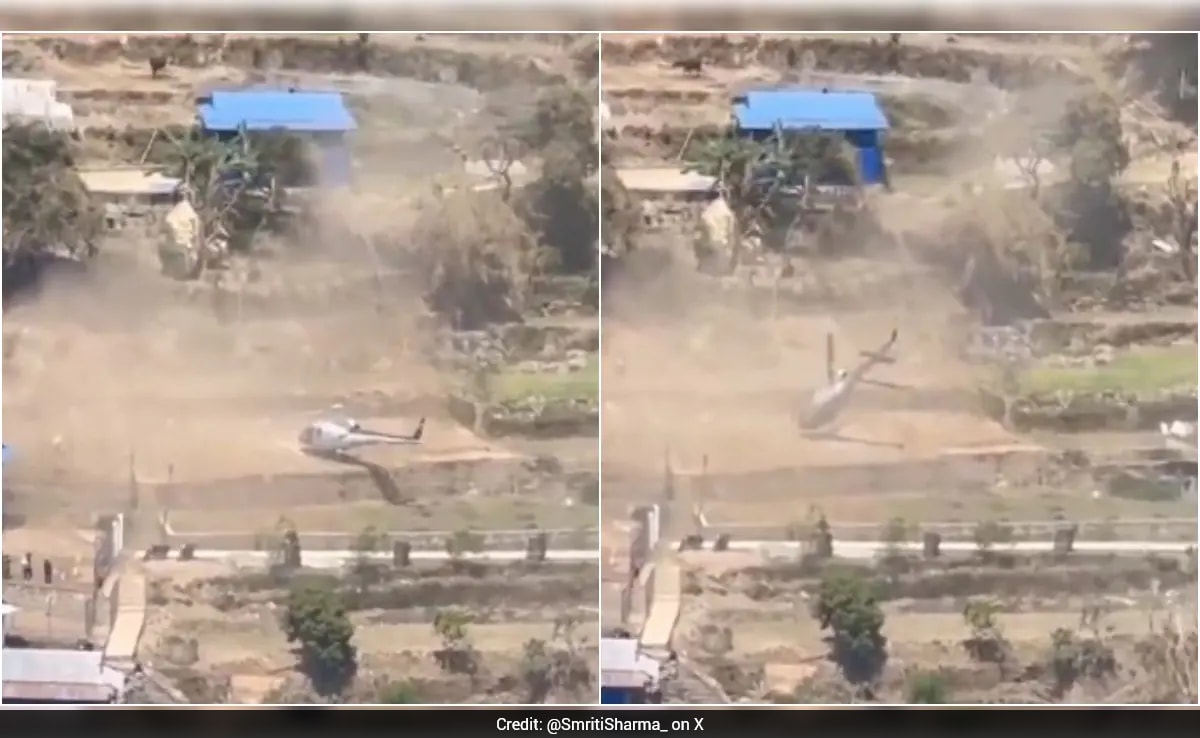
You think you're safe when you're only a few feet off the ground. Most people do. In a car, a low-speed bump at a parking lot pace usually results in a dented fender and a spike in insurance premiums. In a helicopter, being inches from the dirt doesn't grant you a safety net. It actually puts you in one of the most volatile environments a pilot can face. When a chopper loses control just before touchdown or right after liftoff, physics takes over with a violence that defies the relatively low altitude.
Recently captured footage of a helicopter spinning out of control just moments before it was supposed to be stable shows exactly how fast things go south. One second, the skids are hovering over the landing zone. The next, the tail rotor loses authority or a gust of wind catches the airframe, and the machine becomes a multi-ton top. It’s terrifying to watch because it happens in a space we perceive as manageable. It isn't.
Why Ground Effect Isn't Always Your Friend
When a helicopter hovers close to a flat surface, it benefits from something called "ground effect." Basically, the air pushed down by the main rotors hits the ground and creates a cushion of high-pressure air. It makes hovering easier because the engine doesn't have to work as hard to stay aloft.
But this cushion is fickle. If the ground is uneven, or if the pilot transitions too quickly, that stable bubble of air vanishes. You're left with a massive imbalance of torque. If the tail rotor—the part responsible for keeping the nose pointed straight—fails or loses its bite on the air, the entire fuselage starts spinning in the opposite direction of the main blades. This is "loss of tail rotor effectiveness," and at low altitudes, there’s almost zero time to correct it.
The Dynamics of a Low Altitude Roll
In many of these "horrifying" videos circulating online, you'll see the helicopter start to pivot. It looks almost slow at first. Then, the rotation accelerates. The pilot often tries to compensate by pulling "collective"—basically asking for more lift—but if the tail isn't holding, more lift just means more torque. The spin gets tighter.
Once the skids catch the ground while the helicopter is still moving sideways or rotating, it’s game over. This is known as "dynamic rollover." A helicopter doesn't just tip over like a tricycle. It pivots on one skid until the lift vector of the rotor disc forces the machine to slam into the ground. At this point, the main rotor blades hit the dirt.
When a blade spinning at several hundred RPM hits a solid object, it doesn't just stop. It disintegrates. Shrapnel flies in every direction at supersonic speeds. The transmission often rips out of its mounts. The engine, still trying to provide power, can shred itself in milliseconds. This is why bystanders and ground crews are at such immense risk during what looks like a simple landing.
Human Error and the Myth of the Easy Landing
We often blame mechanical failure because it’s easier to stomach, but the NTSB and international aviation bodies like the CAA consistently find that "pilot involved" factors lead the charts. Fatigue, "get-home-itis," and simple over-control are killers.
I’ve seen seasoned pilots get complacent during the last ten feet of a flight. You're tired. You’ve been in the air for three hours. The landing pad is right there. You relax your feet on the pedals. That’s exactly when a crosswind gust or a thermal shift hits. If you aren't "ahead of the aircraft," the machine starts a yaw that you can't catch.
There's also the issue of "vortex ring state" if a pilot descends too vertically into their own downwash. The helicopter essentially falls into its own turbulent air. It loses lift, the pilot panics and adds power, which only makes the turbulence worse. You drop like a stone. If you're 5,000 feet up, you can fly out of it. If you're 20 feet up, you're going to hit the ground hard.
Survivor Reality vs Viral Spectacle
When you watch these crash videos, the "horror" isn't just the impact. It's the aftermath. Modern helicopters are built with crashworthy seats and fuel systems designed to prevent post-impact fires, but they aren't tanks. The sheer G-forces involved in a sudden stop or a roll can cause internal injuries that aren't immediately visible.
Safety investigators look at the "smear" of the debris field. If the blades are shattered into tiny pieces, the engine was producing high power at impact. If the blades are relatively intact but bent, the pilot might have managed to cut power, or the engine failed earlier. These details matter for future safety regulations, but they don't change the trauma for those inside.
What Actually Happens to the Airframe
The physics of a crash are brutal.
- The tail boom usually snaps first due to the centrifugal force of the spin.
- The main rotor mast undergoes extreme "mast bumping" or sheer stress.
- Fuel lines, even "self-sealing" ones, can be compromised if the airframe twists beyond its structural limits.
- The cockpit becomes a cage of flying glass and vibrating metal.
People think "it's only a few feet, they'll be fine." They forget that a helicopter is essentially a giant engine sitting on top of a fuel tank, held together by a "Jesus nut" (the nut that holds the rotor head to the mast). When that system loses its equilibrium near the ground, the energy has nowhere to go but into the occupants and the pavement.
Staying Safe Around Active Helipads
If you're ever in a position where you're near a landing helicopter—maybe at a hospital, a news event, or a tour—stop filming for a second and look at your surroundings.
- Never approach a helicopter until the blades have completely stopped spinning.
- Stay at least 100 feet away unless you are part of the crew.
- Watch for the "tail rotor" especially; it’s nearly invisible when spinning and is the most dangerous part of the machine on the ground.
- If you see a helicopter start to wobble or spin, run in the opposite direction, not toward it to get a better angle.
The video of this recent crash serves as a grim reminder that aviation is an unforgiving environment. It doesn't matter if you're at 30,000 feet or 30 inches. The moment you stop respecting the physics of torque and lift, the machine will remind you why it belongs in the sky and not on the ground in pieces.