You can taste the fire before you see it.
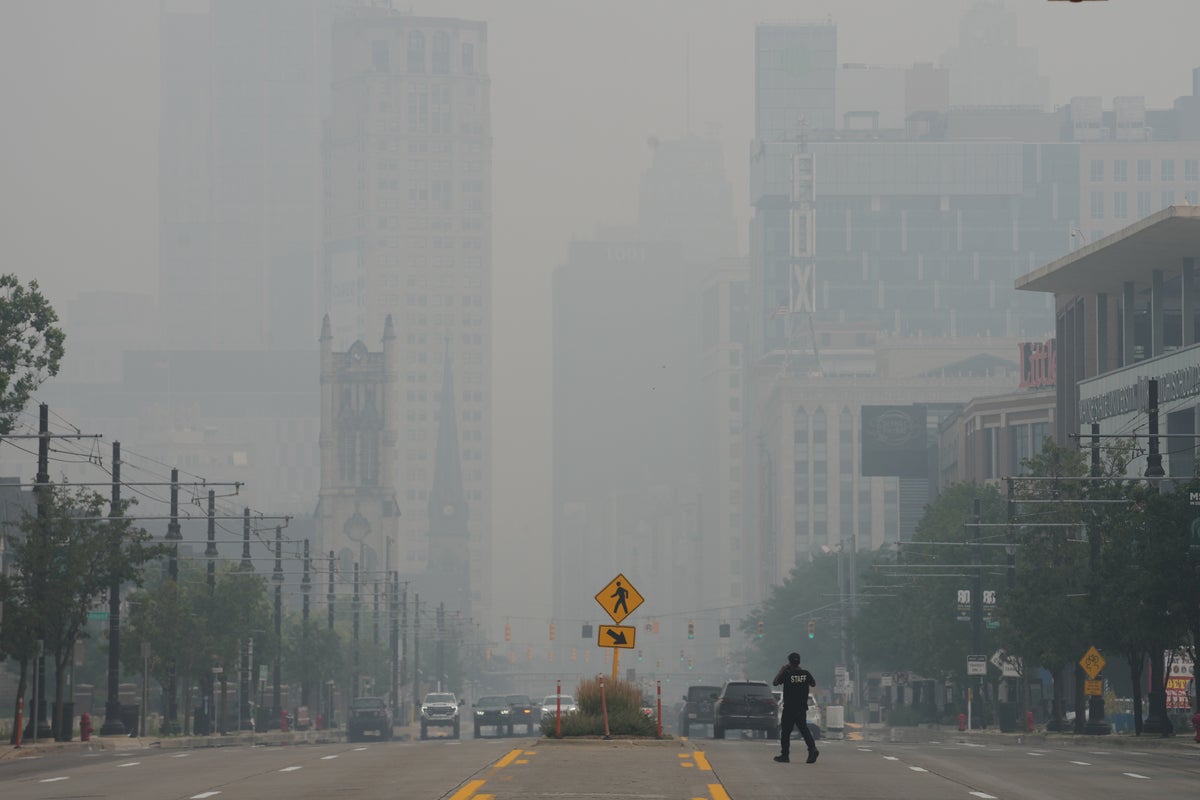
It starts as a faint, metallic tang on the back of the tongue—like pennies resting in a copper cup. Then, the sky begins to change. The vibrant summer blue of a Michigan morning fades into a bruised, copper-colored twilight. The sun, usually a brilliant gold over the Great Lakes, shrinks into a swollen, blood-red marble.
For the third time in four years, the northern horizon has delivered an unwelcome gift. Hundreds of forest fires raging across northern Ontario have sent their heavy, suffocating calling card south. By mid-July, the smoke has drifted across the Detroit River, rolled over the Mackinac Bridge, and settled deep into the lungs of millions of Americans.
Imagine a grandfather in Grand Rapids—let’s call him Robert. He is seventy-two, a retired machinist who spent his life on his feet. He has moderate COPD, a condition he manages with quiet discipline. He used to sit on his front porch to watch the evening light. Now, he stays indoors, the windows tightly sealed, listening to the low, monotonous hum of an air purifier working overtime. Even inside, his chest feels heavy, as if a wet wool blanket is draped over his sternum. He is not alone. In Detroit, the air quality index has spiked past hazardous thresholds, briefly crowning the city with the worst air quality in the entire world.
The invisible particulate matter, known to scientists as PM2.5, is so small that it bypasses the body's natural defense mechanisms, entering the bloodstream directly. It does not care about national borders. It does not respect sovereignty. It simply drifts.
The Broken Promise of the North
This is not a sudden, unpredictable act of nature. It is a recurring pattern, a seasonal tragedy that has transformed from an anomaly into an annual expectation. The anger bubbling up from Michigan’s congressional delegation is not born from a single bad week of weather. It is the culmination of years of patience turned to ash.
On a Wednesday evening, a collective line was crossed. Republican Representatives Jack Bergman, John James, Lisa McClain, and John Moolenaar sent a sharply worded joint letter directly to Canadian Prime Minister Mark Carney. The diplomatic politeness that typically governs relations between the neighboring nations was conspicuously absent.
"We are done accepting apologies in place of action," the lawmakers wrote, their words carrying the weight of a constituency that is tired of breathing other people's negligence.
To understand the fury, you have to look back to the promises of the previous seasons. In 2023 and again in 2025, when the smoke first turned American skies into a post-apocalyptic orange, there were assurances. The Canadian government offered diplomatic regrets and pledges of reform. There were vows to address the root causes of these runaway blazes: chronic under-investment in forest thinning, a lack of controlled burns, and inadequate enforcement against arson.
But when the wind shifted this summer, the reality became impossible to ignore. The promises had not been kept. The forests remained unmanaged, a massive tinderbox waiting for a spark.
A Question of Sovereignty
For generations, the relationship between the United States and Canada has been one of quiet cooperation. We share the longest undefended border in the world. We share trade, culture, and ecosystems. But the current crisis has exposed a fundamental friction in the concept of national borders.
If a factory in Ontario were dumping toxic sludge directly into Lake Huron, polluting Michigan's drinking water, the legal and diplomatic response would be swift and severe. Yet, because the pollution is airborne, and because the source is forest management rather than industrial runoff, the response has been slow, bogged down by bureaucratic hand-wringing.
The Michigan lawmakers framed the issue not as an environmental accident, but as a failure of basic state responsibility.
"Sovereignty comes with responsibility, and the responsibility to prevent a foreseeable disaster from crossing into another country’s airspace has not been met," the letter argued.
It is a provocative legal and philosophical point. At what point does one nation's internal policy—or lack thereof—become an act of aggression against its neighbor's public health? When a state’s hospitals are filled with children and dialysis patients suffering from smoke that originated hundreds of miles away, the abstract concept of foreign policy suddenly becomes intensely personal.
When Neighbors Disagree on the Danger
The reaction to the crisis is not uniform, exposing a divide in how the two nations view the emergency. While the congressional delegation took a combative stance, U.S. Ambassador to Canada Pete Hoekstra—who calls Michigan his home state—offered a more traditional diplomatic tone, praising the long-standing cooperation between American and Canadian firefighting agencies.
But to the person who has to cancel an outdoor wedding, or the farmer watching the hazy sky and wondering how the diffused sunlight will affect the photosynthesis of their corn crops, diplomatic pleasantries feel incredibly hollow.
Consider what happens next if the status quo remains unchanged. The Michigan delegation has already floated a radical alternative: if Ottawa will not or cannot manage its forests, the United States may explore direct, cross-border intervention. This could mean American forest management agencies crossing the border to perform fuel reduction and prescribed burns on Canadian soil. It is an extraordinary proposition, one that would have been unthinkable just a few years ago.
But desperate times breed desperate measures. When the simple act of taking a deep breath becomes a health hazard, the old rules of diplomacy begin to burn away.
The skies will eventually clear. The wind will shift, pushing the grey plumes away from the Great Lakes. But the trust has been damaged, and unlike the smoke, it will not easily dissipate. The true cost of the northern wildfires is measured not just in scorched acres of timber, but in the slow erosion of a historic friendship, one labored breath at a time.