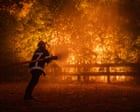
Ash does not fall like snow. Snow has a gentle architecture, a quiet drifting quality that suggests winter is a blanket meant to keep the earth warm. Ash is aggressive. It is the ghost of a pine tree, the skeleton of a summer cottage, the pulverized memory of a hillside that took centuries to grow and minutes to vanish.
When the wind shifted over the pine forests of southwestern France, the air turned the color of a bruised peach.
In Bordeaux, seventy miles from the jagged front lines of the firestorms, people stepped outside onto their balconies and blinked against the grit stinging their eyes. They tasted charcoal before they saw the flames. By then, the statistics were already racing ahead of the trucks. More than three hundred thousand souls had packed what they could carry into the trunks of hatchbacks and onto the seats of bicycles, joining a silent, bumper-to-bumper exodus across a continent that was beginning to feel remarkably fragile.
Pedro Sánchez stood before the cameras in Madrid, his face carved from exhaustion. Difficult hours lie ahead, he said.
That was an understatement.
To understand what happened in France and Spain that summer, you have to forget the television screens that flatten catastrophe into a ten-second weather update. You have to imagine standing in a kitchen in the Landes department, watching the amber light pulse against your living room wall.
Imagine you are Elena, a thirty-eight-year-old teacher who has lived her entire life beneath the comforting green canopy of Europe’s largest man-made forest. The pines here were planted two centuries ago to tame the coastal dunes. They were meant to protect. They were meant to endure. But wood remembers the sun. It stores the dry, blistering heat of successive summers, locking away energy until a single spark—a discarded glass bottle, a hot catalytic converter, a stroke of lightning—turns a reservoir of life into an engine of destruction.
When the evacuation order came through her phone at 3:00 AM, it didn't sound like music. It was a shrill, mechanical shriek that cut through the silence of the dark house.
Two suitcases. That was the mathematical limit of a life.
Photographs of her grandmother, baptism certificates, three favorite sweaters, and a sack of dry cat food. Everything else—the wooden dining table where her family argued about politics, the bookshelves filled with worn paperbacks, the balcony overlooking the garden she had spent five years weeding—was left behind to the mercy of the wind.
The wind is the wild card. It has no allegiance.
Meteorologists call it a dry convective draft. Firefighters call it a monster. When fires of this magnitude grow large enough, they create their own weather systems. They pull oxygen in from miles around with the force of a hurricane, heating the air so intensely that towering columns of fire-infused clouds, known as pyrocumulonimbus, rise six miles into the stratosphere.
Fire breeds lightning. Lightning starts new fires. It is a closed loop of fury.
Across the border in Spain's Extremadura and Andalusia regions, the earth was already baked to the consistency of terracotta. Reservoirs that had sustained olive groves for generations were shrinking into cracked, white-rimmed puddles. Cattle stood listlessly under the sparse shade of stunted oaks, their flanks caked in dust.
When the flames descended from the hills toward the whitewashed villages, the local firefighters—augmented by hundreds of international crews flying in from Germany, Romania, and Poland—faced a wall of heat so intense it melted the rubber tires on their water tenders.
Consider the mechanics of containment. People often imagine firefighters as heroes standing shoulder-to-shoulder with hoses, spraying water directly into the teeth of a giant.
The reality is far more clinical, and far more desperate.
You do not put out a fire of three hundred thousand acres with water. You starve it. Bulldozers tear through ancient woods to carve massive firebreaks, stripping the earth of every leaf, twig, and root down to bare sand and rock. Controlled counter-fires are set, burning fuel ahead of the main beast so that when the wildfire arrives, it hits a sterile vacuum of nothingness and dies of starvation.
It is a scorched-earth defense. To save the forest, parts of it must be intentionally destroyed.
For Elena, stuck on the clogged toll highway heading north toward Bordeaux, the logic of the firebreak offered little comfort. She watched the horizon glow a violent, unnatural crimson through the rear window of her compact car. Beside her, her tabby cat mewed frantically from inside a cardboard carrier, smelling the panic in the sweat and the exhaust fumes.
Traffic crawled at walking speed. For miles, the highway looked like a migration of refugees from a medieval conflict, except everyone was wearing designer sunglasses and listening to real-time traffic updates on FM radio. The juxtaposition of modern comfort and ancient terror is one of the defining signatures of our era. We flee climate collapse in air-conditioned sedans, sipping bottled water, listening to anxious anchors report on the destruction of the very landscapes that nurtured us.
By the fourth day, the smoke reached Paris.
Tourists outside the Louvre squinted at the veiled sun, coughing slightly into their scarves, wondering why the city smelled faintly of a burning campfire. They were hundreds of miles away from the front lines, yet they were breathing the carbon of French pine trees and Spanish scrubland.
We are never as isolated as we think. The atmosphere does not respect municipal boundaries or national borders.
When the wind finally died down on the fifth night, it didn't feel like a victory. It felt like a suspension of sentence.
The rain, when it finally came, was thin and hesitant, turning the newly laid ash into a slick, black paste that coated the roads, the cars, and the remaining blackened toothpicks of what used to be a magnificent forest.
Elena returned home three days later.
Her house was still standing, miraculously spared by a last-minute shift in the wind that diverted the wall of flame fifty yards to the east. But the forest behind her garden was gone. The emerald wall that had sheltered her kitchen from the road, the canopy that had shaded her mornings, the habitat of the red squirrels and the wild boars—all of it had been reduced to a vast, charcoal graveyard stretching to the horizon.
She walked out onto her back patio. The air still smelled of burnt hair and damp earth. She looked down at her garden pots. The geraniums were coated in a fine layer of gray dust, their bright red petals choked by the grit of a changing world.
She reached out, touched a leaf, and wiped the ash away. Beneath the gray, the green was still there. Fragile. Stained. But alive.
The difficult hours were over.
The hard decades were just beginning.