The water in the ring is so still it looks like solid steel.
If you stand on the shore of René-Levasseur Island in Quebec, the silence is heavy enough to press against your eardrums. There are no oceans roaring here. No rushing rivers. Just a massive, circular moat of deep water surrounding a central island, a geometric perfection that feels unsettlingly unnatural in the middle of the Canadian wilderness.
Geologists call it Lake Manicouagan. Astronauts call it the "eye of Quebec."
But to stand there is to realize something much simpler. You are looking at a scar.
About 214 million years ago, a chunk of space rock roughly three miles wide slammed into the crust of our planet. The impact did not just dig a hole. It vaporized mountains. It turned solid granite into liquid glass in a fraction of a second. The shockwave radiated outward, shattering the bedrock, creating a wound so deep and violent that, eons later, when the glaciers melted and the rains came, the water had no choice but to fill the emptiness left behind.
We tend to look at lakes as symbols of peace. We build cabins beside them. We take our children to swim in them. We seek them out to escape the noise of our fragile, chaotic human lives. Yet scattered across the face of our planet are bodies of water born from unimaginable, apocalyptic violence. They are the places where the sky broke through our atmosphere and redefined the geography of Earth forever.
To understand these waters is to understand our own profound vulnerability.
The Twin Scars of the North
Travel northwest from Quebec, deep into the subarctic wilderness of southwestern Nunavik, and the narrative of violence repeats itself. Only this time, it is a double feature.
The Clearwater Lakes—known natively as Wiyâshâkimî—are two massive bodies of water separated by a dotted line of islands. For decades, scientists looked at them and assumed they were twins born of a single moment. The theory was poetic: a massive asteroid, split in two by the agonizing friction of our atmosphere, striking the earth in a synchronized, devastating duet.
It is a beautiful story. It is also wrong.
Recent radioactive dating of the impacted rocks revealed a truth that is far more haunting. The larger western lake was formed by an impact roughly 286 million years ago. The smaller eastern lake? It was gouged into the earth 12 million years later.
Think about the sheer statistical impossibility of that reality. Imagine a dartboard. Someone throws a dart, hitting a specific millimeter on the board. Then, they wait 12 million years, throw another dart, and hit the exact same spot.
Standing on the rocky outcrops of the Clearwater Lakes, looking out over the twin expanses of dark, cold water, the narrative shifts from a singular historical fluke to an ongoing cosmic lottery. The islands in the center of the western lake are not just scenic vistas; they are the central uplifts of the crater, the places where the compressed earth rebounded violently upward after the impact, like water splashing upward when a pebble is dropped into a puddle. Except here, the pebble was a mountain, and the splash froze into solid rock.
The Secret in the Bavarian Woods
Not every cosmic wound remains wild. In Germany, humans did what humans always do: they built a home inside the wreckage.
If you drive through western Bavaria, you will eventually find yourself descending into a wide, fertile depression known as the Nördlinger Ries. It is a lush basin, dotted with red-roofed villages, ancient church spires, and neat patches of farmland. It feels quintessentially European, peaceful, and deeply rooted in history.
But if you look closely at the walls of the medieval buildings in the town of Nördlingen, you will notice something strange. Under the morning sun, the stone walls sparkle.
The town is built out of suevite, a rare type of rock formed only under the extreme heat and pressure of a meteorite impact. When a one-kilometer-wide asteroid struck this region 15 million years ago, the heat was so intense that it instantly pressurized local graphite deposits. It created millions of microscopic diamonds. The local church, St. Georgskirche, contains an estimated 72,000 carats of diamonds embedded directly into its walls.
The people of Nördlingen lived inside a 26-kilometer-wide impact crater for centuries without ever knowing it. They thought the crater walls were just a natural ring of hills. It wasn't until 1960 that American geologists Eugene Shoemaker and Edward Chao proved that the basin wasn't volcanic, but cosmic.
Today, the water that once filled the Ries crater as a massive prehistoric lake has mostly drained away, leaving behind a fertile plain. But the legacy of the water remains in the rich soil that feeds the region, a direct gift from a disaster that occurred millions of years before the first human stepped foot on the continent.
The Blue Eye of Ghana
Deep within the Ashanti region of Ghana, the jungle parts to reveal a body of water that feels almost sacred.
Lake Bosumtwi.
It is a nearly perfect circle, roughly eight kilometers in diameter, enclosed by lush, steep hills that rise like the walls of a stadium. Because the lake has no natural inlets or outlets, it is fed entirely by rainfall. The water is pristine, calm, and terrifyingly deep.
For the Ashanti people, Bosumtwi is not a geological curiosity. It is the home of Asase Ya, the earth goddess, and the place where the souls of the dead come to say goodbye. Because of its sacred status, traditional laws strictly forbid touching the water with iron or using modern boats. To fish or travel across its surface, locals use the padua, a simple plank of wood paddled with the hands.
Science tells us that Lake Bosumtwi was formed just over a million years ago when a meteorite smashed into the dense rainforest canopy. The impact was so severe that it ejected glassy debris all the way across the continent, chunks of which have been found deep in the Indian Ocean.
There is a striking contrast at the edge of Bosumtwi. On one hand, you have the rigorous, clinical language of geology—kinetic energy, shock metamorphism, treading tektites. On the other, you have the quiet splash of a hand paddling a wooden plank across a mirror of water, keeping a sacred covenant with the spirits of the ancestors. Both narratives are trying to make sense of the same thing: an encounter with a force that came from somewhere beyond our understanding.
The Dark Waters of Lonar
The basalt rock of the Deccan Plateau in India is some of the hardest, most stubborn stone on Earth. It was formed by ancient, massive volcanic eruptions that coated the landscape in layers of dense, dark rock.
Then came the traveler.
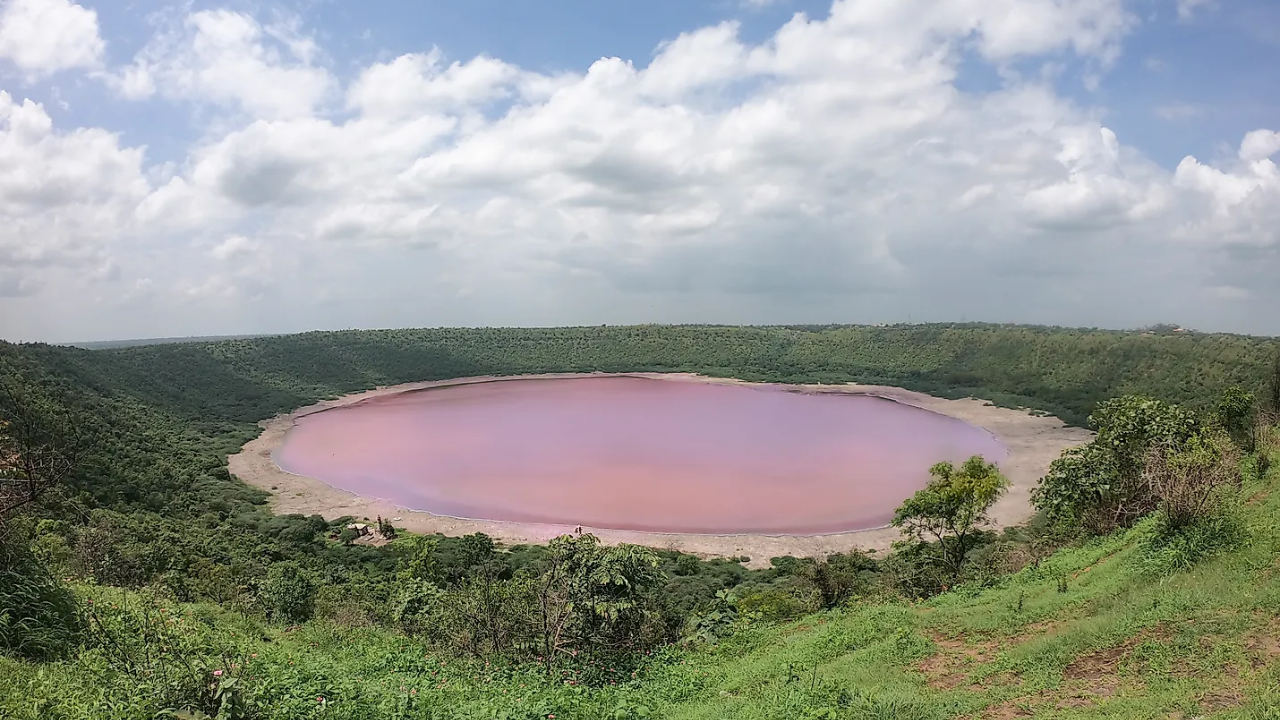
Sometime around 50,000 years ago—a mere blink in geological time—a meteorite traveling at roughly 90,000 kilometers per hour slammed into this basalt shield. The result was Lonar Lake.
Lonar is unique because it is one of the very few high-velocity impact craters formed entirely in basaltic rock anywhere on Earth. Because of this, scientists use it as a stand-in for the surface of Mars or the Moon, studying its chemistry to understand how impacts alter the geology of other worlds.
But if you walk down the steep, jungle-choked walls of the crater today, the science feels secondary to the sheer, eerie atmosphere of the place. The lake water is highly alkaline and saline. It smells of sulfur and minerals. Because of the unique chemical composition, certain types of blue-green algae thrive here, occasionally turning the entire lake a vibrant, shocking shade of pink overnight.
Surrounding the water are the ruins of temples built nearly a thousand years ago, their carved stone pillars slowly sinking into the mud. It feels like a place where time has stalled. The water shouldn't be here; it exists only because the basalt shield was broken by an intruder from deep space.
The Arctic Mirror
To find the purest record of our planet’s cosmic history, you have to go to the extreme edge of the world.
El'gygytgyn Lake sits inside the Arctic Circle in northeastern Siberia. The name translates from the Chukchi language to "White Lake," a nod to the fact that its surface remains frozen for most of the year.
Three. Point. Six. Million. Years.
That is how long the water in El'gygytgyn has been collecting secrets. Unlike most lakes in the northern hemisphere, El'gygytgyn was never scoured clean by glaciers during the ice ages. The impact crater formed a deep, protected bowl that successfully resisted the grinding ice sheets.
Because it survived, the sediment at the bottom of the lake is an unbroken, pristine record of the Arctic climate stretching back millions of years. When scientists drilled into the lake bed, they pulled up core samples that acted like a historical library, revealing exactly how the earth transitioned from a warm, forested Arctic to the frozen wasteland we know today.
It is a lonely place. The wind howls across the gray water, and the horizon stretches out into empty tundra for hundreds of miles. It is dangerous to travel here, and even more dangerous to stay. Yet, it is this very isolation that preserved the crater, turning a ancient scar into the ultimate time capsule of our planet’s survival.
The Quiet Reality of the Horizon
We live our lives on a surface that feels permanent. We build roads, we map borders, and we assume the dirt beneath our boots has always been exactly where it is.
But these seven lakes tell a different story.
They remind us that the earth is not an isolated island floating through a void. It is part of a crowded, kinetic neighborhood. Every drop of water sitting in the ring of Lake Manicouagan, every sparkle of diamond in the walls of a Bavarian church, and every handful of ancient mud drawn from the depths of Siberia is a reminder of a moment when the barrier between the earth and the deep unknown dissolved.
The next time you look at a map, look closer at the circles. Look at the perfectly round bays, the unusual ring-shaped islands, and the deep, landlocked basins that don't seem to fit the landscape around them.
They are not just beautiful places to visit. They are the footprints of giants, filled with water, waiting for us to notice them.