Hong Kong mass media loves a good "convenience" story. They see a new high-speed rail link and instantly churn out identical narratives about how a six-hour train ride from West Kowloon to Zhangjiajie is a massive win for local travelers. They talk about the Avatar mountains. They praise the lack of airport security lines. They paint a picture of effortless, romantic transit across the mainland.
It is a lie. Or, at best, a massive coping mechanism for people who do not understand the true cost of their own time.
The lazy consensus is that sitting on a train for six hours to see overcrowded glass bridges is a smart, budget-friendly holiday. The reality? You are paying a premium in time, sanity, and actual cash to participate in a manufactured tourism bubble that peaked five years ago.
Let us break down why this six-hour train obsession is a symptom of broken travel logic, and what you should actually do instead.
The Fraud of the Six-Hour Timeline
The biggest trick the tourism boards pulled was convincing you that a six-hour train ride takes six hours.
It does not. Anyone who actually manages logistics knows about the hidden friction points of the High-Speed Rail (HSR) network.
- The West Kowloon Buffer: You need to clear co-location customs. That means arriving 45 to 60 minutes early.
- The Station-to-Park Chasm: Zhangjiajie West Station is not inside the scenic area. You need to grab a taxi or bus, navigate local traffic, and head to Wulingyuan or downtown. Add another 45 minutes.
- The Queue Bottleneck: Once you arrive, you do not just walk onto a mountain. You wait for cable cars, elevators, and shuttle buses alongside thousands of tour groups wearing identical neon hats.
By the time you actually look at a sandstone pillar, your six-hour journey has morphed into a ten-hour endurance test.
Compare this to a flight. A direct flight from Hong Kong to Changsha takes roughly two hours. Even with airport wait times, you are ahead. From Changsha, you can take a shorter, internal train or hire a private driver. Yet, travelers stubbornly flock to the direct train because it requires zero critical thinking. They mistake a lack of transfers for efficiency.
The Avatar Premium: You Are Buying Marketing, Not Nature
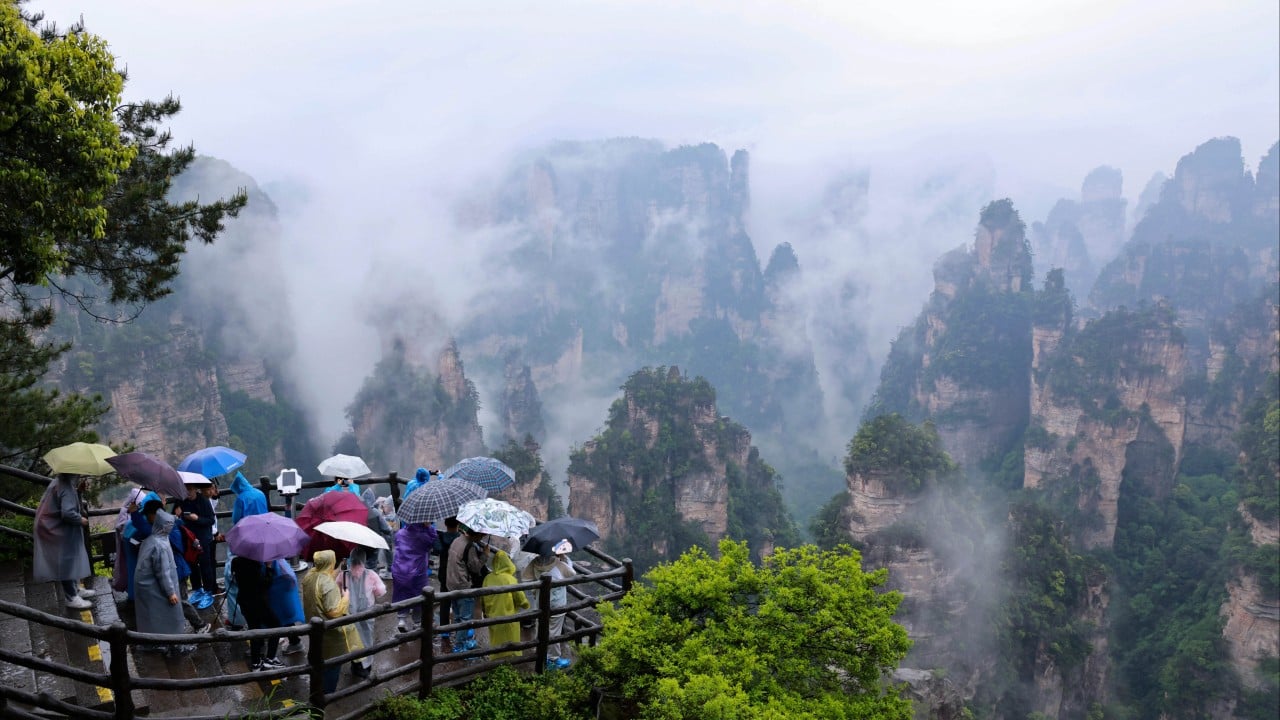
Let us address the elephant in the Hunan province: those towering quartz-sandstone pillars. Yes, they inspired the floating mountains in Hollywood. No, that does not justify the absurd premium you pay to see them.
Zhangjiajie has become a hyper-commercialized theme park mimicking nature. It is the Disneyland of geology. Every square inch of the main scenic areas—Yuanjiajie and Tianmen Mountain—is designed to funnel human traffic through gift shops, overpriced snack stalls, and designated selfie spots.
You are not experiencing the wilderness. You are experiencing crowd control.
If you want sheer scale, Yunnan and Sichuan offer vast, untouched landscapes without the scripted infrastructure. If you want jagged peaks without the Disney-fication, the karst topography around Guilin and Yangshuo is accessible in half the time. Traveling six hours to stand shoulder-to-shoulder on a glass bridge just to prove you went where the movie was made is the definition of basic travel.
The Opportunity Cost Matrix
To understand why this choice fails, look at the math.
Assume the average young professional in Hong Kong makes a decent daily wage. Time is your most scarce asset. When you dedicate two full days of a four-day long weekend solely to sitting in a train seat and staring at the back of someone else's head, you are bankrupting your holiday before it starts.
| Metric | The Direct HSR Route | The Regional Flight Alternative |
|---|---|---|
| Active Transit Time | 7.5+ hours (door-to-door) | 4.5 hours (door-to-door via Changsha) |
| Physical Fatigue | High (static sitting, station crowds) | Medium (dynamic movement through airports) |
| Flexibility | Zero (locked into rigid train schedules) | High (multiple flight and connection options) |
| Cost Efficiency | Low (when calculating lost vacation hours) | High (maximizes on-ground destination time) |
I have seen people plan these trips down to the minute, convinced they are saving money because a train ticket looks cheaper on paper than an airline seat. They ignore the cost of train station food, the premium paid for hotels near the transit hubs, and the sheer mental exhaustion that requires a full day of recovery once they return to Hong Kong.
Dismantling the PAA Assumptions
If you look at standard travel forums, the questions people ask expose their flawed premises.
"Is the high-speed train more comfortable than flying?"
Only if you enjoy zero legroom adjustment and the constant soundtrack of short-video apps playing on speakerphone. The idea that HSR is a luxury experience is a myth kept alive by people who have never flown premium economy. Second-class rail seats are narrow, the cabins are loud, and there is no escape from the chaotic energy of multi-generational tour groups.
"Can I see Zhangjiajie in a weekend?"
Absolutely not. If you take the Friday afternoon train and return Monday morning, you have exactly one full day on the ground. Because the scenic areas are massive and require multiple bus and elevator transfers to navigate, one day means you will see about 15% of the park—the most crowded 15%. You are spending 12 to 14 hours in transit for 6 hours of actual sightseeing. That is not a holiday; it is a grueling commute with a view.
The Counter-Intuitive Alternative: Go Where the Crowds Aren't
If you insist on taking the high-speed rail north from Hong Kong, stop getting off at the hype stations.
Instead of following the herd to Zhangjiajie, drop off earlier. Explore the old towns of western Hunan that the mass tour groups skip, or head straight into the lesser-known valleys of Guizhou. The infrastructure is just as modern, the transit times are shorter, and you can actually hear the wind through the trees instead of a tour guide shouting into a megaphone.
Stop letting viral social media videos and lazy travel journalism dictate your annual leave. A six-hour train ride is not a badge of honor. It is a logistical compromise that yields a sub-par experience.
Book a flight, choose a destination that doesn't rely on a Hollywood tie-in, and stop treating your vacation days like cheap currency.