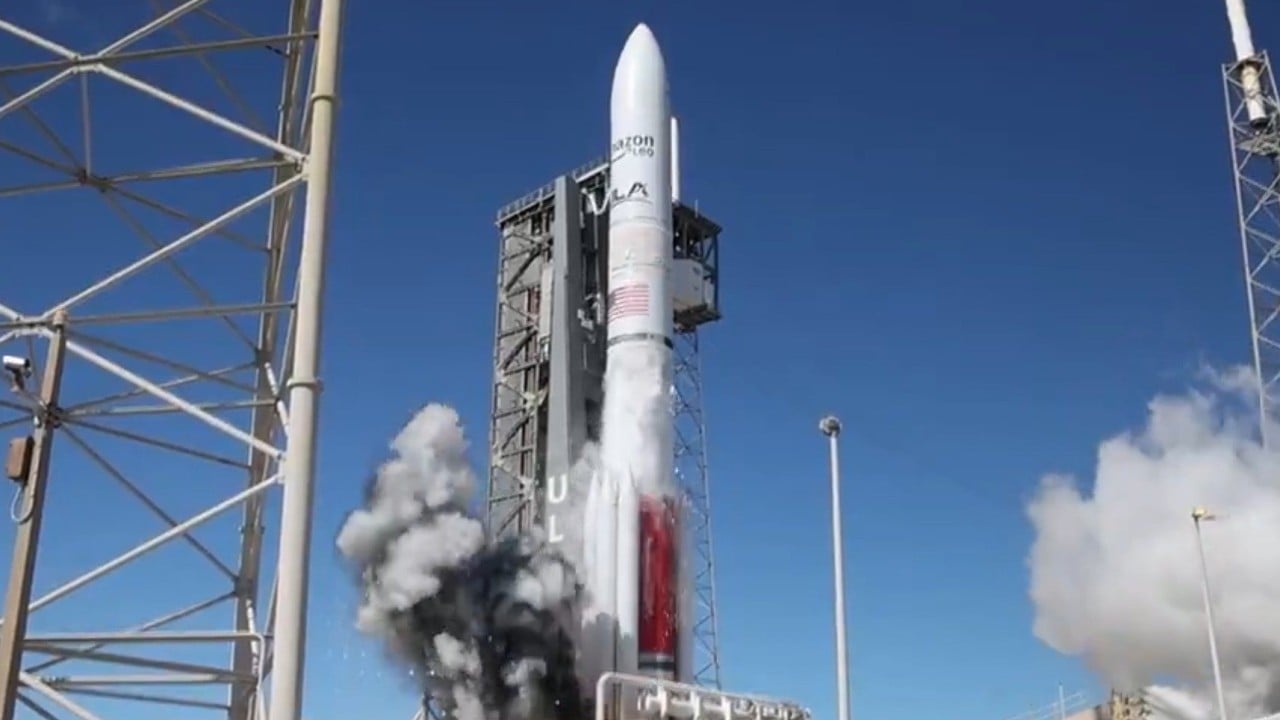
The destruction of forty Amazon broadband satellites during a failed US rocket launch exposes the fundamental mathematical vulnerability of Low Earth Orbit (LEO) constellation economics. When an operator stacks forty identical hardware assets inside a single payload fairing, the launch vehicle ceases to be a simple transport mechanism; it becomes a concentrated single point of failure capable of erasing months of cleanroom assembly in seconds.
Standard aerospace reporting treats a launch anomaly as an isolated mechanical mishap. Operational analysis reveals a deeper systemic issue: the tension between unit-cost reduction through batch launches and schedule risk under strict regulatory deployment deadlines. To understand the true operational impact of losing forty satellites on a single flight, one must examine the mechanics of orbital insertion, the compounding effects on manufacturing cadence, and the cascading delays across launch manifests.
The Architecture of Batch Deployment Risk
Deploying a global satellite internet network requires thousands of spacecraft operating in synchronized orbital planes. Unlike traditional geostationary communications satellites, which operate at roughly 35,786 kilometers above the equator and cover vast swaths of the Earth from a single position, LEO broadband constellations orbit at altitudes between 500 and 650 kilometers.
This lower altitude reduces signal latency—the round-trip time for data to travel from a user terminal to the satellite and back—from over 600 milliseconds to under 40 milliseconds. Achieving continuous global coverage at this low altitude requires a dense mesh of spacecraft. Because each satellite moves rapidly relative to the ground, dozens must pass overhead sequentially to maintain an uninterrupted connection.
To make the capital expenditure viable, operators rely on heavy-lift launch vehicles capable of carrying dozens of flat-packed satellites per flight. The economic logic is straightforward:
- Amortized Launch Cost: Dividing a fixed multi-million-dollar launch fee across forty payloads lowers the per-satellite insertion cost.
- Plane Population Efficiency: Releasing a full batch into a single orbital inclination allows the spacecraft to use onboard propulsion to space themselves out evenly along that specific track without requiring complex orbital plane changes.
- Manifest Compression: Fewer total launches are needed to reach minimum viable coverage thresholds.
The trade-off is extreme risk concentration. During ascent, the payload is subjected to severe acoustic vibration, aerodynamic pressure at Max-Q (the point of maximum dynamic pressure), and structural loads during stage separation. A failure in any primary propulsion system, guidance computer, or stage-separation mechanism results in a total loss of the manifest. There is no partial recovery in orbital mechanics; if the second stage fails to reach orbital velocity—approximately 7.8 kilometers per second for LEO—gravity pulls the entire stack back into the atmosphere, where aerodynamic heating incinerates the hardware.
Operational Mechanics of a Launch Anomaly
When a US launch vehicle fails mid-flight with forty satellites aboard, the immediate physical loss is only the first layer of disruption. The failure triggers a rigid sequence of engineering, regulatory, and logistical bottlenecks that freeze the deployment pipeline.
1. Telemetry Reconstruction and Root-Cause Isolation
Before another rocket of the same configuration can fly, propulsion and avionics engineers must reconstruct the exact timeline of the anomaly. Launch vehicles transmit thousands of channels of telemetry—measurements of chamber pressure, turbopump RPM, propellant tank temperatures, and inertial measurement unit (IMU) attitude data—every millisecond.
Engineers isolate the failure by comparing actual telemetry against nominal flight-simulation envelopes. If a turbopump experiences cavitation or a propellant valve sticks, the flight computer attempts to compensate via thrust vector control. When the deviation exceeds structural or guidance limits, the Autonomous Flight Safety System (AFSS) terminates the flight to prevent debris from falling over populated areas. Identifying whether the fault originated in a singular manufacturing defect or a systemic design flaw determines the duration of the stand-down.
2. Regulatory Grounding and Mishap Investigations
In the United States, commercial orbital launches operate under licenses issued by the Federal Aviation Administration (FAA) Office of Commercial Space Transportation. Under federal aviation regulations, any launch resulting in the destruction of the vehicle or payload mandates a formal mishap investigation.
The FAA suspends the launch license for that vehicle family until the launch provider submits a comprehensive mishap report detailing the root cause and implements corrective actions. While the investigation is led by the launch provider, it requires federal oversight and sign-off. Even a straightforward hardware fault—such as a fractured sensor line or a faulty actuator—typically grounds a rocket fleet for several months. If the root cause points to a structural weakness in an upper stage or an engine redesign, the grounding can extend beyond a year.
3. The Manifest Ripple Effect
Commercial spaceflight operates on tightly coupled schedules. Launch pads, range safety assets, and propellant supply chains are booked years in advance. When one launch vehicle is grounded, payloads scheduled for subsequent flights on that rocket cannot simply transfer to a competitor.
Satellite dispenser rings, structural adapters, and electrical umbilical interfaces are custom-engineered for specific launch vehicles. Moving a forty-satellite batch from one rocket provider to another requires redesigning the payload attach fitting, re-running coupled loads analyses to ensure the satellites survive the new rocket's specific vibration profile, and waiting for an open slot on an already congested manifest.
The Capital and Regulatory Squeeze on Amazon's Constellation
For Amazon’s broadband initiative, Project Kuiper, a launch failure carries specific strategic penalties tied to federal spectrum licensing. Unlike competitors that began deploying hardware earlier, Amazon operates under a strict regulatory clock enforced by the Federal Communications Commission (FCC).
The FCC granted Amazon authorization to deploy a constellation of over 3,200 satellites, conditioned on specific deployment milestones. Under standard FCC rules for non-geostationary orbit (NGSO) systems, the operator must launch and operate 50 percent of its authorized constellation within six years of the license grant, and the remaining 50 percent within nine years. Failure to meet the 50 percent threshold risks losing spectrum rights for the unlaunched portion of the network, potentially allowing competitors to claim those radio frequencies.
Losing forty satellites damages this timeline in three distinct ways:
- Direct Unit Deficit: The operator must manufacture forty replacement spacecraft, consuming raw materials—such as radiation-hardened silicon, gallium arsenide solar cells, and krypton or xenon propellant—that were allocated for future batches.
- Production Line Bottlenecks: Satellite factories are designed for continuous flow, not sudden surge replacement. Diverting assembly line capacity to rebuild lost units slows down the net growth of the active on-orbit fleet.
- Testing and Validation Overhead: If the launch failure involved high-vibration events prior to vehicle breakup, engineers must verify that the satellite dispenser design did not contribute to the anomaly, adding extra structural testing cycles to the remaining ground inventory.
Distinguishing Verified Facts from Operational Hypotheses
Evaluating the fallout of a forty-satellite launch loss requires separating confirmed operational realities from analytical projections regarding long-term market impact.
Established Operational Realities
- Total Payload Loss: A launch failure prior to achieving orbital insertion results in 100 percent destruction of the forty satellites via atmospheric reentry or range safety termination.
- Mandatory Stand-Down: Under US commercial space law, the launch vehicle involved cannot return to flight until root-cause analysis and FAA-approved corrective measures are completed.
- Zero In-Orbit Salvage: Unlike satellites deployed into a suboptimal orbit—which can sometimes use onboard electric propulsion to slowly raise their apogee and salvage the mission—a suborbital launch failure leaves the spacecraft with insufficient velocity to complete even a single revolution of the Earth.
Analytical Hypotheses and Constraints
- Insurance Recovery Limits: While commercial satellite operators often purchase launch insurance, high-volume LEO constellation builders frequently self-insure or carry capped policies because insuring dozens of experimental or early-production units carries prohibitive premiums. Even when insurance pays out, capital does not immediately replace lost manufacturing time or launch pad availability.
- Customer Acquisition Delays: Commercial broadband service cannot launch effectively in a given latitude band until a critical mass of orbital planes is populated. Losing a single batch of forty satellites creates a coverage gap that delays beta testing and commercial service rollout in specific geographic regions, extending the time before the network generates recurring revenue to offset its multi-billion-dollar capital outlay.
- Diversification Friction: Amazon deliberately procured launches across multiple providers—including United Launch Alliance, Arianespace, Blue Origin, and SpaceX—specifically to mitigate single-rocket dependency. However, because heavy-lift rockets across the industry face simultaneous development delays and production bottlenecks, spare capacity across the broader launch market remains severely constrained.
The Structural Limits of Multi-Provider Launch Strategies
The standard corporate prescription for supply chain resilience is multi-sourcing. Amazon applied this exact principle by splitting its launch contracts across four distinct aerospace providers. Yet the loss of forty satellites demonstrates the structural limits of diversification in heavy industry.
In software or consumer electronics, shifting production volume from Supplier A to Supplier B takes weeks. In orbital launch services, switching costs are measured in millions of dollars and multi-year engineering cycles. Each rocket family utilizes different fairing dimensions, different separation shock environments, and different fueling timelines. A satellite batch configured for a specific heavy-lift booster cannot be bolted onto an alternative rocket on short notice.
When one provider experiences a failure, the remaining providers are rarely sitting idle with unallocated rockets. Every major heavy-lift vehicle is either working through its own backlog of commercial and national security payloads or scaling up early-stage production rates. Multi-sourcing prevents a permanent halt to constellation deployment, but it cannot absorb the immediate shock of a forty-unit loss without compressing the operator's margin for error against FCC licensing deadlines.
Strategic Execution Under Launch Constraints
To absorb the loss of a forty-satellite batch and protect deployment schedules against regulatory forfeiture, constellation operators must execute three immediate operational adjustments:
- Decouple Dispenser Architecture: Standardize the mechanical and electrical interfaces of the satellite dispenser system to use universal adapter plates. Minimizing the hardware modifications required to move a satellite stack between different launch vehicles reduces the engineering lead time needed to re-manifest payloads after a competitor's rocket is grounded.
- Maintain a Rolling Buffer Inventory: Shift factory output targets from just-in-time delivery to a permanent ground buffer equal to at least two full launch batches (80 satellites). Maintaining finished, flight-ready hardware in storage ensures that when an alternative launch vehicle becomes available, the operator can immediately fill the fairing rather than waiting for cleanroom assembly to catch up.
- Prioritize High-Demand Latitudes in Orbital Phasing: Re-sequence the orbital plane assignments for the next three successful launches to concentrate initial coverage over high-revenue commercial and enterprise corridors—specifically mid-latitudes between 30 and 50 degrees North—rather than pursuing uniform global distribution. Generating early cash flow and demonstrating active commercial service strengthens the operator's regulatory standing if a formal waiver or deadline extension becomes necessary with the FCC.