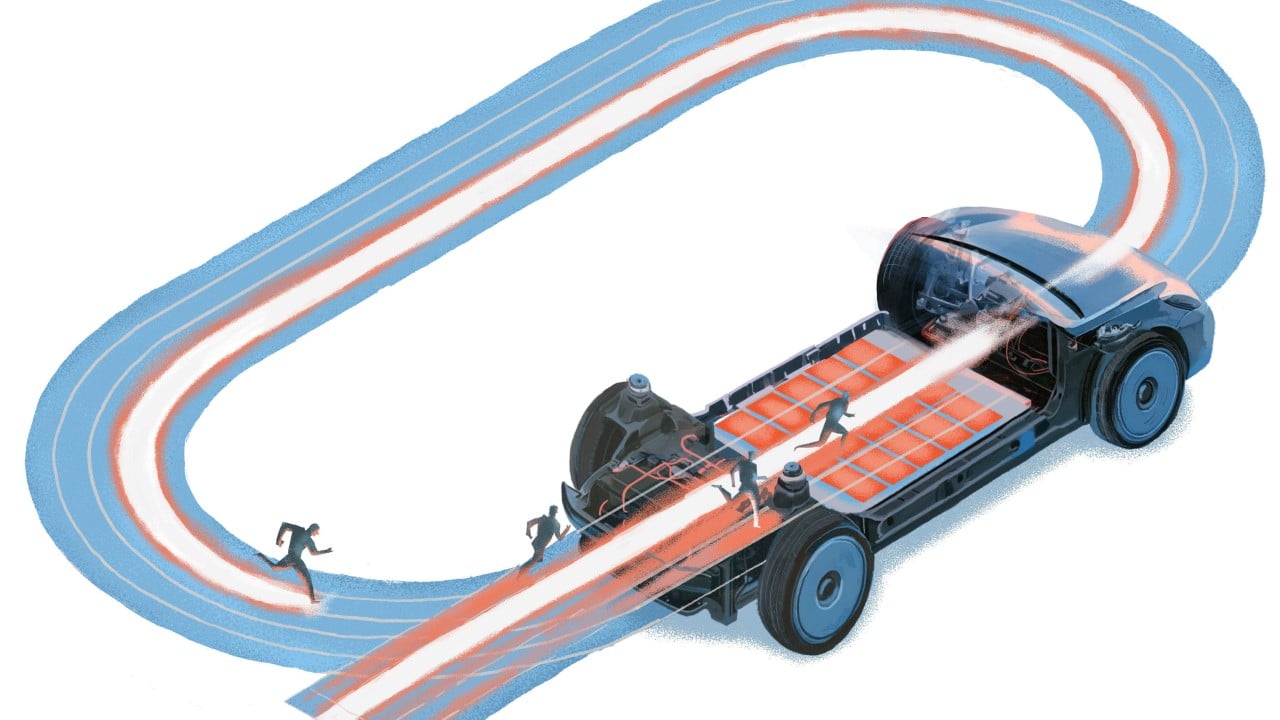
Lin stands on the concrete floor of a Shenzhen factory, wiping graphite dust from the palm of his hand. Around him, massive robotic arms sweep through the air with terrifying precision, laying down sheets of material thinner than a human hair. He has spent twelve years of his life in rooms like this, watching the metal lungs of modern transportation take shape. When he started, electric vehicles were loud punchlines, expensive toys driven by early adopters who accepted dead batteries and endless hours stranded at parking lot charging stations as the price of ideology.
Now, the cars rolling off these assembly lines do not look like compromises. They look like inevitabilities.
Yet Lin wears a frown that the factory hum cannot drown out. He knows the secret fragility beneath the shiny sheet metal. For all the sleek styling and rapid acceleration, the beating heart of every single electric vehicle remains chained to chemistry that has nearly reached its absolute physical limits. The lithium-ion pack sitting inside the floorboards is heavy. It is hungry for rare earth minerals. It gets sluggish in freezing winters and temperamental under the blistering summer sun.
The world looks at China's automotive dominance and sees an unstoppable freight train. Lin looks at the same statistics and sees a wall rushing toward them at Mach speed, unless someone can rewrite the laws of energy storage before the track runs out.
Consider what happens next: a quiet revolution inside test tubes and vacuum chambers, far away from the assembly lines.
To understand why the entire global auto industry holds its collective breath whenever a new battery milestone drops, you have to look past the hype and stare directly into the physics of motion. Moving a two-ton vehicle down a highway at seventy miles per hour requires an astonishing amount of brute force. For a decade, engineers coaxed that force out of traditional lithium-ion cells by packing them tighter, squeezing more energy density into every square inch until the cells began to resemble chemical pressure cookers prone to thermal runaway.
Then came the pivot.
Solid-state batteries, sodium-ion chemistry, and silicon-anode breakthroughs stopped being academic thought experiments and started showing up on balance sheets. These are not minor tweaks. They represent a fundamental shift in how we trap and release electricity. Imagine trading a sponge soaked in volatile liquid for a dense, dry ceramic tile that refuses to catch fire, even when punctured by a steel nail. That is the promise drawing billions of dollars into research labs from Shanghai to Berlin.
China did not stumble into its current pole position by accident. It is the result of a thirty-year chess match played with terrifying discipline. While Western automakers debated whether electric vehicles were a passing fad, Chinese industrial planners secured the mines, trained the engineers, and built an integrated supply chain that spans from raw lithium brine to the final dashboard display.
Factories rose from empty fields in months, not years. Supply chains locked together with terrifying efficiency.
Yet, being first across the initial finish line is a curse if someone else is already building a faster car for the second lap. The rest of the world caught up to the standard lithium-ion playbook. Legacy giants in Detroit, Stuttgart, and Tokyo realized they could not out-volume Beijing, so they decided to out-innovate them. They poured capital into next-generation chemistry, aiming to leapfrog the very supply chain bottlenecks that China spent decades dominating.
This is where the new battery push becomes a high-stakes thriller.
If Chinese manufacturers stick solely to conventional chemistries, they risk obsolescence as the rest of the world introduces solid-state power packs that charge in ten minutes and weigh half as much. But if China successfully transitions its manufacturing behemoth to these advanced chemistries first, the game is over. The market share gap widens into an unbridgeable chasm.
Walk through any urban center in China today, and the auditory landscape has fundamentally changed. The aggressive roar of internal combustion engines has been replaced by the low, futuristic hum of electric buses and sleek sedans gliding past neon-lit storefronts. Silence has become the sound of urban prosperity.
Drivers here do not think about oil changes. They think about kilowatts. They watch battery percentages the way past generations watched gas gauges, waiting for the red line.
And that is where the psychological barrier lives. Range anxiety is not a technical problem; it is an emotional cage. It is the sudden drop in your stomach when you are fifty miles from home, the heater is blasting against a December frost, and the dashboard flashes a warning that your energy reserves are plunging into the single digits.
The new generation of batteries aims to smash that cage completely. We are talking about ranges exceeding six hundred miles on a single charge. We are talking about charging speeds that render the traditional gas station stop an archaic memory, replaced by a five-minute pause to stretch your legs while electrons flood back into the vehicle's core.
To achieve this, researchers are turning away from scarce cobalt and expensive nickel, looking instead to sodium—plentiful, cheap, and harvested straight from sea salt. It is an ironic twist of nature. The element that makes our oceans taste bitter might soon power the trucks delivering our groceries and the taxis carrying us to work.
Critics often point to manufacturing hurdles, cost overruns, and supply chain bottlenecks as proof that the hype will crash against economic reality. They are not entirely wrong. Scaling a laboratory breakthrough to mass production is an industrial meat grinder. Thousands of companies start the journey; only a handful survive the transition from benchtop to gigafactory.
Lin knows this better than anyone. He has watched experimental production lines fail, spewing ruined cathode material into recycling bins while executives sweat over quarterly losses.
But scale changes the math. Once a new manufacturing technique stabilizes, the cost curve drops off a cliff. When sodium-ion or advanced silicon-anode cells achieve parity with legacy lithium-ion production, the economic inertia becomes unstoppable. It creates a domino effect that will ripple through global trade, energy grids, and geopolitical alliances.
Nations that built their entire economic identities on oil extraction are watching their leverage evaporate, replaced by a new scramble for the minerals that make the energy transition possible. The geopolitical map is being redrawn in graphite, lithium, and silicon.
Look at the horizon.
The transition is no longer a question of if, but of how fast and who owns the patents when the dust settles. For China’s electric vehicle titans, these new batteries are the jolt required to stay ahead of an increasingly desperate global pack.
The stakes go far beyond corporate quarterly earnings or national pride. They touch the air we breathe in crowded cities, the stability of electrical grids straining under surging demand, and the fragile climate balance of a warming planet.
When Lin locks up the factory floor at night and steps out into the cool Shenzhen air, he looks at the quiet stream of electric taxis flowing past under the amber streetlights. He knows the machines moving down the avenue are just transitional artifacts, rough drafts of a cleaner future still being written in laboratories down the road.
The true machine, the one that will reshape the century, is still being built in the dark.
And when it finally wakes up, nothing will ever be the same.