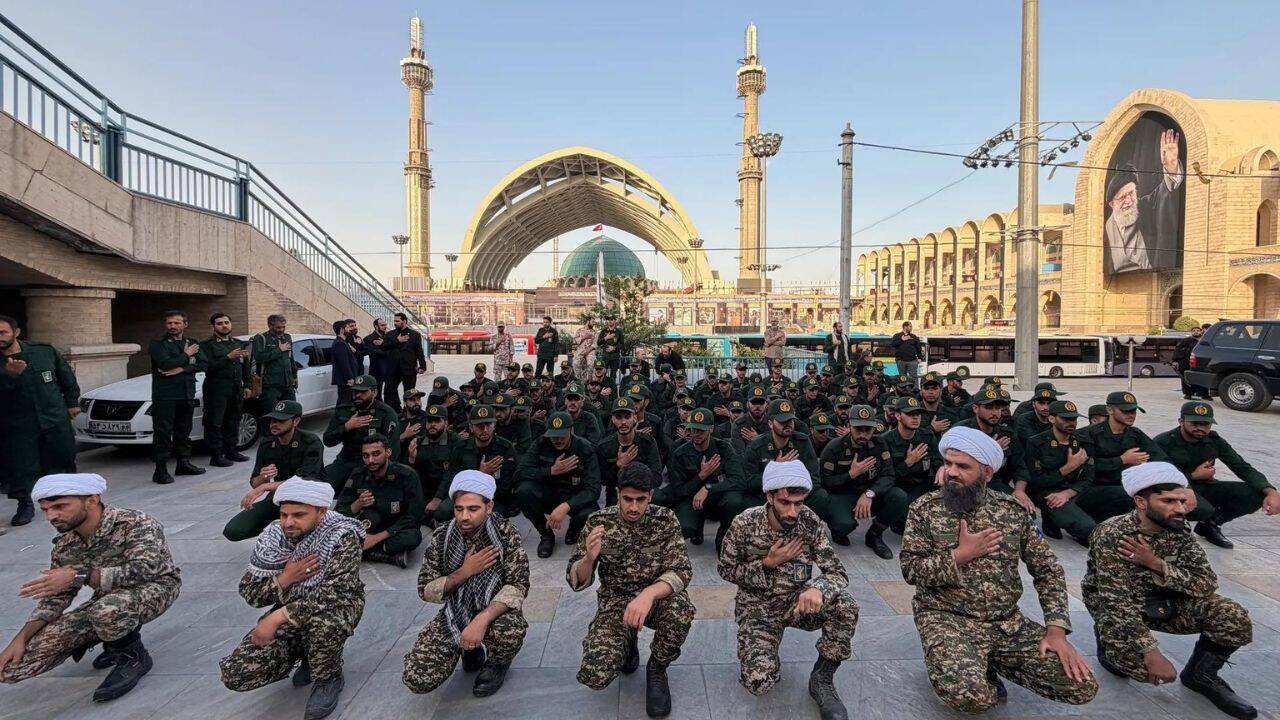
The morning air in the capital carried the scent of exhaust, crushed rosewater, and collective anticipation. On the asphalt of Enghelab Street, the soles of thousands of shoes scraped a rhythmic, low-pitched shuffle. It was the sound of a city holding its breath. Above the sea of black chadors and dark coats, giant loudspeakers crackled to life, their static cutting through the morning chill before the heavy, rhythmic chanting began.
A transition of power in this part of the world is never just a bureaucratic box to check. It is an earthquake whose epicenters are felt in every kitchen, bazaar, and government building across the hemisphere. As the funeral processions for the Supreme Leader got underway, the rhetoric echoing from the podiums was unyielding. The official proclamations promised divine retribution against the United States and Israel, asserting that the end of an era would not signal a softening of resolve, but a hardening of it.
For those watching from afar, these declarations are often dismissed as standard geopolitical theater. But for the people walking these streets, and for the families watching the live broadcasts in Tel Aviv, Washington, and Baghdad, the words carry a weight that threatens to reshape reality. The stakes are entirely human.
The Sound of the Street
To understand the gravity of the moment, one must step away from the analysts' maps and look at the faces in the crowd. Consider a hypothetical shopkeeper named Farid. For thirty years, Farid has sold saffron, dried limes, and mint leaves from a stall in the Grand Bazaar. His life is measured not in geopolitical strategy, but in the rising cost of rice, the marriages of his daughters, and the quiet safety of his neighborhood.
When the loudspeakers boom with promises of conflict, Farid does not cheer. He adjusts the scales on his counter. His eyes wander to his son, who is old enough for military service.
This is the hidden friction of historical turning points. The leaders at the microphones speak of grand destinies, cosmic justice, and regional dominance. The people on the ground think of survival. The state media covers the vast crowds as a monolith of singular will, a unified voice demanding vengeance. Yet, underneath the uniform color of the mourning clothes lies a complex web of anxiety, grief, hope, and quiet terror.
The warnings issued during the funeral ceremonies were specific. Authorities declared that the machinery of retaliation was already in motion, suggesting that the transition period would be marked by action rather than mourning. It is a classic strategy of deterrence, meant to signal strength at a moment of vulnerability. When a nation loses its ultimate authority figure, the immediate instinct of the ruling apparatus is to project absolute invulnerability.
The Calculus of Deterrence
The tension is not confined to the borders of Iran. Across the region, the language of the funeral speech acts as an accelerant. In strategic command centers thousands of miles away, analysts dissect every syllable. They look for micro-shifts in tone. They measure the duration of the pauses between sentences.
Why does a funeral become a platform for warnings of war?
Historically, transitions are the most dangerous windows for any state. They are the moments when adversaries test boundaries and internal factions vie for position. By elevating the rhetoric to a fever pitch, the state hopes to build a protective wall of words around its fragile transition process. They want the world to believe that nothing has changed, that the policy remains ironclad, and that any attempt to exploit the situation will result in catastrophic consequences.
But words have a way of escaping the control of those who utter them. When you tell a population, and the world, that retribution is not far off, you create an expectation. You set a clock ticking.
Consider the perspective of an ordinary citizen in a neighboring country, waking up to see these headlines. The abstract concept of regional stability suddenly transforms into a practical checklist. Do we have enough canned goods? Is the passport updated? Will the flights be canceled next week? The rhetoric of statecraft breaks down into the small, gritty decisions of daily life.
The Echoes of the Past
This moment did not happen in a vacuum. The current hostility is rooted in decades of economic pressure, covert operations, and proxy conflicts that have slowly eroded the space for diplomacy. Every action taken by one side is viewed by the other not as an isolated event, but as another log thrown onto a fire that has been burning since 1979.
The tragedy of this cycle is its predictability. A threat is issued in Tehran. A defense system is activated in Tel Aviv. A statement of absolute support is released from Washington. The gears turn automatically, driven by a mutual distrust so deep that any gesture towards de-escalation is viewed as weakness.
During the funeral, the imagery invoked by the speakers was deliberately historical and religious. They spoke of patience, of long-term justice, and of a cosmic balance that would inevitably tip against their adversaries. This language is powerful because it removes the conflict from the realm of immediate politics and places it in the realm of absolute truth. When a struggle is framed as divine, compromise becomes a betrayal.
Yet, the modern world moves at a pace that structural religious narratives rarely account for. Markets react in seconds. Oil prices fluctuate on the rumor of a speech. Cyber networks monitor infrastructure for the slightest hint of an anomaly. The ancient language of retribution must operate within the hyper-speed reality of twenty-first-century warfare.
The Human Margin
The real question hanging over the funeral procession is what happens when the speeches end and the crowds go home. The collective energy of a mass rally is intoxicating, but it evaporates quickly in the cold light of the following morning.
The new leadership faces a dual challenge. They must satisfy the hardliners who demand that the fierce rhetoric be backed by action, while simultaneously managing an economy that has been choked by isolation. It is a delicate balancing act. One misstep, one over-reaction, and the proxy war that has been fought in the shadows for years could spill out into the open daylight.
We often talk about nations as if they are single entities with one mind. We say "Iran warns" or "America responds." But nations are made of individuals, each with their own threshold for fear and their own desire for peace. The tragedy of the current moment is that those who will pay the highest price for any potential retribution are the ones who had the least say in the words spoken from the funeral podium.
The ceremony will conclude. The body will be laid to rest. The banners will be taken down, and the streets will be swept clean. But the words spoken over the microphones will remain, hanging in the air like heavy smog, leaving millions of people waiting for the other shoe to drop.
The world watches the screens, reading the bold text of the warnings, wondering if this is the prelude to something catastrophic, or simply the final, loud gasp of an era trying desperately to assert its relevance before the future takes over.