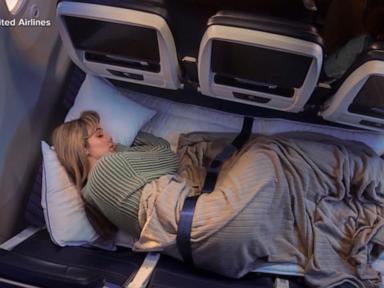
The metal tube hums at thirty-six thousand feet, a low-frequency vibration that settles into the marrow of your bones. If you are sitting in 32B, the world has shrunk to a very specific set of dimensions. Your knees are pressed against a seat pocket filled with a safety card you’ve memorized and a duty-free magazine you’ll never buy. Your elbows are tucked inward, a defensive posture born of the silent, desperate war for the armrest. This is the geometry of the modern traveler. For decades, we have accepted that flying is an exercise in physical compromise, a tax paid in cramps and exhaustion for the miracle of crossing oceans in hours.
But the blueprints are changing.
Engineers and designers at firms like Crystal Cabin and Recaro are no longer looking at the cabin as a storage locker for humans. They are looking at it as a puzzle of biological limits. The goal isn’t just to make the seat softer; it is to hack the very perception of space. When we talk about "First Class comfort in coach," we aren't talking about caviar or champagne. We are talking about the basic human dignity of not touching a stranger's shoulder for six hours.
The Anatomy of the Inch
Consider Sarah. She is a hypothetical consultant, but her back pain is real. She flies three times a month, always in economy, always chasing the lowest fare to satisfy a corporate travel policy written by people who fly private. Sarah represents the "invisible stakes" of aviation design. When she arrives at her destination, she isn't just tired; she is depleted. Her productivity is hampered by the physiological stress of being "contained."
The industry calls it "passenger density." To Sarah, it feels like a vice.
Standard economy seats have hovered around a width of 17 to 18 inches since the dawn of the jet age. However, the human body has not remained standard. We are wider, taller, and more prone to the digital slouch of the smartphone era. The "1st class comfort" movement isn't trying to give Sarah a bed; it's trying to give her a "stagger."
One of the most profound shifts in recent design is the concept of the staggered row. In a traditional layout, three seats sit in a straight line. Shoulders overlap. Hips collide. In the new prototypes being tested by innovators, the middle seat is moved back by several inches and lowered or raised slightly.
The result is a geometric magic trick. By shifting the middle passenger out of the linear plane of their neighbors, you suddenly create several inches of "dead space" that becomes "living space." The shoulders no longer interlock. The middle seat, traditionally the most loathed real estate in the sky, suddenly becomes the widest seat in the row.
The Psychology of the Shell
The physical seat is only half the battle. The other half takes place inside the passenger's mind. There is a specific kind of anxiety that occurs when the person in front of you abruptly reclines, narrowingly missing your laptop screen and invading your last remaining pocket of air. This is the "intrusion trigger."
New designs are moving toward the fixed-shell concept. In this scenario, the back of the seat doesn't move. Instead, the seat pan slides forward and tilts within its own carved-out radius.
Think of it as a cocoon.
When the passenger in front of you "reclines," you don't see it. You don't feel it. Your space remains a constant, inviolable territory. This removes the social friction of the cabin. It stops the silent resentment that bubbles up between 24A and 25A. By stabilizing the environment, designers are reducing the cortisol levels of the entire plane. They are using hardware to solve a software problem—the software being human emotion.
Materials and the Weight of Lightness
The barrier to these innovations has always been weight. Every extra pound of plastic or foam requires more fuel, which increases ticket prices. This is the cold math of the airline industry. To give Sarah her comfort, the airline has to find a way to make the seat lighter than the one it replaces.
We are seeing a transition from heavy steel frames and thick polyurethane foams to carbon fiber composites and 3D-woven fabrics. These materials are thin. They look almost skeletal. But they are engineered to support the human frame at its primary pressure points. By stripping away the bulk, designers create "under-seat" clearance. Sarah can finally stretch her legs because the bulky life-vest container and the thick metal struts have been relocated or slimmed down through advanced metallurgy.
It is a paradox of modern engineering: the less material there is in the seat, the more comfortable the human becomes.
The Power of the Pivot
Beyond the seat itself, the "coach revolution" is focusing on the micro-interactions. The tray table is no longer a flat piece of gray plastic. It is becoming a multi-level docking station. New designs feature eye-level tablet holders and integrated power ports that don't require you to crawl onto the floor to find a socket.
But the real "game-changer"—a term I use only to describe the literal shifting of the industry's focus—is the headrest.
The human neck is a fragile thing. When we sleep upright, our muscles fight a losing battle against gravity. The "wings" on new economy seats are becoming larger, more rigid, and more adjustable. They act as a vertical pillow, cradling the head so the neck can finally go slack. It is a small change, a few ounces of foam and a hinge, but for a passenger on a red-eye from London to New York, it is the difference between a functional morning and a day lost to a migraine.
The Economic Threshold
Why now? Why, after decades of "sardine-class" travel, are airlines finally looking at these prototypes?
The answer is the "Premium Economy" gap. Airlines realized there is a massive demographic of travelers who cannot afford a $5,000 Business Class pod but are willing to pay an extra $200 to avoid the misery of the back row. This competitive pressure is forcing a "trickle-down" effect. As Premium Economy becomes more luxurious, the standard Economy cabin must evolve to stay relevant.
Airlines are beginning to understand that comfort is a brand. In an age of social media, one viral video of a cramped, broken seat can do more damage than a million-dollar advertising campaign can fix. They are investing in these new geometries not out of the goodness of their hearts, but because a comfortable passenger is a compliant, returning, and profitable passenger.
The Invisible Stakes
We often dismiss the complaints of the air traveler as "First World problems." But there is a deeper resonance here. How we treat people in transit reflects how we value them. If we design environments that treat humans as cargo, we shouldn't be surprised when they act out of frustration, anger, and exhaustion.
When an engineer spends three years perfecting the curve of a lumbar support or the tension of a seat-back mesh, they aren't just building a chair. They are building a reprieve. They are acknowledging that the person sitting in 32B has a life, a back that aches, and a destination where they need to be at their best.
The future of flight isn't in the supersonic engines or the windowless cockpits. It is in the quiet victory of a middle seat that is two inches wider. It is in the sigh of relief when the person in front of you reclines and your coffee stays exactly where it is.
We are finally moving toward a world where the miracle of flight doesn't require a sacrifice of the self. The architects of the middle seat are redrawing the lines, proving that even in a tube of pressurized metal, there is room for a little more humanity.
The hum of the engines continues, but the vice is slowly, finally, beginning to loosen.