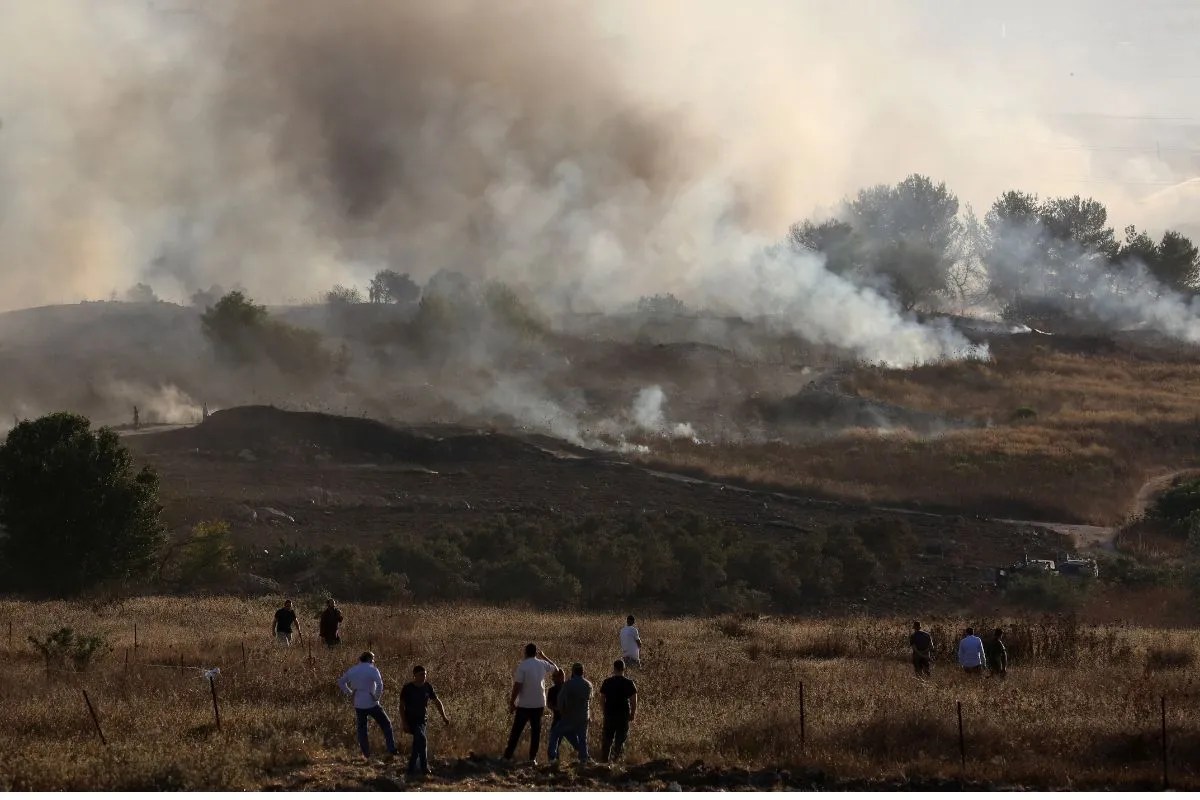
Masked Israeli settlers ambushed European diplomats and Palestinian olive harvesters near the West Bank village of Taybeh on October 17, 2026, smashing a diplomatic vehicle window and assaulting participants with metal bars. Envoys and officials from France, Belgium, and Poland, along with church figures and activists, had gathered in the predominantly Christian town northeast of Ramallah for a community twinning event and the autumn olive harvest.
For years, Palestinian farmers have faced beatings, property damage, and blocked access to ancient groves during October and November. Foreign diplomats and activists often join harvests hoping their passports and official titles act as a shield. In Taybeh, that shield cracked.
What Happened on the Ground in Taybeh
Accounts from participants and local witnesses describe a sudden escalation. Three vehicles arrived carrying masked assailants armed with clubs and metal bars. French mayor Bernard Baudoux wrote on social media that he put on his French tricolor sash as the attackers approached, yet he was struck with metal bars, kicked, and thrown to the ground before managing to retreat to a vehicle.
Witnesses and reports also indicated that assailants smashed a window of a vehicle linked to the Belgian consulate and demanded identification from people inside. Belgian Foreign Minister Maxime Prevot stated that Belgium's consul general, along with French and Polish diplomats and Catholic representatives, had been targeted in Taybeh. An Israeli activist whose car was confronted in video footage said the masked men threatened to kill those inside.
The timing sharpened the shock. The ambush occurred one day after reports of settler attacks against olive harvesters and an assault on Washington Post photojournalist Heidi Levine. It also arrived roughly two weeks before closely contested Israeli elections that threatened Prime Minister Benjamin Netanyahu's hold on power.
| Actor or Institution | Reported Role or Response | Key Takeaway |
|---|---|---|
| Masked Settlers | Confronted vehicles, smashed a consulate-linked car window, and beat victims with metal bars. | Foreign diplomatic status did not deter the assailants on the ground. |
| European Envoys & Officials | Diplomats from France, Belgium, and Poland, plus a French mayor and church figures, attended the Taybeh visit. | European officials pushed for stronger EU action and an end to impunity. |
| Israel Defense Forces (IDF) | Stated the diplomats' tour was uncoordinated with the military and no soldiers were present during the attack. | Highlighted operational gaps and routing delays when emergency calls came in. |
| Israeli Police & Foreign Ministry | Opened an assault investigation, dispatched forensic teams under military escort, and engaged foreign ambassadors. | Official condemnations clashed with skeptical political messaging from the prime minister's office. |
Why Diplomatic Presence No Longer Deters Attacks
Foreign missions have long used field visits in the West Bank to document living conditions and signal political concern. Historically, an official convoy or a consular plate carried an unspoken deterrent. Attackers generally preferred targets with less international visibility.
That calculation has eroded. Over the past several years, militant settler groups have grown bolder in confronting international monitors, journalists, and solidarity workers alongside Palestinian villagers. When assailants wear masks and arrive in coordinated vehicles, anonymity lowers their perceived personal risk. Even if cameras roll, identifying individuals behind masks in a contested rural area takes time that rarely works in prosecutors' favor.
There is also a structural mismatch in how security is managed across the West Bank. More than half a million Israeli settlers live in the territory alongside roughly 3.4 million Palestinians under a patchwork of military and civil authority. Following the Taybeh incident, the Israel Defense Forces stated that the diplomats' tour had not been coordinated with the military and that no troops were at the scene when violence erupted, noting that a call was routed to a divisional operations room handling security personnel rather than civilians.
Coordination gaps are not an abstract bureaucratic detail. When minutes matter on a rural road or olive terrace, delayed dispatch or unclear jurisdiction means attackers can strike, smash glass, and leave before uniformed forces arrive. Critics of Israeli enforcement argue that chronic under-policing of settler offenses creates a climate where perpetrators expect minimal consequences—a pattern that later prompted rare police raids and detentions days after the outcry.
Split Messaging Inside Jerusalem
The aftermath exposed sharp friction in how Israeli officials framed the incident. Foreign Minister Gideon Sa'ar condemned the violence by "Israeli rioters" near Taybeh and said his ministry was working with affected embassies and law enforcement. Police pledged a thorough investigation and sent forensic investigators under military guard to gather evidence.
Prime Minister Benjamin Netanyahu's office struck a very different tone. Rather than focusing solely on punishing the assailants, his office warned of a supposed "smear" campaign against settlers during the olive harvest and criticized reliance on early headlines.
"Impunity for violent settlers must end." — European reaction following the Taybeh attack, linking the assault to broader settlement tensions.
That split reflects a deeper political fault line inside Israel. Some centrist and security figures argue that violent fringes damage Israel's international standing and strategic security. Hardline allies who depend on pro-settlement factions often resist sweeping crackdowns, fearing political backlash at home. For European capitals, watching contradictory statements from Jerusalem makes promises of accountability harder to take at face value.
The Olive Harvest as a Flashpoint
To understand why Taybeh matters beyond a single diplomatic scuffle, look at the calendar. Every autumn, the olive harvest is both an economic lifeline and a test of territorial control in the West Bank. Families rely on the crop for income and food oil, while disputes over access to groves routinely flare up.
Rights monitors and local authorities reported dozens of incidents targeting farmers, land, and harvests across the West Bank around the same period. Farmers described beatings, stolen equipment, blocked roads, and new outposts encroaching on agricultural land. When foreign envoys walk into an olive grove during harvest season, they are stepping directly into a dispute over land use, freedom of movement, and law enforcement.
At the same time, observers should avoid oversimplifying every clash on rural roads. Tensions in the West Bank involve overlapping grievances, disputed property claims, and competing narratives from residents, activists, military officials, and politicians. Establishing exact culpability in chaotic confrontations requires forensic evidence, video verification, and credible witness statements—not assumptions made from afar.
What Europe Can Actually Do Next
Condemnations are cheap in diplomacy. Every major capital knows how to issue a stern statement within hours of an attack on its citizens. Turning outrage into leverage is much harder.
European governments face a familiar dilemma. Member states do not always speak with one voice on Middle East policy, and unilateral moves can carry diplomatic friction with Jerusalem or Washington. Yet when envoys from multiple EU countries are caught in an ambush, Brussels has a direct institutional interest in protecting its personnel and enforcing consistent standards.
Targeted visa bans and asset freezes against individuals credibly linked to violent attacks remain one of the clearest tools available to European governments. Applying those measures consistently—and coordinating them across member states rather than leaving them as patchwork national gestures—would send a sharper signal than press releases.
Consular protocols are another practical piece of the puzzle. Missions sending diplomats or delegations into volatile rural areas must weigh visibility against safety, clarify communication lines with local authorities, and document every incident systematically so evidence holds up in legal and diplomatic channels.
Ultimately, a broken car window in Taybeh is a symptom, not the disease itself. Until law enforcement enforces the rule of law evenly on every road in the West Bank, neither Palestinian farmers nor visiting diplomats can count on basic safety.


