The Sound of an Empty Pot
The heat in Beni does not rise; it drops like a heavy wet blanket from the sky, trapping the smell of charcoal smoke, red dust, and fear. When Ebola strikes a town in the Democratic Republic of Congo, the world reacts with a very specific set of sounds. You hear the mechanical thrum of white helicopters landing at the airstrip. You hear the static hum of walkie-talkies clipped to the belts of international aid workers. You hear the zippers of biohazard suits.
But if you sit in the dirt yards just outside the isolation zones, the most terrifying sound is the silence. It is the absence of a knife scraping against a cutting board. It is the cold, dead quiet of a cooking pot that remains empty because the woman who usually fills it is trapped behind plastic sheeting, fighting for her breath.
We talk about epidemics in the language of warfare. We count the body bags, calculate the transmission rates, and map the clusters. But we rarely talk about the kitchen.
When a virus tears through a community, it does not just attack human T-cells. It destroys the invisible infrastructure of daily life. In the eastern Congo, where conflict has already fractured society for decades, an Ebola outbreak is a final, crushing weight. When a mother is rushed to a treatment center, her children do not just lose her comfort; they lose their cook. When a farmer tests positive, the fields go untended, and the local market stands bare.
The international community arrives with experimental vaccines and high-tech isolation pods. These are miracles of modern science. Yet, they often forget a fundamental truth of human survival.
A patient cannot heal on medicine alone. A doctor cannot operate on adrenaline forever. Someone has to cook the rice.
The Chemistry of Comfort
Consider what happens to the human body under the assault of the Ebola virus. It is a grueling, dehydrating ordeal characterized by high fever, severe vomiting, and internal bleeding. The treatment centers—known as CTEs—are intimidating fortresses of orange mesh and chlorine spray. For a patient inside, stripped of their clothes, surrounded by masked figures who look like astronauts, the world has effectively ended.
In these moments, the body is a battlefield. To fight back, the immune system requires massive amounts of energy. But how do you persuade a terrified, nauseous child to eat standard-issue, institutional rations? How do you fuel the recovery of a pregnant woman when the very sight of unfamiliar food triggers a wave of sickness?
The answer is not found in a laboratory. It is found in the hands of local volunteers, mostly women, who have formed an unofficial, secondary frontline. They call themselves the protectors of the hearth.
These volunteers understand something that the data analysts often miss: food is not just nutrition; it is information. When a patient receives a bowl of sombe—pounded cassava leaves simmered with garlic and palm oil—prepared exactly the way their grandmother made it, the brain receives a powerful signal. It recognizes that they are still human. It signals that they are still connected to the earth, to their village, to life itself.
This is not mere sentimentality. It is clinical strategy. Doctors working in the Beni outbreaks noticed a distinct pattern. Patients who managed to swallow even a few spoonfuls of local, familiar broth had a significantly higher chance of maintaining the physical strength needed to survive the virus's peak. The local food neutralized the psychological paralysis of the isolation ward.
But getting that food into the red zone is a logistical nightmare.
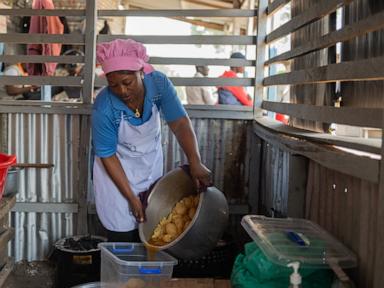
The kitchen volunteers operate under strict, unforgiving protocols. Every tomato must be washed in chlorinated water. Every knife must be sanitized. The women work in oppressive heat, over charcoal fires, preparing hundreds of meals a day for people they may never see alive again. They do it knowing that one mistake, one contaminated surface, could turn their kitchen into a new vector for the disease.
The Price of Solidarity
Let us look closely at one of these volunteers. We can call her Alphonsine. She is not a doctor, nor does she have a degree in public health. Before the outbreak, she sold bright wax-print fabrics at the central market.
When the virus hit her neighborhood, Alphonsine did not flee to the hills like many others. Instead, she walked toward the smoke of the communal kitchens.
"The white cars came and took my neighbor's family," she says, her fingers stained purple from peeling local onions. "They took them away in plastic suits. The children were crying. The youngest was only four. I realized then that if we only let the foreigners do the work, our people will die of fear before the virus even touches them."
Alphonsine and her colleagues receive almost no pay. They face intense stigma from their own neighbors, who whisper that anyone working near the Ebola centers must be carrying the curse. Their husbands sometimes leave them out of fear. Their friends avoid them on the road.
Yet, every morning at five o'clock, the fires are lit.
The menu is calculated with mathematical precision, balanced between traditional tastes and digestive tolerance. For the severe cases, they prepare a thin porridge of sorghum and local honey, easy to swallow, packed with glucose. For the convalescing patients, they roast goat meat and plantains, building back the muscle mass lost to weeks of muscle aches and diarrhea.
They also cook for the healthcare workers. It is easy to forget that the nurses and hygienists inside those heavy protective suits are human beings operating under impossible stress. They sweat out liters of water every hour inside the rubber layers. They witness unimaginable suffering. When they finally peel off their masks, their faces lined with deep purple bruises from the tight straps, they are met not with cold MREs, but with steaming plates of fresh food.
This act of service creates a bridge across a deep chasm of distrust.
Historically, Ebola outbreaks in the Congo have been plagued by community resistance. Rumors spread quickly in environments starved of accurate information. People whisper that the virus is a Western invention, or a political plot to depopulate the region. When international teams arrive with armed escorts, it often hardens this suspicion.
But when the community sees Alphonsine buying bags of beans from the local farmers, when they smell the familiar aroma of roasting peanuts drifting from the kitchen near the treatment center, the wall of resistance begins to crumble. The kitchen becomes a monument of trust. If the local grandmothers are there, the place cannot be an execution chamber.
The Invisible Stakes
The true scale of an epidemic is never captured in the official tallies published by global health organizations. The statistics tell us how many people died of the virus, but they remain blind to the collateral damage.
They do not count the child who survived Ebola but died of severe acute malnutrition three months later because his family's farm collapsed during the quarantine. They do not count the economic suicide of a village cut off from trade routes, where food prices skyrocket by four hundred percent in a matter of weeks, turning a health crisis into a famine.
This is where the volunteers perform their most vital, invisible work. By centering the response around the local food supply, they keep the fragile regional economy breathing.
Every kilo of rice purchased for the Ebola kitchens is money pumped directly back into the hands of local widows and farmers. It prevents the complete erasure of the local market system. It ensures that when the virus eventually recedes—as it always does—there will still be a community left to rebuild.
The work is grueling, exhausting, and profoundly dangerous. The volunteers watch the daily whiteboard outside the treatment center, looking for the names of the people they cooked for the night before. Sometimes, a name is moved to the "discharged" column, triggering a quiet cheer over the bubbling pots. Too often, a name simply disappears, moving to the morgue list.
"We cry into the soup," Alphonsine says softly, stirring a massive caldron of beans with a wooden paddle the size of an oar. "Then we add more salt, and we keep stirring. The living are still hungry."
The Final Chord
Western medical manuals contain thousands of pages on protocol, containment, and viral replication. They detail the exact parts per million of chlorine required to kill a pathogen on a concrete floor. They describe the precise sequence for removing protective gloves without touching the skin.
But nowhere in those manual pages will you find instructions on how to comfort a dying teenager who is crying out for the taste of home. Nowhere does it explain how to maintain the dignity of a community that feels hunted by an invisible monster.
The real victory over Ebola in the forests of the Congo is not won solely by the cold brilliance of science. It is won by the stubborn, defiant persistence of women who refuse to let the fire go out.
As the sun dips below the canopy in Beni, casting long, bloody shadows across the red dirt, the smoke from the volunteer kitchens continues to rise. It smells of charred wood, sweet plantains, and raw survival. It is a fragile, beautiful defiance. In a place defined by sudden death, the simple act of preparing a meal becomes the ultimate declaration of life.