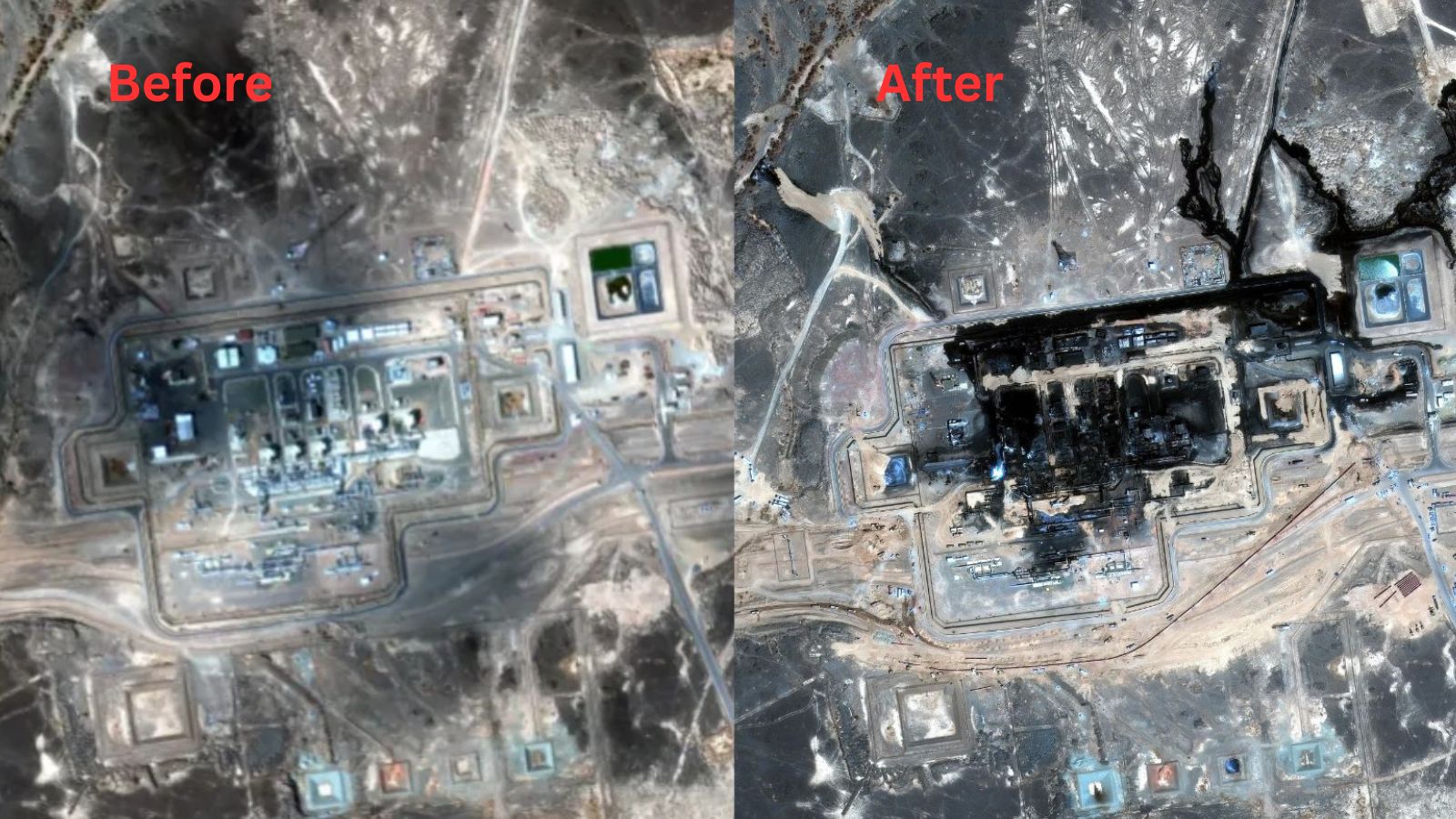
Every time a drone clips a piece of critical infrastructure in the Middle East, the media cycle undergoes a predictable, highly choreographed meltdown. The playbook is identical. First comes the breaking news alert. Then, within hours, commercial satellite operators release high-resolution optical images. A pair of frames appears side by side. Before and after.
Before: a clean, sterile scar of steel cutting across an empty desert floor.
After: a charred pucker, a dark smudge of soot, and a scattering of metallic shrapnel. Meanwhile, you can explore related developments here: The Myth of the Beijing Breakdown and the Collapse of Washington Strategy.
The pundits hyperventilate. Analysts on cable television dust off their worst-case scenarios, drawing thick red arrows across maps and warning that global energy markets are teverging on total collapse. The narrative writes itself: a catastrophic failure of physical security, an exposed jugular vein of the global economy, and proof that modern energy supply chains are fundamentally fragile.
It is a masterpiece of visual sensationalism. And it is almost entirely wrong. To explore the complete picture, we recommend the excellent report by Investopedia.
I have spent decades watching market participants, financial journalists, and armchair strategists panic over high-resolution photography. They look at a scorch mark from three hundred miles up and assume that a blackened patch of sand translates directly to a permanent amputation of global supply. They confuse surface theatricality with structural destruction. They treat a steel pipeline like a garden hose, believing that if you pinch it or puncture it in one spot, the entire system bleeds out and dies.
That is not how industrial-scale energy logistics operate. In fact, it betrays a profound ignorance of basic civil engineering, automated control systems, and network redundancy. If you want to understand why those satellite images are designed to mislead you, you have to look past the pixels and examine how modern multi-billion-dollar transit corridors actually absorb trauma.
The Optical Illusion of Total Destruction
Let us start with what a satellite photo actually captures. It captures light reflecting off the surface of the earth. It shows thermal anomalies, discoloration, and structural displacement of the topmost layer of steel or insulation. To a human eye untrained in industrial forensics, a twisted piece of pipe and a black burn radius look like an apocalypse.
It looks like an open wound.
The reality is far more mundane. Modern crude oil and gas pipelines are heavy-walled carbon steel conduits, often buried underground or encased in reinforced concrete when traversing vulnerable surface zones. They operate under immense internal pressure. When a kinetic impact or an explosive payload strikes a pipe, the metal deforms, energy dissipates, and the immediate area sustains localized damage.
To the camera in low Earth orbit, that localized damage looks catastrophic. To the engineers sitting in a remote SCADA control room three hundred miles away, it is Tuesday.
Pipelines are not passive tubes. They are active, highly monitored vascular networks. The moment pressure drops in a given sector—whether caused by a valve closure or a kinetic breach—automated safety systems react in milliseconds. Line-break isolation valves slam shut, cutting off the supply of hydrocarbons to the damaged zone and starving any fire of fuel long before a satellite can maneuver into position to snap a picture.
The media focuses on the hole. The engineers focus on the boundary. The hole is a localized repair job. The boundary is what keeps the rest of the network running.
The Myth of the Single Point of Failure
The lazy consensus in almost every geopolitical analysis of energy infrastructure relies on the single-point-of-failure fallacy. The argument goes like this: if Country X depends on Pipeline Y to move millions of barrels of crude from eastern extraction fields to western export terminals, any successful strike on Pipeline Y stops the flow of oil, chokes state revenues, and sends Brent crude rocketing past dangerous thresholds.
It sounds logical if your understanding of economics comes from a high school textbook. In practice, major strategic arteries like Saudi Arabia's East-West Petroline—spanning hundreds of miles across the peninsula—are not single lines of unprotected vulnerability. They are massive, looped corridor systems.
When you design a transport network worth hundreds of billions of dollars, you do not build a single string of pipe and cross your fingers. You build redundancy. You build parallel loops, cross-connections, and bypass manifolds that allow operators to reroute flow around a compromised node with the flick of a digital switch.
Imagine a multi-lane highway where a truck breaks down in the middle lane. Traffic doesn't stop forever. Cars merge into the adjacent lanes, the bottleneck clears, and a tow truck removes the obstruction. A pipeline network operates on the exact same principle, only faster and with automated electronic routing.
When a section of pipe is damaged by a drone, the affected segment is isolated via sectionalizing block valves. The upstream oil is diverted into parallel lines or temporarily held in intermediate storage tank farms while maintenance crews mobilize. The throughput drop is often measured in hours, not months. Yet, the satellite images stay online forever, acting as perpetual monuments to a disaster that was mitigated before the dust even settled on the desert floor.
Why Markets Fall For The Pixels
Financial traders are notoriously visual creatures. Give them a chart, a map, or a satellite image of a smoking crater, and their amygdala overrides their spreadsheet.
I have watched institutional investors dump positions based on a tweet containing a Maxar Technologies satellite photo, pricing in a permanent supply shock that mathematical modeling would prove impossible. They confuse the visceral impact of an image with quantitative risk.
This is where expertise matters. Real operational risk in energy logistics is rarely about a hole in a pipe. A hole in a pipe is a mechanical problem with a mechanical solution: excavate, cut out the damaged spool, weld in a new section, x-ray the weld, repressurize, and resume flow. It takes days or, in worst-case scenarios, a couple of weeks. It is expensive, yes. It requires specialized labor and heavy equipment. But it is entirely routine.
The real risks—the ones that never make it onto a glossy satellite snapshot—are systemic and invisible. They are supply chain bottlenecks for specialized forged valves, cyber-kinetic interference with industrial control software, and geopolitical friction points that delay the shipment of replacement components.
If you want to panic, don't panic over a black smudge on a desert sand dune. Panic when you see a shortage of certified pipeline welders, or when sanctions prevent the acquisition of proprietary automation actuators. Those are the constraints that actually restrict capacity. A drone strike with a shaped charge is loud, photogenic, and strategically negligible.
Dismantling The "People Also Ask" Fallacy
If you type inquiries about pipeline security into any search engine, you run into a wall of repetitive, low-resolution questions generated by automated content farms. Let us address the most common ones with brutal, unvarnished honesty.
Can a drone attack destroy a pipeline?
Physically, yes, it can rupture the wall of a pipe and cause a localized fire. Systemically, no, it cannot destroy the pipeline's capacity to transport energy, because modern networks are engineered with compartmentalization and redundancy that render single-strike damage a localized maintenance event rather than a systemic collapse.
How long does it take to repair a pipeline after an attack?
The actual physical repair—cutting out the damaged section and welding in a replacement—typically takes between 48 hours and a week, depending on pipeline diameter, accessibility, and pressure release protocols. The idea that a single strike puts a major export artery out of commission for a year is pure fiction born from political posturing and media sensationalism.
Why don't countries bury pipelines deeper to prevent attacks?
Because burying a pipeline five meters deep instead of one meter deep does not stop kinetic penetrators designed to defeat hardened bunkers, and it exponentially increases the cost of routine maintenance, cathodic corrosion monitoring, and emergency leak detection. Engineering is a game of cost-benefit optimization, not paranoid over-engineering. You protect against the most probable risks, and you build the operational resilience to recover instantly from the rest.
The Cost of Over-Reaction
Every time the media hyperventilates over a satellite image, governments respond with reactionary theater of their own. They dump billions of dollars into bloated, ineffective security theater—deploying expensive anti-drone systems to guard miles of empty desert where nobody is ever going to attack.
It is the equivalent of installing bulletproof glass on a chicken coop while leaving the gate wide open. It placates politicians, lines the pockets of defense contractors, and does precisely nothing to improve the actual resilience of the energy grid.
Real security is not about preventing a scratch on a piece of steel. It is about how fast you can bounce back when the scratch happens. It is about spare parts inventory management, technician response times, software redundancy, and autonomous rerouting capabilities.
The next time a major news outlet publishes a before-and-after satellite comparison of a damaged industrial site, take a step back. Ask yourself what the image is actually showing you. It is showing you localized physics meeting high-grade carbon steel. It is showing you energy being absorbed, contained, and isolated by automated systems that were built precisely for this exact scenario.
Do not let a high-resolution photograph trick you into believing that the world's energy infrastructure is built out of matchsticks. The system is vastly tougher, smarter, and more resilient than the people taking pictures of it from space will ever understand.
Stop looking at the craters. Start looking at the valves.


