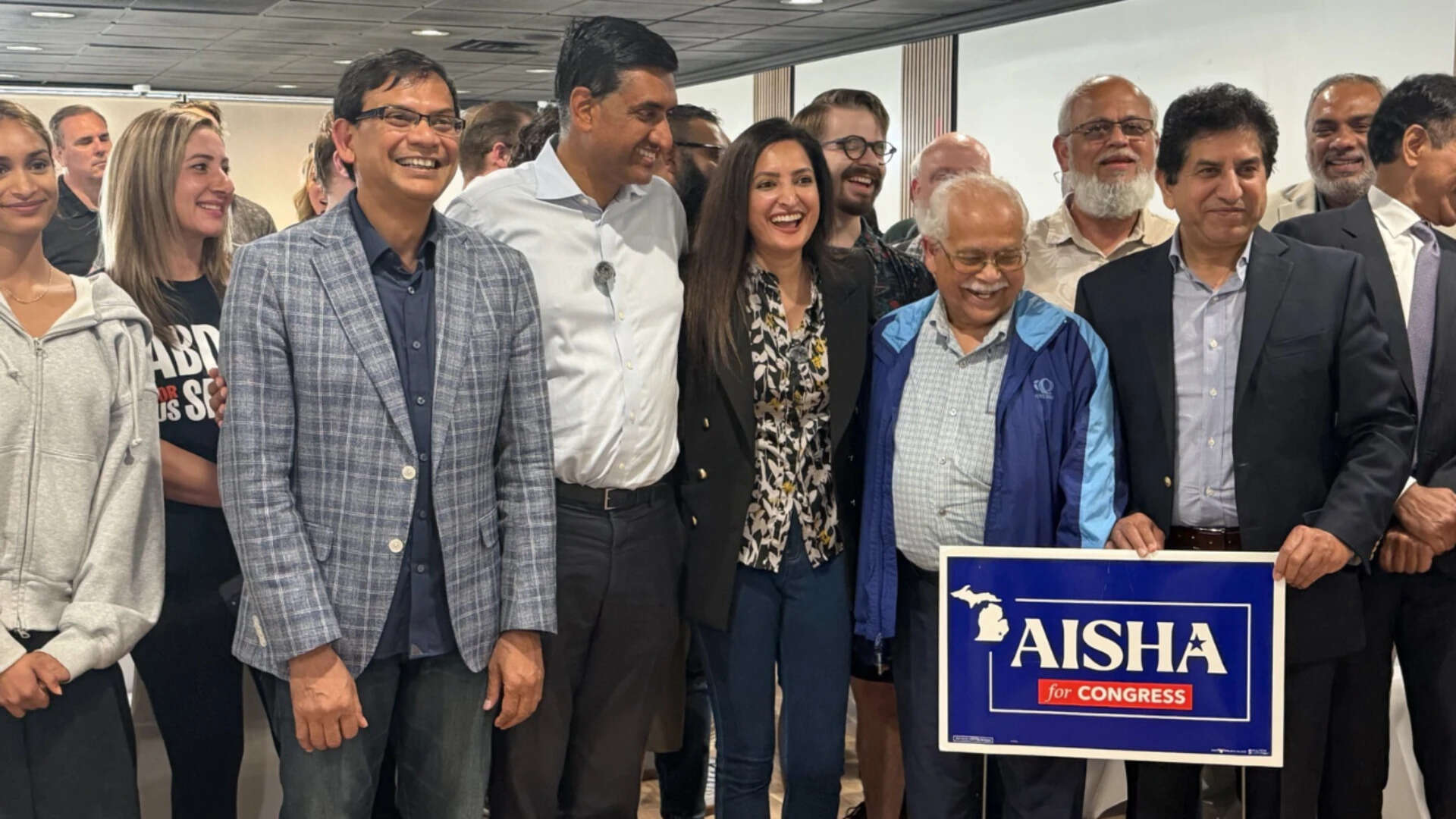
Political endorsements usually follow a predictable, exhausting script. They take place in sterile rooms under blinding fluorescent lights. Politicians read stale talking points off teleprompters. Everyone looks like they would rather be anywhere else.
But a viral 58-second video clip from a casual meet-and-greet in Farmington Hills, Michigan completely broke that mold.
California Representative Ro Khanna sat down for a chat with Aisha Farooqi, an attorney fighting for a congressional seat in Michigan. What happened next wasn't a policy lecture. It was a fast-paced conversation about Bollywood blockbusters, the ultimate Ramadan snacks, and the reality of South Asian identity in America.
Then came the kicker. Khanna looked at her and said, "Now you've got an Indian American endorsing a Pakistani American."
Farooqi didn't miss a beat. "Look at that. Only in America."
"That's what this country is about," Khanna replied.
Honestly, it's easy to dismiss this as a clever bit of public relations. But if you look closer, this endorsement reveals a major change in how the South Asian diaspora handles political power. It shows that the old geopolitical rivalries of the subcontinent don't dictate how the next generation of leaders builds alliances in the US.
The Cultural Common Ground Over Geopolitics
Mainstream media outlets love to focus on the historical tensions between India and Pakistan. They treat the diaspora as a monolith forever caught up in old-world rivalries. This conversation proved how out of touch that perspective really is.
Farooqi opened the chat by pointing out what they actually share. "We're both lawyers. Both Punjabis. Both South Asians," she noted.
Instead of debating foreign policy, the duo bonded over shared cultural touchstones that resonate with millions of immigrants. When Farooqi brought up Bollywood icon Shah Rukh Khan, Khanna immediately chimed in. He noted that My Name is Khan remains one of his favorite films.
The food debate was just as revealing. Farooqi admitted her go-to snack is a samosa, though she switches to pakoras during Ramadan. Khanna smiled and offered his own preference: paneer pakoras. They even agreed on drinks, choosing mango lassis and a solid cup of chai.
This isn't superficial fluff. It matters. By showcasing these shared traditions, Khanna and Farooqi effectively demonstrated how cultural ties can easily override historical political divisions.
Why the Michigan 11th District Matters
Farooqi is running in the Democratic primary for Michigan's 11th Congressional District. This isn't her first time step into the political arena. She previously ran tough campaigns for Michigan's House of Representatives in District 57. She has built a reputation as a fierce advocate for working families.
Born in Aberdeen, Scotland, Farooqi moved to the US and built a serious career. She earned her psychology degree from the University of Michigan-Dearborn and a law degree from the University of Detroit Mercy School of Law. Beyond her legal practice as a real estate attorney, she serves on the Michigan Child Abuse and Neglect Prevention Board. She has also spent years working with local groups like the Muslim-Jewish Advisory Council of Detroit.
Her platform hits right at the core of what working-class families care about. She is vocal about lowering the sky-high cost of living, stopping corporate price gouging, and fighting for Medicare for All. She often talks about how healthcare should never depend on a person's income or their ability to fight with insurance executives.
Getting a nod from a heavyweight like Khanna gives her campaign a serious boost. Khanna has represented Silicon Valley in Congress since 2017. He is a prominent national voice on technology policy, manufacturing, and progressive economics. When someone with that kind of national profile steps into a Michigan race, people pay attention.
A Strategic Pivot for South Asian Political Power
For a long time, South Asian political organizations in the US operated in separate silos. Indian-American groups focused on their specific goals, while Pakistani-American groups did the same. This division often diluted their collective influence on Capitol Hill.
What we're seeing now is a shift toward a broader South Asian political identity. Leaders realize they face identical challenges. They deal with the same rise in hate crimes, navigate the same complex immigration systems, and fight for the same economic opportunities.
Khanna's endorsement proves that building a unified coalition is far more effective than staying divided. By backing Farooqi, he is signaling to donors and voters that identity politics should be about shared values and futures, not past borders. It's a pragmatic strategy designed to maximize political influence in swing states like Michigan, where immigrant communities hold massive electoral sway.
Navigating the Complex Foreign Policy Dynamic
You can't talk about this endorsement without looking at the larger geopolitical backdrop. Khanna serves on the House Armed Services Committee and has long advocated for stronger ties between Washington and New Delhi.
Just days before this video surfaced, Khanna made headlines at the US-India Strategic Partnership Forum Leadership Summit in Washington. He openly stated that relations between the US and India had hit their lowest point in nearly three decades. He pointed a finger at the current administration's unpredictable policies for eroding trust and emphasized the urgent need to rebuild that bilateral partnership.
This context makes his endorsement of Farooqi even more fascinating. It shows a sophisticated ability to separate domestic political organizing from complex international diplomacy. Khanna can aggressively advocate for US-India strategic alliances on the global stage while simultaneously lifting up a Pakistani-American progressive colleague at home. It's a level of political nuance that completely defies old-school stereotypes.
Moving Past Subcontinental Rivalries
For decades, older generations of immigrants carried the emotional weight of partition and regional conflicts with them to the West. That baggage often influenced which candidates they supported and how they organized local communities.
But the political landscape in 2026 looks radically different. The newer generation of South Asian politicians, organizers, and voters grew up with a different reality. They view themselves through the lens of the American immigrant experience. To them, a shared love for Punjabi culture, Bollywood cinema, and basic economic justice matters infinitely more than decades-old border disputes thousands of miles away.
Khanna and Farooqi are proving that the diaspora is ready to move forward. They are showing that solidarity isn't just a nice buzzword to throw around at galas. It is a practical, necessary tool for winning elections and gaining real power in Washington.
If you want to support this growing political movement, the next step is straightforward. Stop treating diaspora communities as fractured groups defined by old maps. Look at the local organizing happening in places like Wayne and Oakland counties. Pay attention to how these cross-cultural coalitions form, how they raise money, and how they turn out the vote. That's where the real future of American politics is being written.