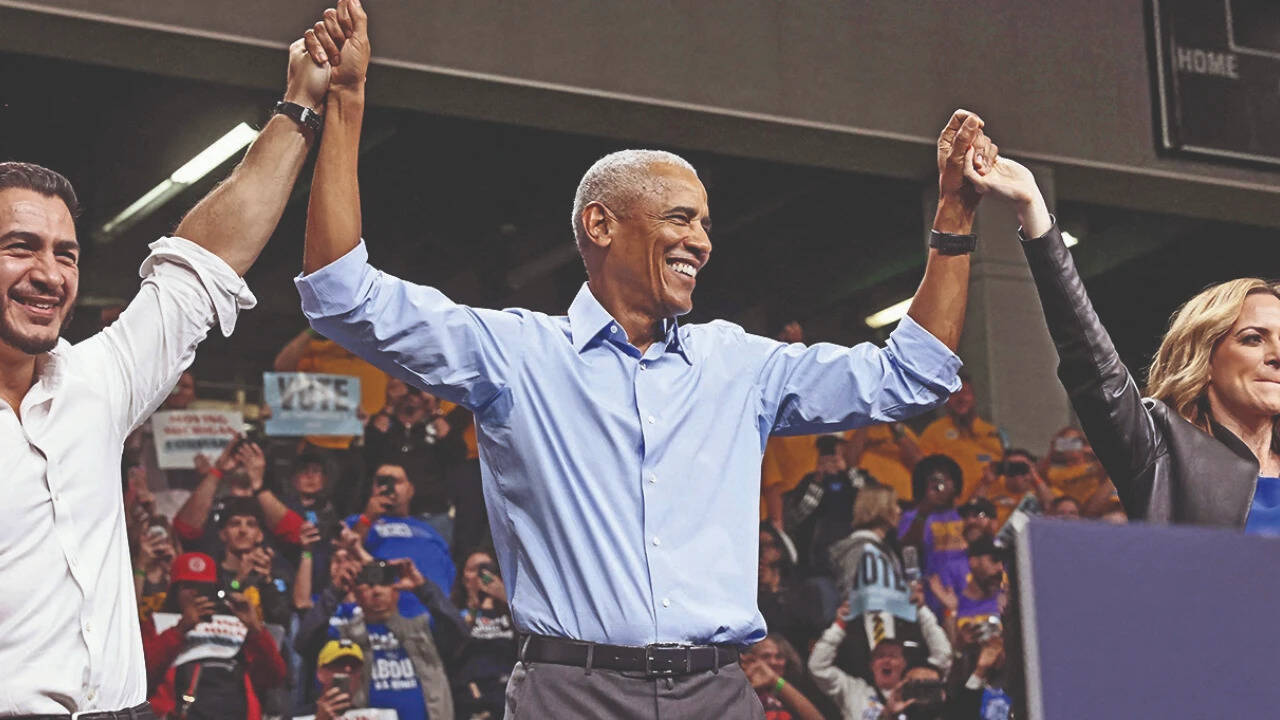
The gymnasium smells like floor wax, damp wool, and the faint, metallic tang of anticipation. It is a Tuesday evening in a battleground state—pick any of them, from the industrial corridors of Pennsylvania to the sun-baked suburbs of Arizona—and the folding chairs are packed tight enough that strangers share armrests.
At the podium, a man who once occupied the most powerful office in the world takes off his suit jacket, rolls up his sleeves, and leans into the microphone.
When former President Barack Obama steps onto a midterm campaign stage, the political press corps usually treats it like a predictable weather event. Headlines reduce the night to box-score bravado: Obama unloads on Trump while stumping for Democrats ahead of midterms. The coverage tallies the sharpest zingers, measures the decibel level of the applause, and files the story away as just another skirmish in an endless partisan war.
They miss the point entirely.
To watch Obama campaign against Donald Trump in a midterm cycle is not merely to witness two political titans trading blows from afar. It is to watch a high-wire act over a widening canyon—one where the safety net of shared civic norms has frayed, and where the ordinary voters sitting in those folding chairs are trying to figure out whether their votes still carry the weight they were promised in high school civics class.
The Weight of a Midterm Year
Midterm elections rarely arrive with the cinematic grandeur of a presidential race. There are no inaugural balls on the horizon, no sweeping biographies played over convention loudspeakers. Historically, midterms are exercises in friction—quiet, stubborn referendums on the party holding the White House, driven by grocery receipts, gas prices, and the ambient anxiety of whatever crisis dominates the evening news.
Yet over the past decade, the American midterm has mutated into something far heavier.
Consider a hypothetical voter sitting in the fourth row of that gymnasium. Let’s call her Elena. She is forty-two, manages logistics for a mid-sized regional hospital, and wakes up at 5:30 every morning to pack lunches before checking overnight supply-chain alerts. Elena does not spend her evenings dissecting cable news panels. She cares about whether her elderly father’s prescription costs will spike next January, whether her town’s public schools can retain math teachers, and why every national conversation feels like a shouting match at a family dinner table where nobody wants to pass the potatoes.
For Elena, the clash between Barack Obama and Donald Trump is not an abstract ideological debate. It is a collision between two fundamentally different theories of how the country works—and who it is supposed to protect.
When Obama takes the stage, his strategy relies on an intimate understanding of Elena’s exhaustion. Having governed through the 2008 financial collapse and navigated two brutal midterm losses of his own in 2010 and 2014, Obama knows firsthand what happens when voters stay home out of frustration or cynicism. In 2010, Democrats lost sixty-three House seats in what he famously called a "shellacking." Four years later, they surrendered the Senate. Those defeats taught him a hard lesson: inspiration without urgency is a luxury a political party cannot afford when the opposing movement treats every election as an existential battle.
Two Visions at the Podium
To understand why Obama’s midterm speeches cut through the noise—and why Trump’s counter-messaging rallies millions of supporters with equal ferocity—you have to look at the mechanics of their appeal.
Imagine two architects standing before the same aging house.
One architect—Obama’s approach—walks the perimeter with a clipboard, pointing out that the foundation is sound, the framing is historic, and the wiring, while strained, can be modernized if everyone pitches in to repair it rather than tearing down the walls. In his speeches, Obama systematically dismantles Trump’s record and rhetoric not just with policy critiques, but with a recurring warning about democratic guardrails. According to Democratic strategists and transcripts from his campaign appearances, Obama frames Trump’s political style as a threat to institutional stability, arguing that deregulation, tax cuts skewed toward top earners, and populist grievances leave working families exposed when economic storms hit.
The second architect—Trump’s movement—looks at the exact same house, kicks the drywall, and tells the crowd that the blueprint was rigged from the start by corrupt contractors who pocketed the budget while the roof leaked.
Supporters of Trump and Republican lawmakers push back sharply against Obama’s framing. From their perspective, Obama represents an entrenched political establishment that promised hope and delivered sluggish recoveries, regulatory overreach, and cultural lectures that ignored the economic realities of heartland communities. When Trump rallies voters ahead of midterms, he points to pre-pandemic economic metrics, border enforcement, judicial appointments, and an unapologetic willingness to disrupt Washington norms as proof that a wrecking ball is sometimes the only honest tool available.
Both arguments tap into real, measurable anxieties. And both depend on convincing voters like Elena that staying on the sidelines is the most dangerous choice of all.
The Invisible Stakes Behind the Applause Lines
It is easy to get seduced by the theater of a campaign rally. The crowd roars when Obama mimics Trump’s cadence or mocks a policy contradiction; the crowd roars just as loudly miles away when Trump nicknames an opponent or lambasts the press. Theater sells tickets. It generates viral clips.
Theater also obscures what is actually on the ballot.
Strip away the personalities, and a midterm election determines the machinery of daily life in ways most people only notice when the gears grind to a halt. Control of the House of Representatives and the Senate decides whether a sitting president can confirm federal judges, pass budget appropriations without government shutdowns, or launch congressional investigations that paralyze an administration’s agenda. Even further down the ballot, midterm elections determine secretaries of state who oversee election certification, attorneys general who enforce consumer and environmental laws, and state legislators who draw district maps for the next decade.
This is where Obama’s role as "closer" becomes critical for Democrats. Modern political campaigns are awash in digital micro-targeting, algorithmic fundraising appeals, and millions of dollars in thirty-second television spots that blur together into white noise by mid-October. By the final weeks of a race, voters are numb.
Obama’s intervention is designed to break that numbness. Unlike current officeholders weighed down by the daily compromises of governing, a former president carries the freedom of perspective. He can connect a local House race in a rural-suburban district to the broader sweep of American history. He can argue, as he frequently does on the stump, that cynical disengagement—the quiet voice whispering nothing ever changes, they’re all the same—is not a sign of political sophistication, but a surrender of power.
Yet there is a paradox built into his presence, one that Democratic operatives openly acknowledge in private conversations. Relying on a former president to generate enthusiasm can highlight a party’s struggle to forge equally resonant messengers among its newer ranks. Critics on the right routinely seize on Obama’s appearances as evidence that Democrats are clinging to the nostalgia of 2008 rather than defending the immediate economic realities facing voters today.
When Politics Becomes Personal
I have spent enough election nights watching returns trickle in from county boards of elections to know that political momentum rarely feels like a tidal wave while it is happening. Usually, it looks like a trickle of people walking into a community center library in the rain, shaking out umbrellas, signing their names in a spiral-bound ledger, and stepping behind a cardboard privacy screen.
That quiet ritual is where the loud rhetoric of Obama and Trump finally meets reality.
Think back to Elena in that gymnasium. When the speech ends, the lights come up, and the crowd files out into the cool night air toward the parking lot, the euphoria of the rally begins to fade. Tomorrow morning, the alarm will still ring at 5:30. The hospital supply spreadsheets will still be waiting. The grocery bill will still be higher than it was three years ago.
What lingers after the motorcade pulls away is a question that no speechwriter can answer for her.
Is democracy a fragile inheritance that requires constant, patient maintenance—showing up in off-year elections, defending institutions even when they move slowly, trusting that incremental progress beats chaos? Or is the system so fundamentally broken that only relentless disruption can force it to listen to ordinary people?
Obama bets his legacy on the first answer. Trump stakes his movement on the second.
The Quiet After the Crowd Goes Home
Years from now, historians looking back at this era will likely not spend much ink cataloging which insult landed harder during a particular autumn campaign swing. They will look instead at turnout spreadsheets, precinct maps, and the razor-thin margins that decided control of Congress.
They will look at what happened after the microphones were turned off.
In the center of that empty gymnasium, a custodian sweeps up discarded campaign flyers and crushed paper water cups under the hum of fluorescent lights. Outside, tail lights bleed red into the dark along the highway as thousands of voters drive home, each carrying a slightly heavier sense of responsibility than they had when they arrived. Everything shouted from the stage—every warning, every promise, every sharp critique—now shrinks down to a single rectangle of paper waiting at a local precinct, where the loudest voice in the room is no louder than a pencil mark.


