The rain in the northern reaches of the Democratic Republic of Congo does not just fall. It consumes. It turns the unpaved veins of the Equateur province into thick, primordial clay, isolating villages from the rest of the fractured world. In these forests, silence is normal. But lately, the silence has carried a different weight.
A thermometer is a simple tool. Glass, mercury, numbers. Yet, in a remote clinic hours from Mbandaka, that small glass tube becomes a heavy instrument of dread. When the mercury climbs past forty degrees Celsius, and the standard antimalarials do nothing to coax it down, the air in the room changes. The local nurse, working under the dim glow of a solar-powered lamp, notices the tiny, unmistakable blooms of purple beneath the patient’s skin. Petechiae. The body’s internal plumbing is beginning to fail.
This is how the monster wakes up.
Public health reports will tell you that Africa’s top health authority has officially confirmed a new outbreak of Ebola virus disease in the DRC. They will give you dates, laboratory acronyms, and perhaps a count of the initial suspected cases. They will use words like surveillance and containment.
Those words are too clean. They smell of bleach and air-conditioned offices in Geneva or Addis Ababa. They do not capture the smell of woodsmoke mixed with chlorine, or the distinct, terrifying rustle of yellow biohazard suits being zipped shut in the humidity of a tropical afternoon.
The Speed of a Shadow
To understand why a handful of feverish patients in a forest clearing matters to a world obsessed with stock markets and artificial intelligence, you have to understand exponential growth. Not as a mathematical concept, but as a biological wildfire.
Ebola is a filovirus. Under an electron microscope, it looks like a tangled piece of thread, delicate and cruel. It does not fly through the air like the flu. It requires intimacy. It demands contact with the sweat, the blood, the tears of the suffering. Because of this, it preys directly on human kindness. It targets the mother bathing her sick child. It waits for the grieving family members washing the body of their patriarch before burial.
Consider a hypothetical family in a village named Bikoro. Let us call the father Alphonse. When Alphonse falls ill, his family does what any loving family on Earth does. They hold his hand. They wipe his brow. They lean close to catch his whispered words. By the time the laboratory in Kinshasa confirms that Alphonse has Ebola, the virus has already quietly moved into four new hosts.
The Africa Centres for Disease Control and Prevention knows this geometry all too well. When they issue a confirmation, it is not an announcement of a new problem; it is an admission that the race has already been running for weeks in the dark.
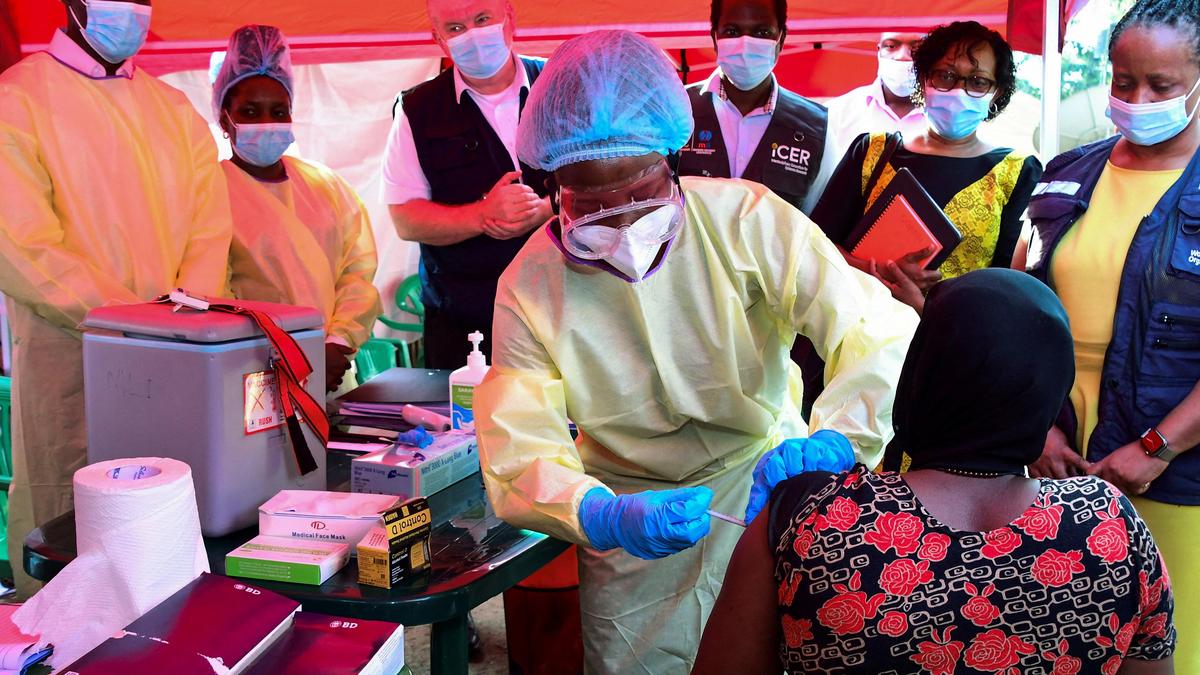
The logistical nightmare of response is hard to grasp until you have stood on the banks of the Congo River. There are few roads here. Medical supplies must travel by motorbike over tracks choked with mud, or by wooden pirogues carving through the brown water. A cooler of experimental vaccines, which must be kept at ultra-cold temperatures, becomes a ticking time bomb. If the ice melts before the motorbike reaches the village, the weapon is useless.
The Ghost of 2014
We have been here before, and that is where the true anxiety lies. The memory of the West African epidemic of 2014 still haunts the corridors of global health. That was the moment the world realized that a localized virus could swallow entire economies and cross oceans. Over eleven thousand people died because the initial response was sluggish, bogged down by bureaucracy and disbelief.
The DRC is different. The country has battled this specific demon more than a dozen times since the virus was first identified near the Ebola River in 1976. The local doctors and nurses are among the most experienced virus hunters on the planet. They know how to trace contacts. They know how to set up isolation tents.
But experience does not breed immunity to fear.
Imagine putting on a personal protective equipment suit when the ambient temperature is thirty-five degrees. Within ten minutes, sweat pools in your rubber boots. Your goggles fog up. Your breath echoes loudly in your ears. You look out through a layer of clear plastic at a frightened child who cannot see your face, only your eyes. You are a specter to them. A symbol of death, even though you came to save them.
The resistance from communities is often misunderstood by outsiders as ignorance. It is not. It is a rational response to an irrational situation. Strangers arrive in white trucks, take away your loved ones, and sometimes return them in sealed body bags, forbidding traditional funerals. If you do not trust the government in normal times, you certainly will not trust them when they arrive in spacesuits.
The Thin Line of Defense
The international community tends to view these outbreaks as distant, tragic spectacles. A news crawl on a television screen. A headline scrolled past on a phone during a morning commute.
That view is a luxury we can no longer afford.
In an interconnected global economy, the distance between a remote Congolese village and a major international airport is measured in days, sometimes hours. The forest is no longer a barrier; it is a starting line. The brave health workers currently wading through the mud of Equateur are not just protecting their own neighbors. They are holding a line for everyone.
The tools have improved. We now have ERVEBO, a highly effective vaccine that can form a ring of immunity around confirmed cases. We have monoclonal antibody treatments that can save lives if administered early. The science is triumphant.
But science requires a delivery mechanism, and the delivery mechanism is human courage. It relies on a local community health worker convincing a skeptical village chief to allow the vaccination team inside. It relies on a driver risking his life on a broken bridge to deliver personal protective equipment.
The sun sets early near the equator, plunging the forest into a deep, uncompromising darkness. In the isolation ward, the generators hum, a fragile counterpoint to the sounds of the night. A nurse sits by a bedside, watching the erratic rise and fall of a patient's chest. Every breath is a small victory. Every hour survived is a step toward the edge of the woods.
The red dust of the roads will eventually settle when the dry season returns. The world's attention will inevitably drift away to other crises, other headlines. But for now, in the quiet heat of the clinic, the glass tube of the thermometer holds the entire world in its balance.