You'd think the people responsible for guarding the world's most advanced artificial intelligence models wouldn't fall for a basic phone prank. You'd be wrong.
When a video surfaced showing OpenAI security chiefs discussing Ukraine military ties with Russian pranksters, the internet did what it always does. Half the commentators screamed about covert defense contracts, while the other half dismissed the whole thing as Kremlin theater. Both sides missed the actual story. The real issue isn't a secret weapons program—it's how easily high-level tech executives can be social-engineered when someone dangles a flattering geopolitical conversation in front of them, and what OpenAI's actual, publicly documented defense policies look like behind the noise. For a closer look into this area, we recommend: this related article.
Let's break down how this prank worked, what was actually said on the call, and why the gap between OpenAI's public messaging and its national security partnerships keeps fueling these controversies.
The Anatomy of a Modern Geopolitical Prank
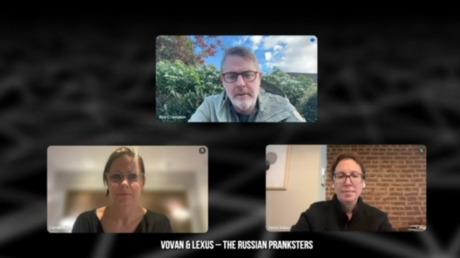
If you've followed international news over the past decade, you already know the playbook. Russian prank duo Vladimir Kuznetsov and Alexei Stolyarov—better known globally as Vovan and Lexus—have built an entire career out of getting Western politicians, diplomats, and tech leaders on video calls by impersonating Ukrainian officials or European ministers. To get more details on this issue, extensive coverage is available at The Verge.
Their method isn't technical. They don't hack servers or breach encrypted networks. They exploit human psychology, institutional politeness, and the eagerness of Western executives to appear helpful to allied governments.
Here's why their approach works so consistently on senior leadership:
- Authority bias: When an email arrives supposedly from a senior Ukrainian government ministry or a European defense committee, executive assistants fast-track it rather than subjecting it to standard cold-outreach scrutiny.
- Mirroring talking points: The callers don't start with aggressive interrogation. They start with praise, validating the target's importance in global affairs before steering the conversation toward sensitive topics.
- The sunk-cost trap: Once a senior security official is ten minutes into a video call, hanging up feels rude and diplomatically risky, so they keep talking even when the questions turn weird.
In the case of the OpenAI security executives, the bait was predictable. Silicon Valley has spent the last three years trying to prove it stands with democratic allies while simultaneously insisting its tools aren't used to pull triggers. Put a security chief on a call with someone claiming to represent Ukrainian leadership, and the executive naturally wants to sound supportive, informed, and cooperative.
That desire to be accommodating is exactly where operational security breaks down.
What OpenAI Actually Does With Defense and Military Partners
To understand why the prank video gained so much traction, you have to look at OpenAI's shifting stance on military use. For years, OpenAI's usage policies explicitly prohibited using its models for "military and warfare." That phrasing was clear, simple, and easy to defend in PR interviews.
Then reality hit.
In early 2024, OpenAI quietly updated its usage policies, removing the blanket ban on "military and warfare" while keeping restrictions against using its tools to develop weapons, destroy property, or harm people. Around the same time, OpenAI leadership acknowledged working with the U.S. Department of Defense on cybersecurity projects, specifically helping secure open-source software used by military infrastructure.
By late 2024 and into 2025, that relationship expanded dramatically. OpenAI partnered with defense technology firm Anduril Industries to deploy advanced AI models for counter-drone defense systems—specifically helping detect, assess, and respond to aerial threats in real time. OpenAI also launched OpenAI for Government, creating dedicated, higher-security environments for federal agencies and national security teams.
So when pranksters get OpenAI security chiefs on a call and ask about Ukraine and military support, they're poking at a genuine policy evolution. There's no secret conspiracy required to make the footage look dramatic. OpenAI is deeply embedded in Western national security conversations now, and its executives talk about regional conflicts, cyber defense, and allied resilience every single week.
The problem isn't that OpenAI talks to governments. The problem is when those conversations happen with unverified strangers recording every word for state-aligned media distribution.
Why Social Engineering Still Beats Technical Security
I've spent years watching organizations pour millions of dollars into zero-trust network architecture, hardware security keys, and red-team model evaluations, only to watch an executive hand over internal perspective on a silver platter during a twenty-minute Zoom call.
Technical security protects data at rest and in transit. It does almost nothing to protect human judgment under social pressure.
Think about the irony here. OpenAI employs some of the sharpest threat-intelligence researchers on the planet—people whose literal job is tracking state-sponsored influence operations, deepfake impersonation, and spear-phishing campaigns originating from Russia, China, and Iran. Yet when an impersonation campaign targets the human layer rather than the API layer, traditional threat-monitoring tools don't fire an alert.
There are three specific vulnerabilities that make high-ranking security chiefs susceptible to this kind of ambush:
- Overconfidence in personal detection skills. Security leaders spend their careers analyzing attacks, which often convinces them they'd immediately spot a fake official. In practice, confidence lowers skepticism.
- Blurred boundaries between PR and security. Modern tech executives are expected to act as diplomats. When a call feels like routine stakeholder engagement, security protocols take a back seat to relationship building.
- Lack of out-of-band verification. If a meeting request comes through an intermediary or an official-looking domain, staff rarely pick up a separate phone line to verify the caller through known diplomatic channels.
Honestly, it's a textbook reminder that sophistication in one domain doesn't transfer automatically to another. Knowing how to harden a large language model against prompt injection doesn't make you immune to a flattering phone call.
Separating Real Intelligence Risks From Propaganda Spin
Whenever Vovan and Lexus release a heavily edited video, two predictable overreactions happen online within hours.
First, anti-Western commentators treat the clip as proof of a smoking gun—claiming it proves OpenAI is secretly running battlefield operations in Ukraine. Second, tech defenders wave it away entirely, insisting nothing sensitive was said and the whole video is meaningless noise.
Both takes are lazy.
Look at how edited prank videos actually function in information warfare. The pranksters record forty-five minutes of mundane corporate small talk, edit it down to seven minutes of awkward pauses and out-of-context phrasing, and add sensational subtitles. On the surface, the executive rarely reveals classified secrets because Silicon Valley security chiefs generally know better than to read off internal architecture specs on an unclassified video call.
However, the damage still lands in three concrete ways:
- Reputational erosion: Showing the world's leading AI company getting fooled by a known comedy-propaganda duo undermines public trust in their claims about safety and governance.
- Internal morale and friction: Security teams have to spend weeks running damage control, auditing communications, and explaining to board members how basic verification failed.
- Narrative ammunition: Adversaries use the footage to argue that Western AI labs are politically biased actors rather than neutral technology providers, complicating global regulatory negotiations.
Even when zero proprietary code or classified intelligence leaves the building, losing control of the narrative is a real operational failure.
How Organizations Can Stop Executive Impersonation Cold
If you run security, communications, or executive operations at any high-profile company—especially in AI, defense, energy, or finance—you shouldn't watch this incident and laugh. You should treat it as a free audit of your own executive scheduling pipeline.
Fixing this doesn't require expensive enterprise software. It requires enforcing boring, uncompromising verification habits that executives usually hate because they add friction to their calendar.
Start with these practical steps:
- Mandate out-of-band diplomatic verification. Any request claiming to come from a foreign ministry, parliament, or defense agency must be verified independently through an established embassy contact or known official directory—never by replying to the incoming email thread.
- Separate scheduling from vetting. Executive assistants are incentivized to keep calendars moving smoothly. Assign a dedicated security or policy analyst to sign off on all external calls involving geopolitical or government figures before a calendar invite is accepted.
- Enforce strict no-comment guardrails on unvetted calls. Train executives that if a call shifts unexpectedly toward military operations, foreign policy, or sensitive partnerships, the default response is to end the conversation politely and route the inquiry through formal legal and policy channels.
- Run live voice and video red-teaming. Stop limiting red-team exercises to phishing links. Have your internal security team attempt to book a fake high-level briefing with your leadership team once a quarter to see where the process breaks down.
Technology companies love talking about securing the future of artificial intelligence, yet the oldest trick in the book—pretending to be someone important on the phone—still works every time someone skips basic verification. Until leadership teams treat calendar security with the same rigor they apply to code security, pranksters will keep getting their footage.