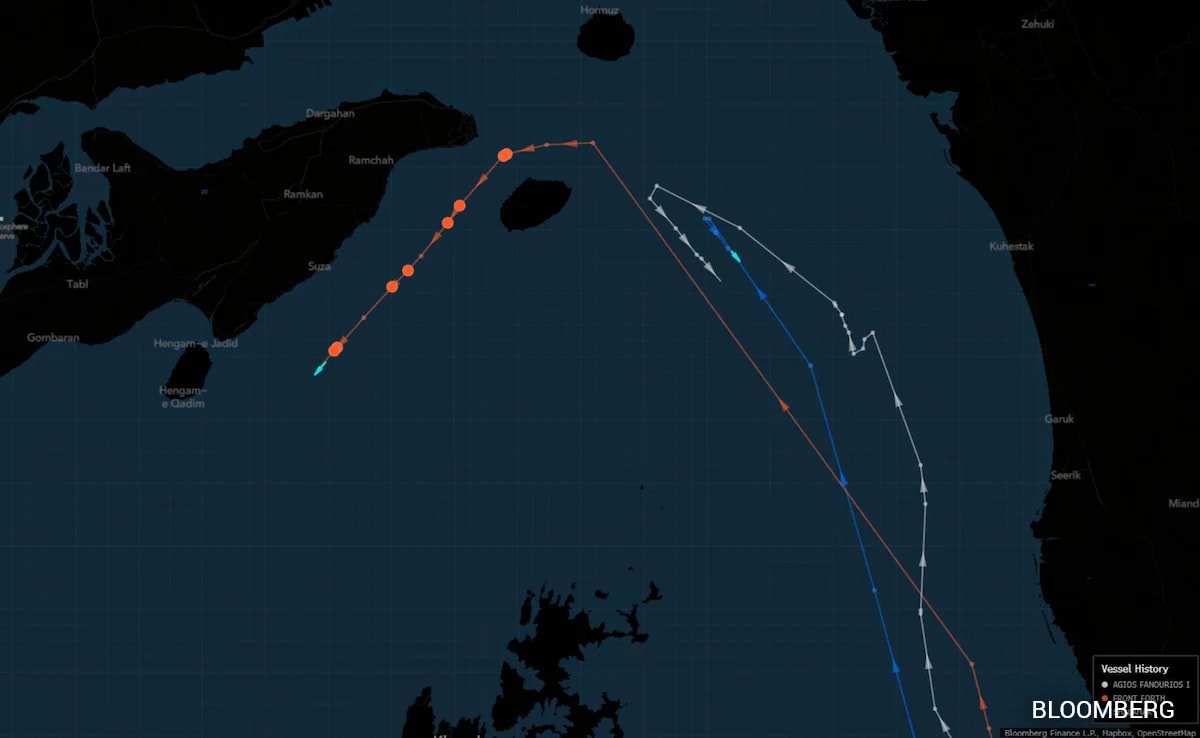
The sudden U-turn of two massive supertankers at the mouth of the Strait of Hormuz on Sunday was not a navigational error. It was a billion-dollar vote of no confidence. As US-Iran peace talks in Islamabad sputtered into a stalemate, the Pakistan-flagged Shalamar and the Iraq-bound Agios Fanourios I abruptly abandoned their approach to the world’s most volatile chokepoint. While the industry watched the diplomatic breakdown in real-time, the real story wasn't just the failed handshake—it was the collapse of a fragile, backdoor maritime security protocol that had briefly convinced insurers it was safe to return to the Gulf.
The incident highlights a brutal reality for the global energy market. Political "ceasefires" mean nothing to a ship captain when the rules of engagement on the water are being rewritten by the hour. These vessels were empty, heading into the Persian Gulf to pick up the very crude oil the world is desperate for as Brent prices hover at historic highs. Their retreat proves that despite political posturing from Washington and Tehran, the Strait is effectively a dead zone for commercial shipping that lacks a specific, often clandestine, stamp of approval.
The Mirage of Safe Passage
For forty-eight hours, the maritime world allowed itself to believe the "Islamabad Window" was real. Following weeks of devastating strikes on Iranian infrastructure and a retaliatory blockade that choked off 20% of global oil supply, a two-week truce was supposed to see the Strait reopen. The Shalamar and the Agios Fanourios I were the test cases.
Unlike the Mombasa B, which successfully navigated the Iran-approved channel between Larak and Qeshm islands on Sunday, the aborted tankers encountered a shifting set of demands. Iranian Revolutionary Guard (IRGC) naval commands had signaled that "civilian vessels" would be granted passage under "specific conditions." In the opaque world of maritime intelligence, those conditions often involve more than just a radio check-in. Reports have surfaced that Tehran is attempting to impose a "transit toll" of $1 per barrel on vessels using their waters—effectively a $2 million surcharge for every Very Large Crude Carrier (VLCC).
When the Islamabad talks hit a wall—punctuated by US Vice President JD Vance’s blunt assessment that the lack of an agreement was "bad news for Iran"—the "specific conditions" for the tankers likely became impossible to meet. The risk of seizure or a "limpet mine accident" suddenly outweighed the massive daily charter rates these vessels command.
The Insurance Deadlock
To understand why a ship turns around when a diplomat stops talking, you have to look at the Lloyd’s of London war risk premiums. During the height of the February conflict, these premiums surged to levels that made a single voyage cost-prohibitive for all but the most desperate national oil companies.
The brief ceasefire was supposed to trigger a downward adjustment. Instead, the lack of a formal signed agreement has left insurers in a state of paralysis.
- The Approval Gap: Iran demands ships use their specific lanes and seek direct military approval.
- The Sovereignty Conflict: The US Navy has maintained that the Strait is an international waterway and has even begun mine-clearing operations to ensure a "safe pathway."
- The Captain's Dilemma: Following a US-cleared path might lead to an Iranian seizure; following the Iranian path might be seen as a violation of sanctions or an admission of Iranian jurisdiction over international waters.
The Mombasa B likely moved forward because its cargo, destination, or ownership was part of a pre-arranged "dark fleet" or a sanctioned bypass that the IRGC had already cleared. For a Pakistan-flagged vessel or an Iraq-bound tanker, the legal and physical risks of being caught in the crossfire of a renewed military escalation are simply too high.
The Ghost of 1980s Tanker Wars
We have seen this script before, but the stakes are significantly higher in 2026. During the Tanker War of the 1980s, over 500 ships were attacked, yet the global economy was less intertwined with just-in-time delivery systems. Today, the closure of the Strait doesn't just raise gas prices; it shuts down refineries in Asia within weeks and threatens the structural stability of the European energy grid.
The turnaround of the Shalamar is a signal to the markets that the "normal" flow of oil is a long way off. We are entering a phase of "asymmetric navigation," where only ships with specific political protection or those willing to pay what amounts to state-sanctioned extortion can move.
The US military's attempt to "guarantee" passage by sending warships into the waterway has, paradoxically, increased the immediate danger for civilian tankers. The IRGC has already threatened to respond to the presence of American mine-sweepers, viewing them not as security, but as an infringement on their "defensive" mining operations. For a tanker captain, a US Navy escort is less a shield and more a target.
Beyond the Diplomatic Table
The Islamabad talks failed because the distance between the core demands—permanent sanctions relief versus verifiable nuclear and regional de-escalation—is wider than the Strait itself. But for the shipping industry, the failure is more granular. It represents the lack of a "Hotline" or a technical maritime agreement that separates commercial transit from high-level geopolitics.
Without a technical agreement on "Safe Transit Zones" that both the US Fifth Fleet and the IRGC respect, the Strait remains closed in practice, if not in official decree. The U-turn of those supertankers was the physical manifestation of a diplomatic vacuum.
If these vessels continue to avoid the Gulf, the "forward positioning" of empty tonnage will collapse. Refineries in Iraq and the UAE will run out of storage space for their crude because there are no ships to take it away. This is the "ghost blockade"—a scenario where the guns aren't firing, but the fear is so pervasive that the world’s energy artery stops beating anyway.
The next few days will determine if the Mombasa B was a fluke or the start of a very expensive "pay-to-play" transit system managed by Tehran. For now, the supertankers idling in the Gulf of Oman are waiting for a signal that isn't coming. They are the true barometers of the crisis, and today, they are pointing away from the Gulf.
Get used to the $120 barrel. The "Islamabad Window" just slammed shut.