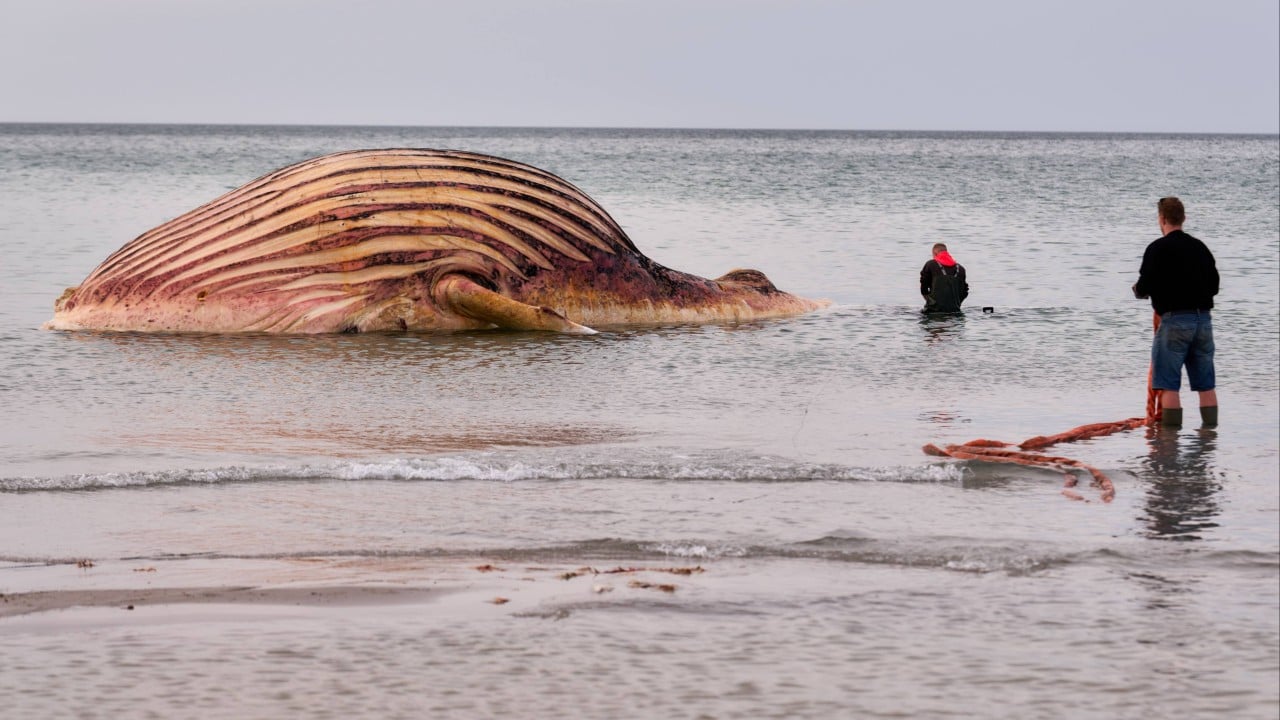
The bloated, twelve-ton carcass of a humpback whale nicknamed Timmy was dragged onto a beach on the Danish island of Anholt on Saturday, ending a multi-week logistical nightmare and a months-long media spectacle. Technicians used a heavy truck and thick cables to pull the decaying marine mammal from the shallow waters of the Kattegat strait, where it had languished since mid-May. A specialized team of Danish veterinarians and biologists will begin a postmortem examination this week, searching the animal’s stomach and tissues for answers.
They are unlikely to find many surprises. The brutal reality is that Timmy died because humans prioritized viral sentimentality over veterinary science.
What the public was told was a heroic, privately funded rescue mission was, in truth, an agonizing, prolonged execution. By tracing the timeline from the whale’s first appearance in the Baltic Sea to the chaotic operation that dropped it into the North Sea, a disturbing picture emerges of how internet fame, wealthy hubris, and pseudoscience overrode the frantic warnings of marine biologists. Timmy did not die of natural causes. The whale died because a crowd demanded a miracle for an animal that needed euthanasia.
The Baltic Trap and the Illusion of Survival
Humpback whales do not belong in the Baltic Sea. The body of water is shallow, heavily trafficked, and lacks the high salinity and specific food webs required to sustain a thirty-three-foot-long cetacean. When the whale—initially thought to be a young bull but later identified by researchers as a female—wandered through the narrow Danish straits in early March, its fate was largely sealed.
By the time locals near Timmendorfer Strand heard the whale’s deep, distressed moans, the animal was already starving and compromised. It quickly became entangled in commercial gill nets. While volunteer groups and local authorities initially managed to cut away some of the ropes, the whale repeatedly beaching itself on sandbanks indicated a much deeper systemic failure.
When a large whale strands, its internal chemistry begins to self-destruct. Without the buoyancy of the ocean, the sheer mass of the mammal crushes its own internal organs, restricting blood flow and causing severe muscle breakdown known as rhabdomyolysis. This releases massive amounts of myoglobin into the bloodstream, poisoning the kidneys.
Recognizing these irreversible physiological realities, the International Whaling Commission issued a blunt statement on April 7. The commission explicitly warned that the whale's chances of survival were negligible and that further attempts to refloat the animal would only prolong its suffering. State-sponsored rescue efforts were officially abandoned.
Then came the private money.
Crowdfunding Agony under the Guise of Hope
Where scientists saw a terminal patient, wealthy entrepreneurs and social media influencers saw a branding opportunity. A highly publicized, privately funded initiative took over the operation, raising vast sums from a public gripped by live-blog updates and push alerts. The whale was given two names by competing factions: Timmy and Hope.
The scene along the German coast deteriorated into a bizarre circus. Police had to erect cordons to prevent onlookers from swimming into the freezing waters to touch the animal. Online, the discourse shifted from ecology to esotericism. Self-proclaimed "whale whisperers" claimed they could communicate telepathically with the mammal, while fringe groups linked to esoteric movements asserted they could create a healing aura around the sandbank. Rescuers who suggested euthanasia received death threats from an angry public convinced that corporate entities or local museums wanted the whale to die to steal its skeleton.
Driven by public pressure and unburdened by scientific oversight, the private operators launched Operation Cushion. On May 2, they successfully loaded the weakened, highly stressed animal onto a flooded cargo barge. The plan was to transport the whale out of the Baltic and release it into the deep, open waters of the North Sea, where it supposedly stood a chance.
The transport itself was a logistical disaster. Reports later surfaced of intense infighting among the rescue crew aboard the vessel. Under duress and running out of time, the team dropped the whale into the water near the northern tip of Denmark—far short of the intended Atlantic-facing destination.
The private team pointed to data from a satellite tracker attached to the whale’s back, claiming that deep dives proved the operation was a victory. The media swallowed the narrative. Major international outlets ran triumphant headlines celebrating the "spectacular rescue."
It was a lie. The whale was dead within days.
The Physics of Decomposition and the Logic of a Beach Necropsy
When the tracker stopped moving and the carcass was spotted floating near Anholt on May 14, the triumphant narrative shattered. For two weeks, the Danish Environmental Protection Agency wrestled with how to handle twelve tons of rapidly decomposing biological matter rotting in shallow waters near a popular tourist beach.
The initial plan was to tow the carcass to the deep-water port of Grenaa, where a controlled necropsy could be performed in a clinical setting. That plan was hastily abandoned after three separate attempts to secure towing lines failed. The whale’s body had entered a highly volatile state of decay.
As a whale decomposes, the bacteria inside its massive digestive tract continue to multiply, producing immense volumes of methane, hydrogen sulfide, and ammonia gas. Because whale skin and blubber are incredibly tough and elastic, the carcass acts as a natural pressure vessel. Towing an advanced-stage whale carcass against ocean currents creates severe hydrodynamic drag. Had the team persisted in pulling Timmy toward Grenaa, the structural integrity of the skin would have failed, resulting in a catastrophic, explosive rupture that would have contaminated the towing vessels and scattered putrefying tissue across miles of shipping lanes.
Faced with this hazard, Danish authorities chose the only viable alternative: dragging the whale onto the sandbank at Anholt to perform the autopsy directly on the beach.
The upcoming examination will catalog the physical toll of the rescue attempt. Scientists expect to find severe internal bruising from the barge transport, advanced kidney failure brought on by multiple strandings, and significant quantities of plastic and netting remnants in the baleen and stomach. The tissue samples will be distributed to natural history museums for genetic research, providing a meager scientific consolation prize for an avoidable tragedy.
The Cost of Toxic Altruism
The death of Timmy highlights a growing crisis in wildlife conservation: the weaponization of public sympathy against scientific consensus. When emotional investment from online communities dictates the treatment of injured fauna, the outcome is rarely beneficial to the animal.
Euthanasia is often the only humane option for a stranded large cetacean. Forcing a dying animal through the trauma of heavy machinery extraction, long-distance barge transport, and sudden release into unfamiliar waters is not conservation. It is cruelty masquerading as compassion.
The entrepreneurs who funded the operation have moved on to other projects, their social media feeds scrubbed of the definitive victory declarations posted on May 2. The public has stopped sending push notifications. Left behind on a remote Danish beach is a rotting monument to human ego, waiting for the scalpels of veterinarians who knew how this story would end before the first line was ever tied.