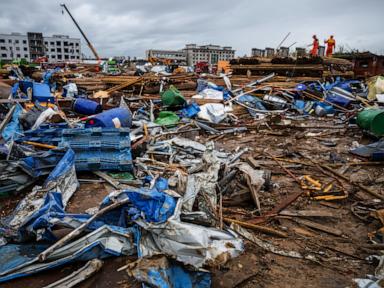
When twin tornadoes and violent convective storms ripped through central China, cutting paths of destruction through Wuhan and Jiangsu province, the immediate state media reports focused on the grim numbers: 11 dead, hundreds injured, and thousands of homes collapsed. Yet the real story is not the raw meteorological data. It is the widening gap between China’s rapid urban expansion and the structural vulnerabilities of its secondary cities. High-velocity winds exposed critical flaws in local construction standards and early-warning dissemination that officials have long overlooked.
For decades, China's infrastructure push prioritized vertical density and speed. This approach works well under standard conditions but creates catastrophic vulnerabilities when extreme weather hits. The disasters in Wuhan’s Caidian district and Shengze town in Suzhou were not freak anomalies. They represent a predictable consequence of building vulnerable communities in the direct path of shifting climate patterns.
The Myth of the Unpreventable Disaster
Local authorities frequently categorize tornadoes as "force majeure"—unpredictable acts of nature that defy human preparation. This defense is crumbling. While tornadoes are historically less frequent in China than in the American Midwest, the eastern and central plains have always been susceptible. The problem lies in a regulatory framework that treats severe convective windstorms as secondary risks compared to flooding or earthquakes.
Building codes in many of China's expanding industrial sub-districts lag behind the realities of modern weather. Residential blocks in manufacturing hubs like Shengze often rely on lightweight steel roofing, temporary worker housing, and poorly reinforced brick masonry. When a wedge tornado carrying winds upwards of 200 kilometers per hour strikes these areas, these structures do not just fail. They turn into shrapnel.
The structural failure observed in these recent storms highlights a systemic oversight in municipal engineering. Wind-load resistance calculations for low-rise residential and industrial buildings in central provinces are routinely calculated using outdated historical averages. They fail to account for the increasing intensity of modern convective systems.
The Broken Link in Emergency Broadcasting
Detecting a tornado is only half the battle. Delivering that information to a citizen in harm's way is where the system truly broke down. China possesses sophisticated meteorological satellites and a dense network of Doppler radars. Forecasters in Beijing and provincial capitals often see the signatures of severe rotation minutes before a touchdown.
The breakdown occurs at the localized level.
In the case of the Wuhan and Jiangsu strikes, the storms hit during late evening and night hours. While weather bureaus issued high-level alerts via smartphone applications and SMS blasts, these methods rely on active human monitoring. They require a population to be awake, checking their phones, and capable of interpreting vague "severe wind" warnings that do not explicitly mandate immediate shelter. The old-world infrastructure of localized sirens and automated public address systems has been largely dismantled or neglected in the rush toward digital-first governance.
A digital alert is useless if the recipient is asleep or if the local cellular tower is knocked out by the first gust of a supercell.
Industrial Density Meets Extreme Weather
The high death toll and injury count in these regions are directly tied to land-use choices. Central and eastern China feature some of the highest population and industrial densities on earth. When a tornado touches down in a rural area, it destroys crops. When it touches down in the industrial corridors of Jiangsu, it hits a dense matrix of factories, warehouses, and migrant dormitories.
The Vulnerability of Migrant Housing
Migrant workers bear the brunt of these disasters. The economic engine of China's secondary cities relies on cheap, rapidly deployed infrastructure to house the labor force. These structures frequently bypass the rigorous seismic and wind engineering audits applied to high-profile commercial skyscrapers in Shanghai or Shenzhen.
Factory Line Failures
Large-span industrial warehouses are particularly vulnerable to sudden pressure drops caused by tornadoes. The massive roofs of these buildings act like sails. Once a single joint or wall section fails, the wind enters the structure, creates immense upward lift, and rips the entire roof off. This compromises the walls and leads to total structural collapse within seconds, trapping workers inside.
The Cost of Retrofitting the Heartland
Fixing this problem requires a massive, expensive shift in how China approaches climate adaptation in its interior. Updating building codes for new construction is relatively straightforward, though it drives up real estate development costs. The true challenge is retrofitting the millions of existing structures that are functionally defenseless against tornadic winds.
Local governments, already facing significant debt burdens, are reluctant to enforce expensive structural upgrades on small businesses and low-income residential sectors. It is far cheaper politically to manage the aftermath of a disaster through state-led cleanup efforts and standard insurance payouts than it is to mandate a multi-billion-dollar reinforcement campaign across entire provinces.
This reactive strategy is becoming unsustainable. As global thermal patterns shift, the atmospheric instability required to trigger violent supercells is moving into areas with higher population densities. The central plains can no longer treat tornadoes as an American phenomenon or an occasional eastern anomaly.
Rethinking Sub-District Urban Planning
True resilience cannot be achieved by merely handing out flashlights and updating phone apps. It requires an overhaul of sub-district urban planning.
Municipalities must integrate micro-refuges into industrial parks—reinforced concrete reinforced structures designed to withstand intense localized pressure drops. Relying on residents to seek safety in standard brick-and-mortar homes or under corrugated metal roofs is a policy of managed casualty.
The path forward requires a cold, analytical look at the physical limits of current infrastructure. Until local building inspections match the sophistication of national meteorological radar networks, the death tolls from central China's storm seasons will continue to read less like natural disasters and more like structural failures.


