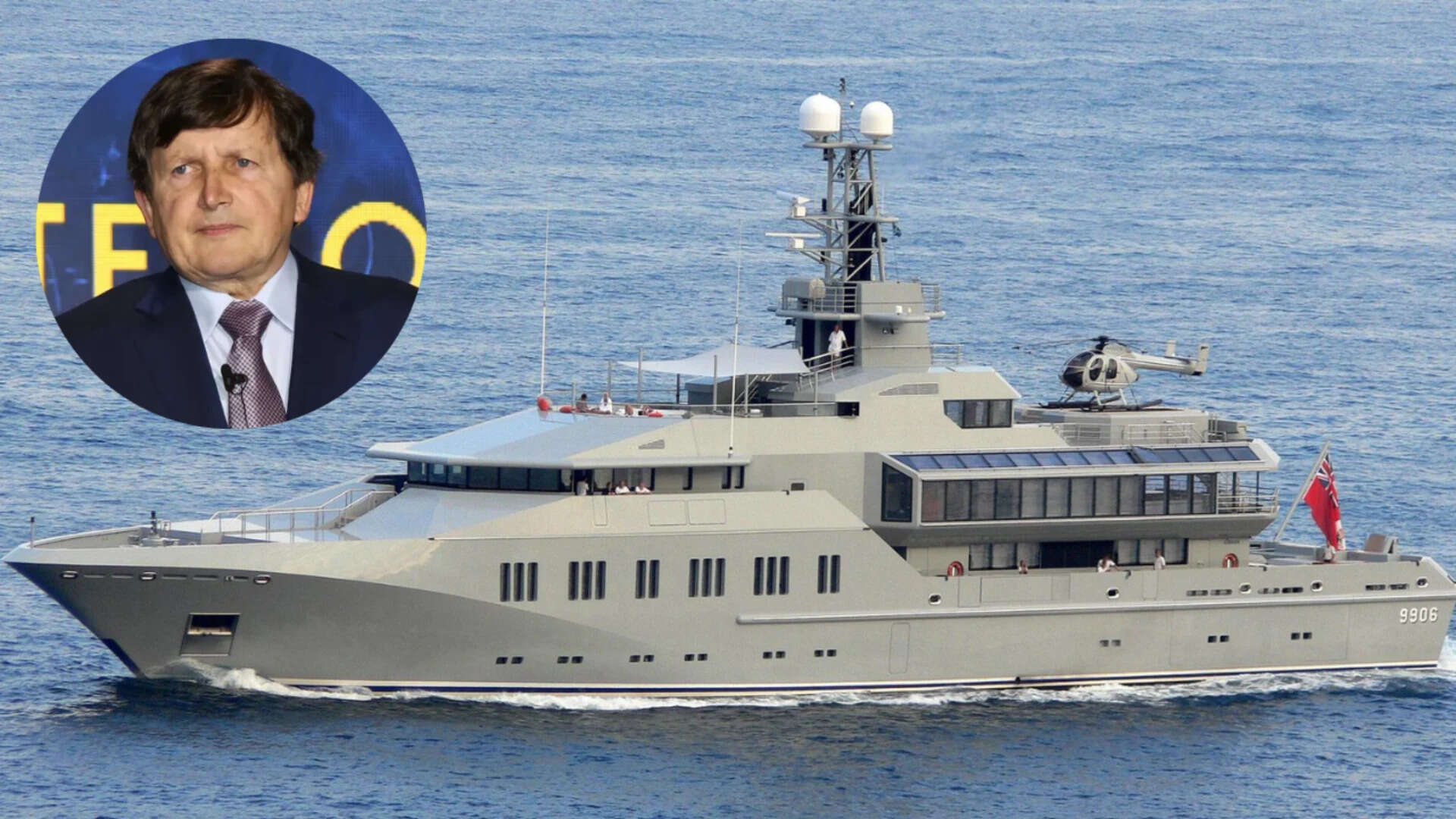
Buying real estate is usually the default play when you strike it rich. You buy the penthouse in Manhattan, the villa in Monaco, and maybe a sprawling estate in California. But if you have a net worth of several billion dollars, those static properties start looking less like achievements and more like massive tax traps.
Charles Simonyi figured this out early.
As Microsoft employee number 40, Simonyi built the applications team that gave the world Word and Excel. He is a brilliant software architect, a two-time space tourist, and currently worth about $7.2 billion. Decades before the tech elite began fleeing high-tax states for Florida and Texas, Simonyi designed a much more creative escape hatch.
He stopped buying homes on land.
Instead, he commissioned a custom-built, 233-foot superyacht named Skat, packed up his things, and spent up to six months of every single year living and working on the water. He sidestepped millions of dollars in property taxes, dodged local municipal red tape, and enjoyed the best waterfront real estate on Earth.
It was brilliant. It was incredibly comfortable. And it was entirely legal.
The Tax Strategy Behind a Floating Address
High-net-worth individuals face a constant barrage of local property taxes, state income taxes, and municipal regulations. If you buy an apartment in Montreal, Copenhagen, or Monte Carlo, you immediately trigger a massive administrative headache. You deal with zoning boards, local utility companies, and annual property taxes that scale with the value of the home.
Simonyi realized that a mobile asset offered a massive advantage.
By living on a yacht for roughly half the year, he did not establish a permanent tax domicile in high-tax jurisdictions that track your presence on land. In most parts of the world, if you spend fewer than 183 days in a country, you can avoid being classified as a tax resident. While Americans still face federal income taxes on worldwide earnings regardless of where they sleep, avoiding state, county, and municipal property taxes on ultra-luxury estates saves millions.
Think about the waterfront. The most exclusive land in European capitals like Stockholm, Oslo, or Copenhagen cannot be bought at any price. It is often reserved for historic landmarks or royal palaces.
But Simonyi could dock Skat right next to those palaces.
He once joked that his yacht gave him the absolute best real estate, the most luxurious bathroom, and a top-tier restaurant, all without paying a single dime in local municipal property taxes. When he was tired of the view, or when local tax authorities started asking too many questions, he simply ordered the captain to pull up the anchor and sail away.
Skat Was Built Like a Floating Warship
Most billionaires buy yachts that look like glossy, organic toys. Simonyi hated that aesthetic. He famously noted that most modern superyachts looked as if they had been carved out of soft cheese.
He wanted a ship that looked like a ship.
He hired legendary yacht designer Espen Øino to bring his vision to life. The result was Skat, which translates to "treasure" in Danish (a nod to a former partner), delivered by the German shipyard Lürssen in 2002.
It did not look like a vacation cruiser. It looked like a military stealth vessel.
With flat, sharp-angled steel plates, an industrial two-tone grey paint job, and the project number "9906" painted in military-style font on the side, Skat was intimidating. It was so convincing that a real naval vessel once delayed entering a port because the officers genuinely mistook Simonyi’s luxury home for an unidentified foreign warship.
Despite the aggressive exterior, the interior was a masterpiece of minimalism. Simonyi turned the living spaces into a floating modern art museum, displaying original works by Roy Lichtenstein and Victor Vasarely alongside classic mid-century furniture like Arne Jacobsen Egg chairs.
The Insane Engineering Under the Hood
You cannot run a multi-billion-dollar software empire from a boat if the plates are rattling and the engines are roaring. Because Simonyi planned to use the yacht as his primary office for half the year, he demanded extreme quiet.
He applied his engineering mindset to the construction process.
Typically, yacht builders try to insulate individual rooms to keep noise out. Simonyi went to the source of the noise. He had the shipyard mount the massive diesel engines, watermakers, air conditioning compressors, and generators onto a single, massive steel platform.
This entire platform was then suspended on specialized industrial shock mounts.
This military-grade floating deck system absorbed almost all mechanical vibration before it could travel through the steel hull. When cruising at a comfortable 15 knots, the noise level in the owner’s suite was a mere 34 decibels. For context, a quiet bedroom in a rural home at night sits around 30 decibels, while a standard office environment is around 50 decibels. Simonyi created a library-quiet sanctuary in the middle of the ocean.
He visited the German shipyard every single month during construction to inspect progress. He even had full-scale wood mock-ups of the bridge and salon built on land so he could test the ergonomics before the steel was cut.
How You Can Adopt the Mobile Asset Mindset
You might not have $7 billion in the bank, but the strategic philosophy Simonyi used is highly applicable to anyone looking to optimize their life and business.
First, stop thinking of physical real estate as the ultimate store of value. Owning land locks you down. It makes you a target for local tax hikes, changing political climates, and local municipal overreach. If you can transition even a portion of your business or personal assets to digital or mobile alternatives, you gain immense leverage.
Second, understand the power of geography hopping. Many remote founders and digital nomads use the "flag theory" to run their businesses. By earning money in one jurisdiction, keeping assets in a second, and living temporarily in a third, you dramatically lower your overhead.
Simonyi eventually sold Skat in 2021. But he did not buy a penthouse in New York. Instead, he upgraded. He commissioned Norn, a massive 295-foot Lürssen yacht that cost an estimated $250 million, continuing his legacy of living on the water on his own terms.
Look at your own balance sheet. Are you over-allocated in heavy, static assets that trigger high taxes and maintenance fees? It might be time to start thinking about how to make your life just a little bit more mobile.