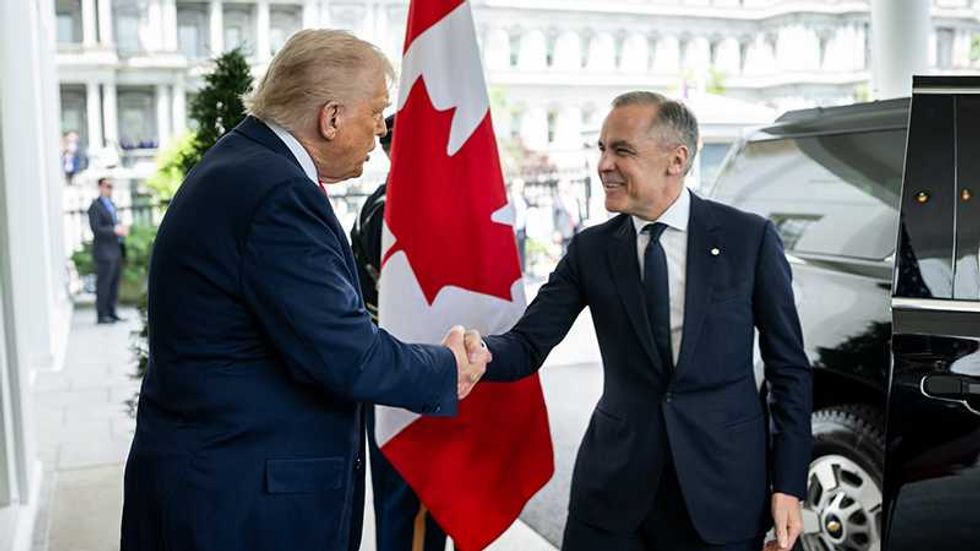
The financial fallout of the escalating trade confrontation between Washington and Ottawa is no longer a theoretical exercise for economists or a distant abstraction debated in academic journals. It is an immediate, punishing cash drain hitting balance sheets across the North American manufacturing corridor. When the White House levied aggressive fifty percent duties on a targeted roster of Canadian imports, including industrial cement, timber, and vital assembly components, the shockwaves instantly bypassed government accountants and landed directly on corporate ledger books and consumer receipts.
For decades, the physical border separating the United States and Canada operated as an administrative speed bump rather than an economic barrier. Millions of dollars in raw materials, automotive sub-assemblies, and finished goods crossed the line multiple times before a final product rolled off an assembly line. That integrated supply chain is now being treated like an adversarial supply chain.
To understand the mechanics of this friction, one must look past the fiery rhetoric of executive press conferences and examine the actual logistics. Take the automotive sector, which spans Michigan, Ontario, and points south. A wiring harness built in Windsor crosses the Detroit River, is installed into a chassis in Ohio, and gets shipped back north for final trim before heading to a dealership. Under the new trade measures, parts of this loop face severe penalty taxes. Every single crossing becomes a toll booth where profitability bleeds out.
Corporate executives who spent their careers optimizing just-in-time inventory models are suddenly forced to stockpile raw materials or absorb punishing surcharges. The cost is not magically absorbed by foreign entities. Importers of record—American businesses buying the inputs—write the checks for the duties at the port of entry.
Consider a hypothetical manufacturing outfit in the Midwest that relies on specialized Canadian steel alloys. If a shipment valued at one million dollars suddenly incurs a heavy surcharge, that mid-sized firm faces an instant cash-flow crisis. They cannot simply source an equivalent domestic alternative overnight. Specialized metallurgy requires years of qualification, testing, and regulatory sign-offs. Re-tooling a supply chain takes eighteen months minimum, while the tariff bill is due at customs in thirty days.
The political theater surrounding infrastructure projects highlights the human cost of this friction. The ceremonial opening of the Gordie Howe International Bridge, a vital multi-billion-dollar span intended to streamline commercial traffic between Michigan and Ontario, turned into a diplomatic standoff. While local leaders celebrated the completion of a physical link designed to eliminate bottlenecks, federal positioning kept top officials uninvited amid disputes over toll-sharing revenues and border levies. Bridges that should unify regional commerce are instead functioning as monuments to political posturing.
Economists tracking the broader macro picture note that these frictions act as an insidious tax on domestic growth. When input costs spike for building materials, construction projects stall. When automotive parts face penalties, vehicle prices climb on showroom floors. The consumer ultimately pays the difference through higher prices on everyday goods, eroding purchasing power at a time when household budgets are already stretched thin by persistent inflation.
Negotiators in Ottawa and Washington continue their high-stakes poker game, signaling that these measures might serve as leverage for upcoming trade pact reviews. Yet treating multi-trillion-dollar regional trade integration as a volatile bargaining chip creates permanent scars. Investment capital hates uncertainty. When rules change via executive decree from one month to the next, corporate boards shelve expansion plans. Factories that could have been built in the industrial heartland remain unbuilt, sacrificed on the altar of short-term political leverage.
The bill for this ongoing feud is being settled daily on factory floors, at customs checkpoints, and inside retail checkout lines.
Trump's New Canada Trade War, Explained
This video provides a detailed breakdown of the recent trade escalation between the United States and Canada, focusing on how tariffs function as an immediate tax on domestic consumers.
http://googleusercontent.com/youtube_content/1


