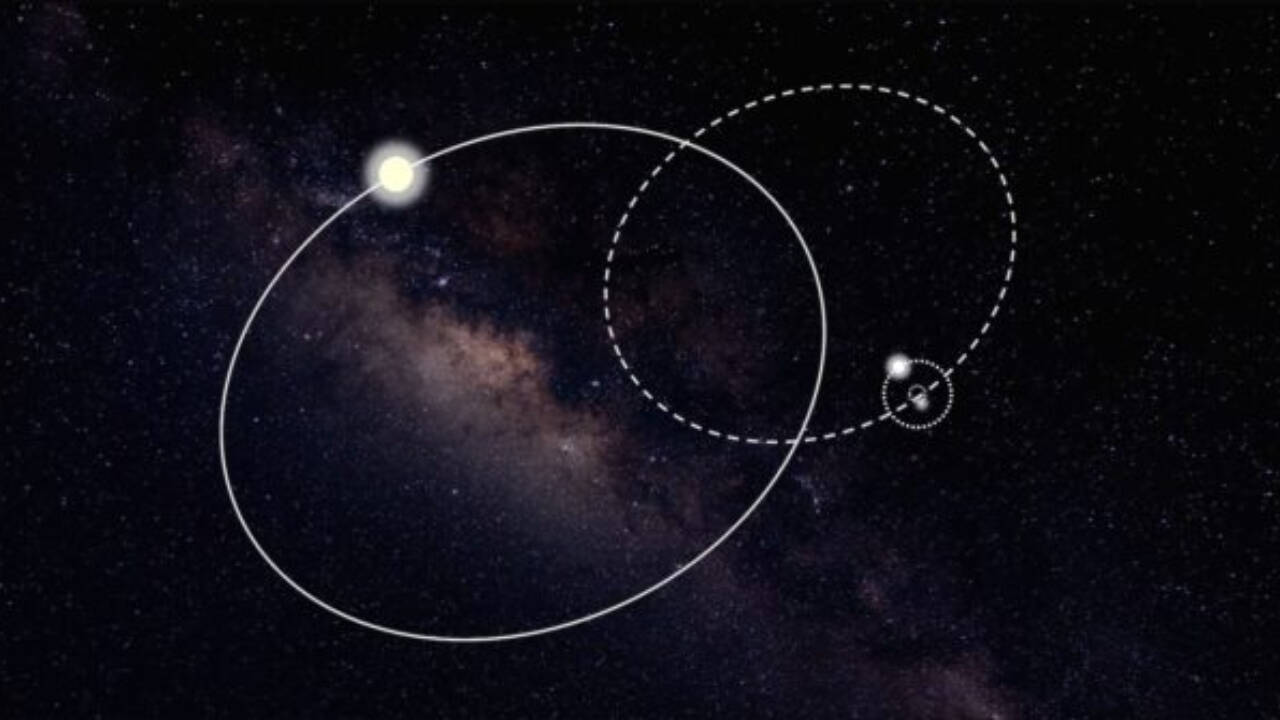
Space is supposed to follow rules. Stars orbit stars, planets orbit stars, and gravity pulls in predictable, elegant ways. But every once in a while, the universe throws a curveball that makes astrophysicists question their textbooks. When astronomers discovered a rare triple-star system hosting a spinning millisecond pulsar, they didn't just find a pretty cosmic light show. They found a high-gravity laboratory capable of pushing our understanding of physics to the absolute brink.
Most stars live in cozy pairs. Binary systems are the cosmic norm, accounting for the vast majority of stellar real estate in our galaxy. Triple systems exist, sure, but finding a tight-knit trio where one member is an ultra-fast millisecond pulsar is like finding a vintage Rolex inside a working grandfather clock. It defies ordinary expectations of how stellar nurseries birth and shape celestial bodies.
Let's clear up a massive misconception right out of the gate. People hear "pulsar" and picture a spinning neon sign or some kind of laser beam cutting through the void. In reality, a pulsar is the corpse of a massive star, crushed down into a neutron star the size of a city yet heavier than our Sun. It packs more mass than a stellar furnace into a sphere smaller than Manhattan.
And this particular pulsar doesn't just sit there. It spins on its axis every 3.2 milliseconds.
Think about that for a second. An object weighing hundreds of thousands of times the mass of Earth completes a full rotation roughly three hundred times every single second. That is faster than your kitchen blender on its highest setting. It whips magnetic fields and radiation beams across the cosmos with terrifying precision.
The Anatomy of a Stellar Trio
To understand why this system matters, you have to look at how these three objects interact. You aren't looking at a simple binary dance. You have a complex gravitational balancing act involving the central pulsar and its stellar companions.
In many pulsar systems, the dead star spins so fast because it spent millions of years cannibalizing its neighbor. Material from a companion star spirals inward, transferring angular momentum and spinning the neutron star up to these dizzying velocities. Astronomers call this "recycling." But pulling off this cosmic gymnastics routine inside a stable triple system is extraordinarily difficult. Most systems would have been violently disrupted, flinging one or more stars into deep space during the chaotic mass-transfer phase.
Instead, this system survived. The companions didn't get ejected. They settled into a delicate, gravitational waltz that has lasted for eons.
Why Pulsar Timing Is the Ultimate Scientific Tool
Pulsars are nature's most accurate atomic clocks. As they spin, they sweep beams of electromagnetic radiation across space. When those beams sweep past Earth, radio telescopes catch them as regular, rhythmic pulses.
Because their rotation rates are so remarkably stable, any tiny deviation in the arrival time of those pulses tells a story. If a planet orbits the pulsar, its gravitational tug wobbles the neutron star, slightly changing the distance the radio waves must travel to reach Earth. Astronomers read these tiny time shifts like a cosmic ticker tape.
In a triple system, the math gets wonderfully messy. The pulsar experiences gravity not just from one immediate companion, but from a second outer star exerting its own steady gravitational pull. This creates a complex gravitational three-body problem that classical physicists spent centuries trying to solve.
Albert Einstein loved this kind of problem. Or rather, his theories predicted what should happen when massive objects move through strong gravitational fields.
Testing the Strong Equivalence Principle
Here is where the discovery turns from a neat astronomy fact into a physics heavyweight bout.
Einstein built General Relativity on the foundation of the Equivalence Principle. The core idea is simple: gravity pulls on all objects with the exact same acceleration, regardless of their mass or internal composition. Drop a feather and a hammer in a vacuum, and they hit the ground together.
But what happens when you test that rule inside the intense, crushing gravitational binding energy of a neutron star? Neutron stars are so dense that a significant fraction of their total mass is actually stored as gravitational binding energy. According to standard physics, gravity should pull differently on an object with immense self-gravitational energy compared to a normal star or a white dwarf.
Physicists call this potential violation the Strong Equivalence Principle. For decades, scientists hunted for cracks in Einstein's theory by looking for deviations in pulsar timing within multiple-star systems.
Systems containing a millisecond pulsar paired with white dwarf companions provide the cleanest testing grounds. Because the outer star pulls on both the inner pulsar and its immediate companion, any tiny difference in how gravity accelerates the self-gravitationally heavy neutron star versus the lighter white dwarf shows up in the arrival times of those millisecond pulses.
When researchers crunch the numbers on these rare triple setups, Einstein keeps winning. The data shows no deviation from General Relativity down to astonishingly tight margins. Gravity treats mass the same way, even when that mass is squeezed into a city-sized dead star spinning at breakneck speeds.
The Chaotic Origins of the Trio
You might wonder how nature manages to build such an elaborate configuration in the first place. Stars don't usually form as pristine hierarchical triplets with a recycled millisecond pulsar right in the middle.
The evolutionary path is a messy soap opera of stellar dynamics. It usually starts with a binary pair where the more massive star evolves faster, swells up, and dumps gas onto its companion. That mass transfer kickstarts the pulsar precursor. Later on, a third star wanders into the gravitational capture zone, or the system interacts with a dense stellar cluster, trapping the newcomer into a wider orbit.
Then comes the tidal stripping, orbital decay, and orbital expansion. Every phase carries the risk of a gravitational ejection. The fact that this specific system made it through the gauntlet tells us that nature finds a way to stabilize configurations we previously thought were mathematically doomed to tear themselves apart.
What This Means for Future Astronomy
Every time we find an extreme laboratory like this, we sharpen our tools. The techniques used to parse the minute timing signals of a 3.2-millisecond pulsar trickle down into other fields of astrophysics.
Gravitational wave detectors like LIGO rely on precise timing and an understanding of how compact objects orbit each other. Pulsar timing arrays across the globe use similar principles to hunt for the low-frequency hum of merging supermassive black holes across the universe.
Studying these extreme systems isn't an exercise in stargazing for its own sake. It is about stress-testing the rules that govern the universe. If gravity breaks anywhere, it will break where fields are strongest and densities are highest.
So far, the universe remains stubbornly compliant with Einstein's vision. But as telescope arrays get sharper and our data collection gets cleaner, we keep pushing the boundaries. Keep an eye on the skies, because the next cosmic oddball we find might finally show us where the old equations start to crack.