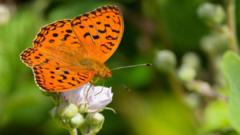
Britain's rarest butterflies are dodging extinction not through pristine isolation, but through the heavy hooves and messy feeding habits of cattle. Conservationists are deploying livestock to aggressively manipulate habitats where hands-off preservation failed. By tracking the decline of species like the Duke of Burgundy and the High Brown Fritillary, ecological data reveals that manicured nature reserves are actually lethal to insects. True survival requires structural chaos. Massive, four-legged herbivores provide exactly that by tearing up dominant grasses and exposing the soil.
For decades, the prevailing wisdom in British conservation was simple. If a patch of woodland or chalk grassland contained a rare species, you fenced it off. You kept humans out, stopped any industrial activity, and let nature take its course.
The results were catastrophic.
Without large herbivores wandering the terrain, aggressive scrub and coarse grasses like tor-grass and purple moor-grass took over. They choked out the delicate flora that specialized insects depend on for survival. The Duke of Burgundy butterfly (Hamearis lucina) became a primary victim of this well-intentioned neglect. Its caterpillars eat only primroses and cowslips. When scrub builds up, it shades out these low-lying plants. The butterflies simply vanish.
The Mechanics of the Hoof and Tongue
To understand why cattle are necessary, one must understand how they eat. It is a violent, mechanical process. Unlike sheep, which clip vegetation short and uniform like a lawnmower, cows use their long tongues to wrap around clumps of grass and pull.
This tearing action creates a highly erratic structural variety in the vegetation. It leaves behind a patchwork of tall tufts, short patches, and bare ground.
For an insect, this variation is a matter of life and death. The microclimate at the ground level changes entirely based on grass height. Tall tufts offer shelter from predators and harsh weather. Shorter patches allow the sun to warm the soil, creating the precise thermal conditions required for butterfly eggs to hatch.
Then there is the sheer weight of the animals. A fully grown traditional breed, such as a Highland, Galloway, or English Longhorn, weighs up to two-thirds of a ton. When these animals move across a hillside, their hooves smash through dense mats of dead vegetation known as thatch.
This trampling accomplishes several things at once.
- It creates pockets of bare earth where primrose and cowslip seeds can actually reach the soil and germinate.
- It breaks up dominant bracken stands, preventing the fronds from forming an impenetrable canopy.
- It creates physical depressions in the mud that catch water and retain heat, functioning as tiny incubators for insect life.
Without this heavy disturbance, the ground becomes a stagnant mat of dead matter. Seeds cannot hit the dirt. The sun cannot warm the soil profile. The ecosystem essentially suffocates under its own unmanaged growth.
Why Sheep and Machinery Cannot Replicate the Effect
Many land managers initially attempted to replace wild herbivores with sheep or mechanical mowers. It was cleaner, easier to manage, and faced less public resistance.
It did not work.
Sheep are highly selective feeders. They target the tender, flowering plants first, precisely the species that conservationists want to multiply. By eating the flowers and leaving the tough, woody scrub behind, sheep accelerate the degradation of butterfly habitats. They also compact the soil uniformly rather than creating the broken, varied topographies left by cattle.
Mechanical mowing introduces an entirely different set of problems. A tractor or brush cutter is indiscriminate. It slices through everything at a uniform height, instantly destroying any caterpillars or chrysalises attached to the vegetation. Furthermore, machinery leaves behind a thick layer of clippings. If these clippings are not manually raked and removed, a laborious and expensive task, they rot on top of the soil. This adds unwanted nutrients to the ground, fueling the growth of aggressive nettles and docks while choking out the specialized wildflowers.
Cattle offer a dynamic solution. They actively avoid many of the delicate wildflowers when coarser forage is available. They redistribute nutrients unevenly through their dung, creating localized hotspots of fertility while leaving other areas nutrient-poor, which is exactly what rare wildflowers require to compete against dominant weeds.
The Economic Friction of Conservation Grazing
Deploying cattle onto nature reserves sounds elegant in theory, but the practical execution is a logistical nightmare. The economics of modern farming run completely counter to the needs of conservation biology.
Commercial agriculture prizes rapid weight gain and high meat yield. Modern continental cattle breeds like Limousin or Charolais are bred for rich lowland pastures. Put those heavy, sensitive animals on a steep, scrubby hillside covered in bracken and gorse, and they will lose condition quickly. They can injure themselves on rough terrain, and they struggle to digest the coarse, fibrous plants that dominate neglected reserves.
Therefore, conservationists must rely on rare, traditional breeds. Belted Galloways, British Whites, and Red Polls are hardy enough to survive on poor forage, but they grow slowly. Their meat yield is lower, meaning farmers cannot easily monetize them in a standard supply chain.
This creates a severe shortage of the right animals. Nature charities often have to buy and manage their own herds, transforming ecologists into reluctant livestock managers.
The costs are significant.
+---------------------------+-----------------------------------+
| Expense Category          | Hidden Realities                  |
+---------------------------+-----------------------------------+
| Fencing and Containment   | Standard livestock fencing fails  |
|                           | on rocky or steep reserve terrain |
+---------------------------+-----------------------------------+
| Water Infrastructure      | Moving water to remote hillsides  |
|                           | requires solar pumps and piping   |
|                           | that freezing winters can destroy |
+---------------------------+-----------------------------------+
| Stockmanship and Labor    | Checking animals daily on vast,   |
|                           | overgrown sites takes hours of    |
|                           | manual tracking on foot          |
+---------------------------+-----------------------------------+
When a charity budget is stretched thin, the cost of veterinary care, bovine tuberculosis testing, and winter feed can quickly deplete funds that would otherwise go toward land acquisition or public education.
The Bureaucratic Quagmire of British Policy
Compounding the economic strain is a rigid and shifting regulatory framework. Following Britain's exit from the European Union, the transition away from the Common Agricultural Policy to the Environmental Land Management schemes was supposed to reward farmers for delivering environmental benefits.
Instead, it has created administrative chaos.
Many smallholders who want to graze traditional cattle on sensitive sites find themselves trapped in a web of conflicting rules. One government agency might demand that scrub be cleared to maintain a specific open habitat status, while another penalizes the farmer if cattle disturb nesting birds during the spring.
The funding models are equally unpredictable. Subsidies are frequently tied to rigid calendar dates rather than the actual condition of the land. A contract might dictate that cattle must be removed from a hillside by October first. However, if the summer was unusually wet and warm, the grass might keep growing well into November. The farmer is forced to remove the animals precisely when their grazing is most needed, leaving the habitat to overgrow before the winter frost.
Furthermore, the threat of bovine tuberculosis hangs over every conservation grazing project in England and Wales. A single positive test can lock down a herd, preventing animals from being moved between disconnected reserve sites. This leaves some areas overgrazed and trampled to mud, while nearby sites go completely untouched, reverting rapidly to impenetrable scrub.
The Counter-Argument of Over-Grazing
While the return of cattle has saved specific populations of the Duke of Burgundy in places like the North Downs and the Cotswolds, the strategy is not without its critics within the scientific community. Some entomologists warn that the current enthusiasm for conservation grazing has turned into a blunt instrument applied without nuance.
If livestock densities are too high, or if animals are left on a site for too long, the benefits quickly reverse.
Over-grazing obliterates the structural diversity just as effectively as under-grazing. Every scrap of vegetation is stripped bare, leaving insects nowhere to hide from the elements or predators. The heavy trampling that opens up seedbeds can turn into severe soil erosion, washing away the delicate topsoil on chalk hillsides during heavy winter rains.
The margins of error are incredibly narrow. Managing a site for the Duke of Burgundy requires keeping the sward height between five and fifteen centimeters, with plenty of scrub margins left intact for adult butterflies to roost. Achieving this exact balance requires constant, daily evaluation of the pasture. It cannot be managed via a generic spreadsheet in a regional government office. It demands experienced stockmen who understand both animal behavior and insect ecology, a combination of skills that is becoming increasingly rare.
The survival of Britain’s most endangered insects relies entirely on this messy, high-stakes compromise. Pristine wilderness is an illusion in a landscape shaped by millennia of human and animal interaction. If the public wants to keep these rare species from winking out permanently, they must accept that the solution involves muddy hooves, torn fences, and the heavy, unglamorous work of livestock management. True ecological restoration is not a scenic postcard. It is a working pasture.