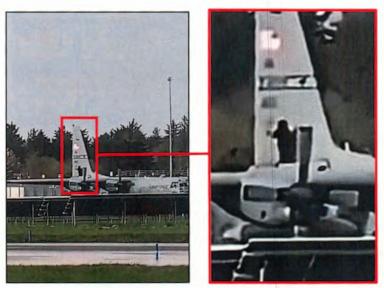
Rain falls differently in County Clare. It does not drop from the sky so much as it drifts sideways, carried off the Atlantic in cold, persistent sheets that turn concrete runways into dark mirrors. On a quiet ramp at Shannon Airport, a multimillion-dollar machine built to command the skies sat motionless, chained to the earth while its crew slept miles away in warm beds. Then came the crunch of tearing aluminum.
Silence. Read more on a connected issue: this related article.
That single, sickening sound—the unmistakable shriek of composite skin meeting unyielding steel—changes everything for the people standing on the tarmac in the middle of the night. You do not need to be a military aviator to know that specific kind of dread. Anyone who has ever backed a borrowed car into a concrete pillar at two miles per hour recognizes the cold wash of adrenaline that follows, except here the repair bill runs into the tens of millions of dollars and the vehicle belongs to the United States government.
Federal investigators eventually confirmed what airport workers on the night shift already knew in their bones. A United States military jet, parked during a routine transit stop at Ireland's westernmost international gateway, had been severely damaged on the ground. Not by enemy fire. Not by a catastrophic engine failure at forty thousand feet. It was wrecked while sitting completely still on friendly asphalt. Additional journalism by The New York Times highlights related perspectives on the subject.
The Illusion of the Safe Harbor
To understand why a stationary warplane getting clipped at a civilian airport matters far beyond an aviation maintenance log, you have to understand the psychology of transit stops. In military aviation, danger is mapped in clear, dramatic zones. Pilots train relentlessly for contested airspace, missile lock warnings, flameouts over open ocean, and night landings on pitching carrier decks. The checklist for combat is thick, rehearsed until muscle memory takes over when terror hits.
Nobody rehearses for a Tuesday night in Shannon.
Consider a hypothetical crew chief—let us call him Miller—who has spent fourteen hours nursing an aging airframe across the Atlantic from a stateside base toward the Middle East or Eastern Europe. His ears still hum from the cabin pressure. His boots are scuffed from pre-flight walk-arounds in three different time zones. When the wheels finally touch down on the long concrete strip beside the River Shannon, every muscle in his body loosens by a fraction. The mission, for the next twelve hours, shrinks to a simple routine: chock the wheels, connect the ground power, hand the keys to local ramp operations, and find a hot meal before the next leg east.
That exhaled breath is where the trouble lives.
Shannon Airport has served as a quiet, indispensable stepping stone for American military flights for decades. Positioned on the western edge of Europe, it sits at the exact geographical hinge where transatlantic endurance meets European logistics. Civilian travelers pass through its terminal duty-free shops buying wool sweaters and Irish whiskey, often glancing out the rain-streaked glass at grey fuselage silhouettes parked on the distant apron without giving them a second thought. To the casual observer, those jets look invincible. They radiate an aura of untouchable technological dominance, all sharp angles, matte radar-absorbent paint, and stenciled warnings.
Yet on the ground, a modern military aircraft is remarkably fragile. Stripped of its speed and altitude, it becomes an oversized, delicate sculpture of carbon fiber, precision sensors, and pressurized hydraulic lines. A standard commercial tug, a fuel bowser driven by a tired contractor at three in the morning, or a misjudged wingtip clearance during a tight tow can inflict structural trauma that no armor plating was ever designed to absorb.
Anatomy of a Ground Collision
When federal authorities release a terse confirmation that a military jet was damaged while parked at a foreign civilian airfield, the public reads a headline and moves on. Inside the aviation world, however, those twelve words trigger a cascade of forensic obsession.
How does a multi-ton aircraft get wrecked when its engines are off?
Usually, it comes down to geometry and blind spots. Modern tactical and transport jets are built with sweeping wingspans and low-slung engine nacelles that extend far beyond the pilot's or tow driver's natural sightlines. On a crowded civilian ramp—especially one shared with commercial airliners, cargo haulers, and regional turboprops—space is measured in inches. Ground handling crews operate under relentless clock pressure. Turnaround times dictate profitability for civilian contractors, while diplomatic flight clearances dictate schedules for military crews.
Imagine the choreography required to move a fifty-ton ground support vehicle within six feet of a parked jet's horizontal stabilizer in driving wind and low visibility. Wing-walkers—the human eyes stationed at the extremities of an aircraft to signal stop before contact—can lose visual contact with a driver for two seconds. A wet patch of tarmac can cause a heavy tow tractor to slide eighteen inches past its braking point. A miscommunication over radio frequencies, filtered through heavy regional accents and the roar of an auxiliary power unit, can turn a routine pushback into a slow-motion collision.
The physics are unforgiving. Unlike an automobile bumper engineered to crumple and pop back out, aircraft skins are stressed structures. Every square inch of fuselage carries aerodynamic load. When a heavy service vehicle strikes a parked jet, the damage rarely stops at the visible dent. Force travels inward along ribs and bulkheads, hairline fractures spiderweb through composite panels, and delicate internal wiring harnesses shear behind intact exterior plates. A scrape the size of a dinner plate can ground an aircraft for nine months.
The Geopolitical Friction on the Tarmac
There is another layer to an incident on Irish soil that no maintenance manual covers. Ireland is a militarily neutral nation, and the presence of United States military aircraft at Shannon Airport has been a subject of fierce political debate, public protest, and quiet diplomatic balancing for more than twenty years.
Every time a military transport or fighter detachment touches down in County Clare, it enters a delicate political ecosystem. Irish authorities permit unarmed transit flights under strict diplomatic conditions, treating the airport as a logistical pit stop rather than a forward operating base. Local workers refuel the planes, service the lavatories, and clear the ramps, caught between the economic lifeblood the airport brings to the west of Ireland and the simmering controversy over foreign wars passing through their backyard.
When an accident happens on that ramp, the privacy of military secrecy collides head-on with civilian jurisdiction.
On a sovereign military base in Nevada or Germany, a ground collision is handled behind razor wire. Military police cordon off the hangar, military safety boards impound the records, and the public rarely learns the extent of the damage until a heavily redacted annual report surfaces years later. At a civilian airport in a neutral country, that curtain drops. Local airport authorities, Irish aviation regulators, civilian insurance adjusters, and federal investigators from Washington all suddenly have a stake in the wreckage sitting outside Gate 14.
Questions multiply rapidly. Who was driving the vehicle that struck the jet? Was it a local civilian contractor employed by the airport authority, or a military ground crew member? Did the aircraft park in an assigned bay, or was it shuffled to an overflow stand due to commercial traffic congestion? Who pays when a civilian fuel truck ruins a sensor pod worth more than a suburban neighborhood?
I have spent enough time around aviation safety reports to know that the official narrative always arrives months after the real story has already been decided on the ramp. By the time lawyers finish arguing over liability clauses between sovereign governments and airport operators, the human reality of the night has been scrubbed clean into passive-voice bureaucracy. An incident occurred. Damage was sustained. Procedures are under review.
Nobody writes about the mechanic who had to call his commanding officer at two in the morning to explain why a combat-ready asset was suddenly bleeding hydraulic fluid onto an Irish puddle.
The Invisible Bill We All Pay
It is tempting to laugh at the absurdity of a premier military power having its hardware banged up in a parking lot. Humor is a natural defense mechanism when institutional competence looks foolish. Yet behind the dark comedy of a parked jet getting wrecked lies a sobering truth about modern military readiness.
The United States military does not have spare jets sitting in bubble wrap waiting to replace sudden losses. Modern aviation fleets are smaller, older, and vastly more expensive to maintain than they were a generation ago. Every single airframe in the inventory is scheduled down to the flight hour, woven into a global web of deterrence, reconnaissance, and rapid response.
When one jet is knocked out of commission on an Irish tarmac, the shockwave ripples across continents.
Another crew in Virginia loses their planned rest cycle to cover the missed transit leg. A spare parts depot in Utah has to strip components from a training aircraft to fabricate a custom replacement rib that hasn't been manufactured since 2014. A specialized repair team—engineers, structural metallurgists, non-destructive testing inspectors—has to pack crates of diagnostic gear and fly commercial to Shannon, setting up a makeshift field hospital inside a rented civilian hangar while the wind howls off the Atlantic.
The financial cost is staggering, often running into tens of millions of dollars for complex composite and avionics repairs. Yet the strategic cost is measured in time. While that jet sits jacked up on cradles in County Clare, waiting for custom-milled titanium brackets and federal airworthiness sign-offs, it is absent from the airspace it was sent to patrol.
What Cold Concrete Teaches Us About Power
We like to imagine that global power is decided in dramatic moments—in war rooms under harsh fluorescent lights, on aircraft carrier bridges during storms, or in high-altitude dogfights at supersonic speeds. Those are the images that fill movies and history books.
Reality is far less glamorous and far more fragile.
Most of the time, the projection of power depends on mundane, unglamorous choreography: a tired twenty-two-year-old holding illuminated wands in the rain, a checklist clipped to a wet aluminum board, a truck driver checking his mirrors one extra time before reversing near a wingtip. When those tiny, invisible systems fail, the most sophisticated war machine on earth becomes helpless scrap metal before it ever leaves the ground.
Think back to that rainy ramp in Shannon after the noise stopped. The flashing amber beacons of airport safety vehicles would have painted the wet fuselage in rhythmic strokes of orange light. Ground crews would have stood around the crumpled metal in high-visibility jackets, breath fogging in the cold Irish air, staring at a wound that made no sense. Above them, commercial airliners continued their normal approaches into the night, passengers unbuckling seatbelts and reaching for overhead bins, completely unaware that a quiet geopolitical and financial disaster had just unfolded fifty yards from the taxiway.
Power looks permanent when it is roaring across the sky. It looks entirely different when it is parked in the dark, waiting for a tow truck in the rain.