Walk into any crowded movie theater on a Tuesday night and listen to the ambient noise before the lights drop. There is the rustle of waxed paper, the low murmur of weekend plans, the faint blue glow of a dozen screens dimming one by one. We come to the dark expecting a clean bargain. We hand over twenty dollars and two hours of our lives, and in exchange, the cinema gives us a clear villain, a righteous hero, and a neat little bow at the end so we can walk back to our cars feeling whole.
Then a movie like Josephine arrives and breaks the contract.
If you glance at the marquee or skim the trades, you might think you know what you are getting into. Channing Tatum is on the poster. After two decades of watching him trade on effortless charm, kinetic grace, and the kind of broad-shouldered warmth that makes him feel like everyone’s favorite older brother, his name carries a specific promise. You expect a certain rhythm. You expect him to fix things.
He cannot fix this. Nobody can.
Written and directed by Beth de Araújo—a filmmaker whose 2022 debut Soft & Quiet proved she has an almost terrifying gift for capturing the suffocating dread of real life in real time—Josephine is not a star vehicle. It is a slow-motion earthquake disguised as a domestic drama. And standing right at the epicenter is a young actor named Mason Reeves, delivering a performance so stripped of child-actor artifice that watching her feels less like viewing a movie and more like accidentally reading someone’s private diary.
To understand why this film lingers under your fingernails for days, you have to strip away the Hollywood machinery and look at the invisible architecture of childhood.
The Architecture of a Secret
Think back to the exact moment your own childhood ended.
It rarely happens with a cinematic explosion. More often, it happens on an ordinary afternoon when you witness something you do not yet have the vocabulary to explain. You see a crack in the armor of the adults you thought were invincible. You realize the rules you were taught—be polite, follow instructions, stay inside the lines—do not actually protect you from the chaos of the wider world.
That fracture is the beating heart of Josephine.
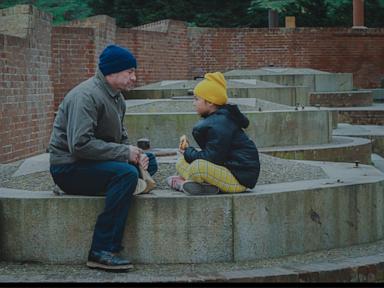
In the film, Mason Reeves plays the title character, an eight-year-old girl living in San Francisco with her parents, Damien (Tatum) and Claire (Gemma Chan). On paper, their life has the warm, sunlit texture of an idealized modern family. There are morning routines, scraped knees, half-eaten breakfasts, and the steady, rhythmic hum of two working parents trying their best to keep all the plates spinning.
Then Josephine witnesses a brutal crime in Golden Gate Park.
Here is where a lesser movie would turn into a courtroom procedural or a vigilante thriller. A lesser movie would hand Channing Tatum a wrench or a badge and let him hunt down the monster so the audience could cheer. Beth de Araújo refuses that cheap catharsis. She knows that in the real world, the aftermath of trauma is rarely loud. It is quiet. It is sticky. It gets into the floorboards of a house and changes the way air moves through the hallway.
Consider what happens next in the mind of an eight-year-old.
Adults process horror by talking, filing reports, calling lawyers, and debating policy over dinner. Children process horror by rearranging their internal furniture to make sure the roof doesn't collapse. When Josephine sees something violent and incomprehensible, she doesn't have a nervous breakdown. She adapts. She starts watching her parents with a hyper-vigilant, almost clinical intensity. She begins testing boundaries—not out of rebellion, but out of a desperate, unspoken need to figure out where the edges of safety actually are.
Watching Reeves navigate this emotional minefield is nothing short of astonishing. Most child performances rely on precociousness—a raised eyebrow, a clever line delivered like a miniature adult, a big theatrical sob on cue. Reeves does none of that. Her face is a quiet weather system. You can watch a thought form behind her eyes, stall out against the wall of her own limited understanding, and harden into a sudden, inexplicable burst of anger or withdrawal.
When the Protector Is Powerless
I remember sitting in the third row of a cramped screening room during the festival run, watching the scene where Damien tries to put Josephine to bed a few weeks after the incident. Around me, grown men and women were shifting uncomfortably in their seats, holding their breath.
Channing Tatum has never been better, precisely because de Araújo strips away every single tool he usually relies on. Tatum is a physically imposing man; his body language usually communicates capability and control. In Josephine, that size becomes a liability. Every time he crouches down to eye level with his daughter, you can feel the sheer agony of a father realizing his strength is completely useless against the thing hurting his child.
You cannot arm-wrestle a nightmare. You cannot outrun a memory that lives inside your daughter’s head.
Tatum plays Damien with a bruised, stumbling tenderness. He asks the wrong questions. He pushes when he should pull back, and pulls back when he should hold on. Watching him try to coax the truth out of Josephine is like watching someone try to perform delicate surgery wearing winter mittens. His love for her is massive, undeniable, and entirely insufficient.
Gemma Chan, meanwhile, brings a razor-sharp, brittle realism to Claire. While Damien wants to confront the damage head-on and clear the room of ghosts, Claire tries to wall it off through sheer force of normalcy. If they keep the schedule, if they go to school, if they pretend the park is just a park, maybe the poison will dilute itself.
It is a dynamic every parent recognizes in their bones, even if they have never faced a crisis of this magnitude. When something breaks inside a family, one partner wants to tear open the drywall to find the leak, and the other wants to paint over the water stain and hope it dries. Neither is wrong. Both are terrified.
The Myth of Childhood Resilience
We love to tell ourselves a comforting lie about kids. We say they are resilient. We say they bounce back. We look at a child laughing at a cartoon ten minutes after a tragedy and think, Thank goodness, she didn't really understand what happened.
Beth de Araújo’s script dismantles that myth piece by piece.
Children do not bounce back; they grow around the obstacle, the way a tree grows around an iron fence left in the woods. The bark eventually covers the metal, and from a distance, the trunk looks healthy. Only when you cut deep do you realize the steel is still sitting right at the core, dictating every angle of the wood.
To ground this psychological reality, think of how a child learns the rules of a game. Suppose you teach a child to play chess, and halfway through the match, you suddenly flip the board over without warning. If you don't explain why you flipped it, the child doesn't conclude that you had a bad day. The child concludes that flipping the board is a legal move—and worse, that they might be the one who accidentally triggered it.
That is the invisible stake of Josephine.
Josephine begins acting out at school and at home in ways that baffle the adults around her. She becomes fascinated by power—who has it, how it is used, and what happens when someone decides to take it by force. De Araújo captures these moments with an unblinking, naturalistic camera that stays right at Josephine’s shoulder height. The adult world looms above her—knees, elbows, muffled voices arguing behind half-closed doors, fragments of news broadcasts cut off the second she walks into the kitchen.
The sound design alone deserves a trophy. Instead of swelling orchestral strings telling us when to feel sad, the film surrounds us with the low-frequency hum of a city that never stops moving. Sirens wail three blocks away. A radiator clanks in the night. A dog barks behind a wooden fence. To an adult, these are background noises. To a child whose internal alarm system has been permanently tripped, every sound is a potential warning shot.
The Director Who Refuses to Blink
It takes a specific kind of courage to make a film this patient.
In an entertainment industry obsessed with metrics, second-screen pacing, and algorithmic hooks designed to stop viewers from checking their phones, Josephine demands your undivided presence. Beth de Araújo doesn't rush the silence. She lets a shot linger on Mason Reeves staring at a bowl of cereal for ten seconds longer than is comfortable, because she knows that in that tenth second, something breaks open behind the girl’s eyes.
This is the same instinct that made Soft & Quiet such an unforgettable gut-punch, though the register here is entirely different. Where her debut was a relentless, single-take pressure cooker about radicalization and hate, Josephine is sprawling, atmospheric, and deeply empathetic. She isn't interested in judging Damien and Claire for their failures as parents, nor is she interested in turning Josephine into a symbol of lost innocence.
She treats them like human beings caught in an impossible storm without a map.
Look at how the film handles the legal and social fallout of the crime. In most American dramas, the justice system is presented as a mechanism for closure. You testify, the gavel bangs, the credits roll. Here, the bureaucracy is just another layer of confusion. Well-meaning social workers, police officers, and therapists ask Josephine to recount what she saw, forcing her to rehearse a trauma she hasn't even processed yet. Every time she tells the story, the memory loses a little more of its raw reality and turns into a script she has to perform for grown-ups who look at her with pity.
Reeves plays those scenes with a chilling, quiet compliance. You can see her learning, in real time, how to give adults the version of herself they want to see so they will leave her alone. That realization—that a child is learning to wear a mask before she even knows who she is underneath it—is harder to watch than any overt act of screen violence.
What We Owe the Witnesses
If you are looking for an easy Friday night escape, stay away from Josephine. There are no soaring speeches. Nobody gets a standing ovation in a courtroom. Tatum does not get a monologue that wraps fifty years of generational trauma into ninety seconds of Oscar-bait brilliance.
What you get instead is something infinitely rarer: honesty.
You get the messy, unscripted truth of what it looks like when a family tries to love each other across a chasm that words cannot bridge. You get Channing Tatum at his most vulnerable, trading his movie-star armor for the slumped shoulders of a dad who realizes he cannot protect his little girl from the dark. You get Gemma Chan capturing the quiet desperation of a mother trying to hold a fragile world together with sheer willpower.
Above all, you get Mason Reeves.
In years to come, when people talk about the great child performances in cinema—the ones that didn't feel like acting at all, like Victoire Thivisol in Ponette or Brooklynn Prince in The Florida Project—Reeves’s name belongs right at the top of the list. She carries the entire weight of the film on shoulders that look far too small for the job, and she never once drops it.
Long after the screen goes black and the theater lights flicker back on, one image stays with you. It isn't the crime in the park, and it isn't the arguments in the kitchen. It is a small girl standing at the edge of a doorway in the half-light, watching the adults she loves try to pretend everything is fine, silently calculating the distance between the world they promised her and the one she actually lives in.