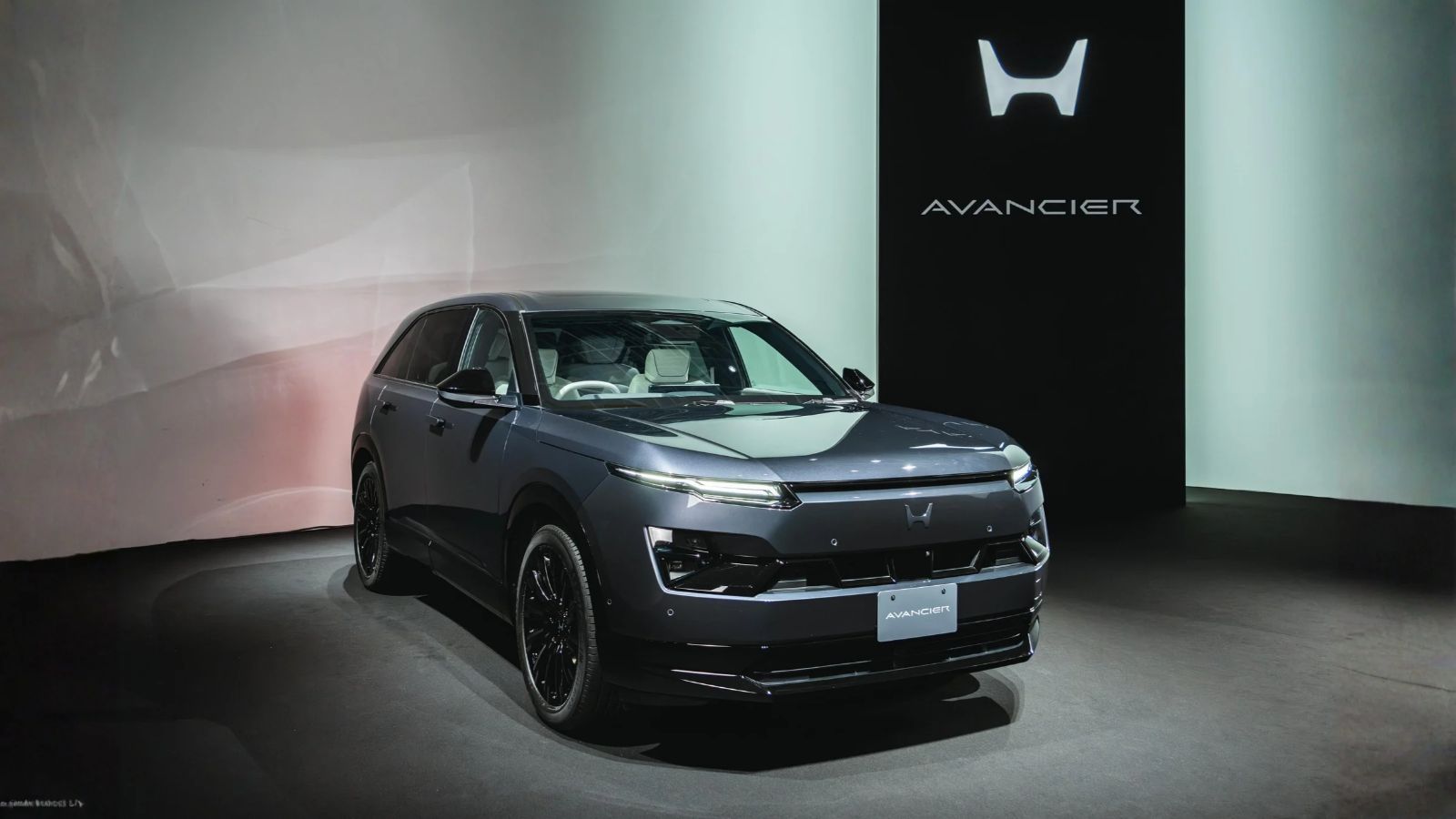
Look closely at the hood of the newly unveiled Honda Avancier SUV, and you will see something missing.
The box is gone.
For decades, the famous silver "H" sat trapped inside a rounded trapezoidal frame, a neat metallic border that signified reliability, predictability, and a certain polite restraint. It was the badge on the car your neighbor bought because they did not want to think about their car. On the new Avancier, that border has vanished. The two vertical strokes of the letter now flare outward like open hands, a nod to Honda’s earliest designs from the 1960s, stripped of decoration and set cleanly against the sheet metal.
Most people scrolling past a press release will call it a minor cosmetic tweak. They are wrong.
When a legacy automaker alters its primary emblem—the mark stamped onto steering wheels, key fobs, and factory gates around the world—it is rarely about graphic design. It is a flare fired into the dark. The Avancier, wearing that frameless badge, arrives as the first of 15 next-generation hybrid vehicles Honda plans to launch globally by March 2030. Behind that single corporate milestone lies a quiet, high-stakes reckoning for millions of ordinary drivers who are tired of being told how to feel about the cars in their driveways.
The Exhaustion of the Modern Driveway
Consider a hypothetical driver named Elena. She is forty-two, lives outside a mid-sized city where winters bite hard, and commutes forty minutes each way. Three years ago, Elena sat at her kitchen table with a spreadsheet, trying to do the responsible thing. Everyone around her—politicians, commercials, her brother-in-law at Thanksgiving—insisted the internal combustion engine was dead, and that buying anything without a massive battery pack was an act of stubbornness.
So she looked at pure battery-electric vehicles. She priced out the home charger installation, mapped the fast-charging stations along the highway she takes to visit her parents, and stared at the sticker prices that seemed untethered from reality. Then she looked at traditional gas crossovers, feeling a vague, nagging guilt every time fuel prices spiked. Elena did not want to be an early adopter beta-testing charging networks in February sleet. She did not want to feel like a villain either. She just wanted to get to work, haul groceries, and keep her monthly budget intact.
Elena is not an outlier. She is the center of the automotive universe.
For the past several years, the auto industry operated on a script written largely by Wall Street analysts and Silicon Valley evangelists. The assumption was simple and linear: consumers would abandon gasoline overnight, leap straight into fully electric vehicles, and never look back. Automakers poured tens of billions of dollars into factories built exclusively for pure electrics, treating hybrid technology as an awkward adolescent phase—a temporary bridge to be crossed quickly and forgotten.
Then reality arrived at the dealership lot.
Charging infrastructure expanded unevenly. Cold weather shaved range off batteries in ways brochures rarely highlighted. Insurance premiums climbed, resale values wobbled, and the everyday buyer quietly stepped back. Drivers like Elena looked at the math and hesitated. The industry had sprinted ahead, only to turn around and realize the crowd was still standing at the starting line, waiting for something that actually fit their lives.
Why Fifteen Hybrids by 2030 Changes the Math
I remember standing on a rain-slicked test track outside Tochigi years ago, listening to a veteran Honda powertrain engineer explain why the company refused to treat hybrids as a mere compliance exercise. While competitors bolted tiny electric motors onto existing transmissions just to squeeze out a few extra miles per gallon on regulatory tests, Honda obsessed over how the gas engine and electric motor talked to each other.
To understand what Honda is doing with its next-generation hybrid system—the architecture debuting in the Avancier and rolling out across 15 models through March 2030—you have to stop thinking of a hybrid as a gas car with an electric helper.
Think instead of a relay runner passing a baton at full sprint.
In older hybrids, you could feel the handoff. You pressed the pedal, the electric motor nudged the car forward, and then, with a slight shudder or a sudden rise in engine noise, the gasoline engine woke up and took over. It worked, but it reminded you constantly of the compromise under the hood. Honda’s two-motor hybrid philosophy flips that relationship. For most city and suburban driving, the electric motors drive the wheels directly, delivering that immediate, quiet surge people love about pure electric cars. The gasoline engine acts primarily as a generator, spinning at its most efficient speed to feed electricity into the system, only coupling directly to the wheels at steady highway cruising speeds where internal combustion actually shines.
What is new in this next-generation rollout—and why the Avancier matters far beyond its sheet metal—is the scale and refinement of that architecture. Honda has re-engineered its engines and electric drive units to shed weight, cut manufacturing costs, and improve thermal efficiency across both mid-size and large platforms. By committing to 15 distinct next-gen hybrid models before the end of the 2029 fiscal year in March 2030, Honda is making a calculated, massive bet: that for the rest of this decade, the most practical way to cut carbon and fuel consumption at scale is not by forcing every household to rewire its garage, but by making every gallon of fuel go dramatically further without changing how people refuel.
The Anatomy of the Avancier
Step back and look at the vehicle carrying this strategy into the showroom.
The Avancier nameplate is not entirely new to Honda’s history—it has appeared on sleek, upscale crossovers in markets like China and even a station wagon in Japan decades ago—but this iteration represents a sharp convergence of Honda’s global ambitions. Positioned as a flagship crossover SUV, the Avancier is built for the exact segment where family budgets and engineering demands collide hardest.
Large SUVs are notoriously difficult to make efficient. They are heavy, they push a wall of air down the interstate, and owners expect them to carry four adults, luggage, and a dog without feeling sluggish merging onto a fast highway. Historically, making a big crossover economical meant making it slow, noisy, or exorbitantly expensive.
With the new Avancier, Honda is using its flagship space to showcase what the next-gen hybrid system can do under heavy load. The cabin strips away the cluttered button arrays that plagued dashboards ten years ago, favoring clean horizontal sightlines and physical controls where muscle memory demands them. Under the floor and hood, tighter packaging allows the hybrid components to sit lower, dropping the vehicle’s center of gravity so it corners with less body roll than a tall family hauler has any right to exhibit.
More importantly, the Avancier establishes the visual and mechanical template for the fourteen models following in its wake. When an automaker launches a major powertrain overhaul, it rarely debuts it in an economy compact first. Margins on small cars are razor-thin. You launch the new architecture at the top of the lineup, where buyers appreciate quietness, torque, and refinement, and where the engineering costs can be absorbed before trickling down into the Accords, Civics, and CR-Vs that fill suburban parking lots.
The Vulnerability Behind the Badge
It would be easy to frame Honda’s announcement as a victory lap, a triumphant "I told you so" aimed at rivals who overextended themselves on pure electric vehicles. That would be dishonest.
The truth is messier and far more human. Honda, too, has spent the last several years wrestling with an industry undergoing violent structural change. As a company built from the ground up by Soichiro Honda—a mechanic who hammered piston rings in a wooden shed and insisted engineering should always serve human joy—Honda has occasionally looked hesitant in the modern era. Critics accused the brand of moving too slowly on electrification, of clinging to caution while flashier startups grabbed headlines and market valuations.
Even inside the company, there was a palpable tension between honoring its mechanical heritage and surviving a regulatory environment that threatened to make internal combustion illegal within a decade. You could see that hesitation in some of its recent styling—safe, conservative, almost apologetic.
That is why the removal of the frame around the "H" mark carries such emotional weight.
In Japanese corporate culture, changing a foundational symbol is never done lightly. Keeping the border meant staying inside the box—protecting what was already built, defending turf, playing not to lose. Removing the border is an admission that the old boundaries no longer protect anyone. Whether the threat comes from agile Chinese automakers rewriting software expectations, traditional rivals slashing prices, or regulators shifting timelines, hiding inside a frame is no longer an option.
The open-armed "H" first appeared on Honda vehicles in the 1960s, when the company was an audacious newcomer challenging established giants on Formula One circuits and motorcycle tracks with little more than stubbornness and clever metallurgy. Bringing that openness back on the nose of the Avancier is a quiet acknowledgment that survival now requires the same hunger.
What Drivers Actually Gain—And What Remains Uncertain
Strip away the corporate roadmaps and the 2030 timelines, and what does this shift actually mean for someone shopping for a car over the next few years?
First, it means choice is returning to the showroom floor without a penalty attached. For several years, hybrid trims of popular SUVs were treated like luxury upgrades—hard to find, marked up over sticker price, and restricted to top-tier packages loaded with features buyers did not ask for. By scaling next-generation hybrids across 15 models by March 2030, Honda is moving hybrid power from a boutique option to the default heartbeat of its lineup. Higher production volume drives down battery and motor costs, which eventually brings down monthly payments for ordinary households.
Second, it means fewer compromises in daily driving. A driver like Elena does not have to plan a weekend road trip around charging apps or worry about whether a hotel parking garage has working plugs. She stops at any gas station on any rural highway, spends four minutes refueling, and drives another five hundred miles. At the same time, her daily commute through stop-and-go traffic runs largely on smooth, quiet electric propulsion, cutting her fuel bills nearly in half compared to a conventional SUV of the same size.
Yet honesty demands admitting what this strategy does not solve.
A hybrid, no matter how sophisticated, still burns fossil fuels. It still carries both an engine and a battery pack, meaning two systems that must be engineered to coexist reliably over fifteen years and two hundred thousand miles. And while March 2030 sounds comfortably distant, four years in automotive development is the blink of an eye. Supply chains for rare earth minerals, shifting tariffs across borders, and unpredictable fuel prices could easily test Honda’s rollout schedule before the fifteenth model ever reaches a dealership.
Nothing about the next decade of transportation is guaranteed. Anyone promising a painless transition is selling something.
The Road Ahead
Still, stand back and look at the broader picture taking shape across the industry. The fever dream of an overnight transformation has broken, replaced by something quieter, more pragmatic, and infinitely more durable. People do not buy press releases or five-year strategic visions. They buy the machine that starts on a freezing Tuesday morning when the kids are late for school and the fuel gauge is hovering near empty.
On the front grille of the new Avancier, that redesigned silver "H" catches the light without a border holding it in. Two open lines, reaching outward, anchored firmly to the road beneath.