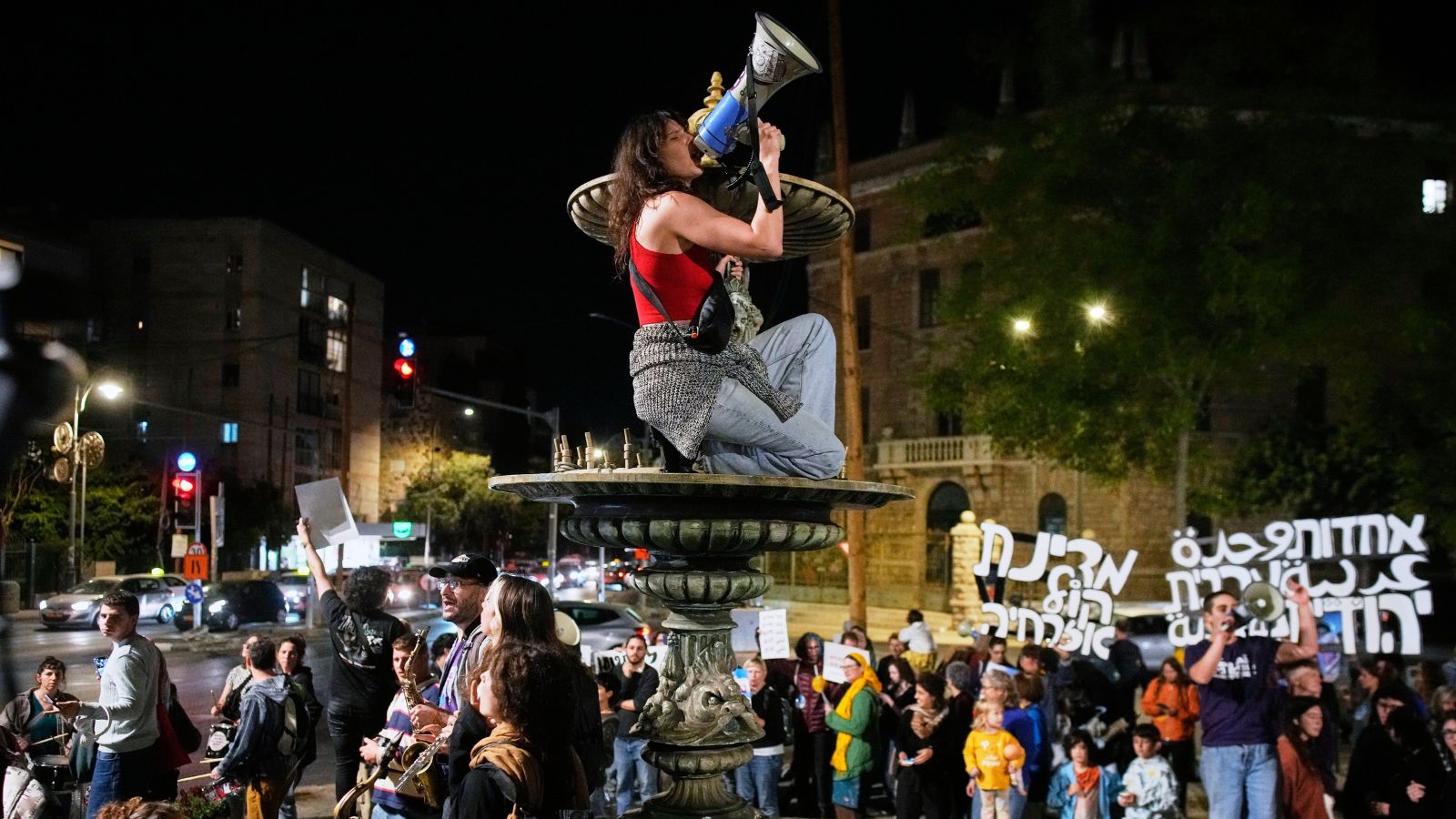
The Jerusalem sky turns the color of bruised plums just before the sirens wail on Friday afternoon. You can smell the yeast from the bakeries along Jaffa Road, thick and sweet, mixing with the exhaust of the last buses rushing toward the suburbs before the city locks its doors for twenty-five hours.
For decades, that siren meant a truce. Left and right, secular and observant, soldier and scholar—everyone put down their swords for Shabbat.
Not anymore.
When former military chief and Yashar party leader Gadi Eisenkot released a statement just hours before sundown, warning that the outgoing government was actively harming Israeli democracy, he was not just firing another volley in a routine parliamentary squabble. He was naming a fracture that has crept into living rooms from Haifa to Beersheba. The cold numbers of the 2026 Knesset election tell one story, a clinical ledger of seats won and lost. The human reality behind those numbers tells another.
The Arithmetic of Exhaustion
Let us look at the scoreboard first, stripped of spin. On October 27, 2026, nearly 5.7 million Israelis walked into polling booths, pushing turnout to an extraordinary 77.98 percent. People did not show up in those numbers out of casual civic duty. They showed up because they were terrified of what would happen if they stayed home.
When the Central Elections Committee finalized the count on November 4, the verdict was unmistakable, yet maddeningly inconclusive. Benjamin Netanyahu’s Likud remained the single largest party with 27 seats, a bruised shadow of its former dominance, dropping nine seats from the previous term. Right behind him stood Eisenkot’s newly minted Yashar party, surging to 21 seats. Naftali Bennett’s Together party captured 12, while the Joint List climbed to 11. The Democrats and Ra’am each secured eight. Yisrael Beiteinu, Otzma Yehudit, and United Torah Judaism each took seven. Shas and the Religious Zionist Party finished with six apiece.
Do the math. Sixty-one seats are required to govern in Israel’s 120-seat parliament. Netanyahu’s outgoing right-wing and religious bloc collapsed from its ruling majority down to 53 seats. The Jewish opposition bloc landed at 48. Arab-led parties held the remaining 19.
Nobody won. Everybody bled.
To understand what 53 versus 48 actually feels like on a Tuesday morning in Tel Aviv or a Thursday night in Petah Tikva, stop looking at parliament charts and picture a dinner table. Let us create a hypothetical family—call them the Levi household—to see how this gridlock lives inside ordinary walls. In this scenario, the father, Avi, spent three hundred days in reserve duty over the past three years, returning home with gray in his beard and a knee that aches before rain. His sister, Maya, runs a small tech consultancy in Ramat Gan and has watched investors hesitate as the shekel faltered amid political paralysis. Their cousin, Yossi, studies in a yeshiva in Bnei Brak, believing deeply that Torah study protects the nation just as fiercely as a rifle.
When Eisenkot warns before Shabbat that the government is damaging democracy, Avi hears a soldier’s blunt diagnosis of institutional rot. Maya hears a warning about the courts and the rule of law that keep her business viable. Yossi hears an existential threat to his way of life, a demand for universal military conscription that feels to his community like forced assimilation.
Three people. One family. Three completely incompatible definitions of survival.
Why the Timing of a Warning Matters
Politics in Israel usually operates at a shout. Statements are crafted for the evening news cycle, sharp and disposable, designed to trigger outrage on social media before morning coffee.
Sending a message right before Shabbat changes the acoustic frequency.
In Jewish tradition, the hours leading into Friday evening are meant for heshbon nefesh—an accounting of the soul. You clean the house. You settle debts. You ask forgiveness from neighbors so you can enter the day of rest with a clean slate. By choosing that exact window to accuse the current leadership of eroding democratic norms and to defend his fellow lawmakers against vitriolic attacks, Eisenkot was pulling political rhetoric out of the mud of tactical maneuvering and placing it squarely on the doorstep of national conscience.
Think of Israeli democracy right now like an old stone house built on a fault line. For seventy-eight years, the residents argued endlessly about how to paint the walls, who got the biggest bedroom, and how much money to spend on the garden. Those fights were loud, sometimes furious, yet nobody questioned the foundation. Everybody agreed the roof had to stay up.
Over the past few years, the tremors began. The judicial overhaul protests that tore through the streets prior to the war. The trauma of October 7 and the grinding, agonizing campaigns in Gaza. The bitter, unresolved wound over who bears the burden of military service. Slowly, terrifyingly, the arguments stopped being about the furniture and started targeting the load-bearing walls.
When a caretaker government clings to power without a parliamentary majority, and when pressure mounts on state gatekeepers—from the Attorney General to the head of the Shin Bet—the mortar begins to crumble. Eisenkot’s pre-Shabbat warning was a structural engineer pointing at a hairline crack in the main beam and saying, If we keep slamming the doors, the ceiling comes down on all of us.
The Trap of the Unity Mirage
Naturally, when a house starts shaking, someone always suggests locking everyone in the same room until they agree to be friends.
In the weeks following the October 27 vote, Prime Minister Netanyahu repeatedly called on Eisenkot to join a national unity government. On the surface, it sounds noble. The country is exhausted. The economy needs stability. Security threats on multiple borders do not pause for coalition negotiations. Why wouldn't two seasoned leaders shake hands, split the ministries, and calm the waters?
Because in politics, a unity government without shared rules is not a truce; it is a hostage situation.
Eisenkot dismissed Netanyahu’s overtures as political spin, laying out non-negotiable conditions: parting ways with extremist factions and committing to foundational democratic principles and equal national service. Look closely at what happened next. Even the mere rumor of talks between Likud and Yashar sent tremors through the opposition, prompting Yair Golan’s Democrats to pull away from Eisenkot’s bloc. Meanwhile, ultra-Orthodox party Shas declared it would not negotiate with any left-wing coalition, and far-right figures alternated between calling for brotherly unity and attacking the legitimacy of Arab lawmakers.
I have watched enough coalition cycles in Jerusalem to recognize this specific paralysis. It is a chess game where every player refuses to move a pawn because they are convinced the board itself is tilted.
If Eisenkot enters a government led by Netanyahu without ironclad guarantees on the judiciary and the Haredi draft, he legitimizes the very system he told 913,629 voters he came to dismantle. He loses his credibility overnight, just as Benny Gantz did in previous cycles. Yet if he refuses to bend and cannot cobble together 61 seats without relying on parties that refuse to sit together—such as right-wing nationalists and Arab factions—the country hurtles toward another election.
It is a suffocating bind. Frankly, looking at the arithmetic of the 26th Knesset, it is hard to see a clean exit that does not leave half the nation feeling betrayed. Anyone claiming to have an easy formula for 61 seats right now is either lying to you or lying to themselves.
The Invisible Casualties of Gridlock
While politicians trade barbs in the Knesset corridors and draft careful statements before sundown, the real cost of this democratic erosion is paid quietly, far from the cameras.
It is paid in the hesitation of a young surgeon at Hadassah Hospital wondering whether to accept a fellowship in Boston and never come back. It is paid in the quiet rage of a mother in Sderot whose children still flinch at the sound of a slamming car door, watching lawmakers argue over ministerial portfolios instead of mental health funding. It is paid in the bitterness of Arab citizens—who turned out in massive numbers to vote, boosting the Joint List and Ra’am to 19 combined seats—only to hear senior ministers smear their entire community as illegitimate partners in the state's future.
President Isaac Herzog felt compelled to address this toxicity directly when he received the official election results, warning against vulgarity, racism, and the dangerous habit of smearing entire publics. When the head of state has to beg citizens not to dehumanize one another after a democratic vote, you know the fever has reached the brain.
Democracy rarely dies in a single cinematic coup. There are no tanks rolling down Rothschild Boulevard. Instead, it erodes through exhaustion. It wears down when emergency measures become permanent habits. It shrinks when public servants are treated as partisan enemies rather than neutral guardians of the law. It hollow outs when citizens stop believing their ballot can actually change the trajectory of their daily lives.
Rebuilding the Load-Bearing Walls
So how does a fractured nation step back from the edge? Not through glossy unity slogans, and certainly not through another round of cynical tactical alliances.
The path out requires boring, unglamorous, structural repair. First, it demands locking in the rules of the game before deciding who gets to hold the trophy. A governing coalition—whether temporary or full-term—must anchor basic constitutional protections so that no slim majority of 61 seats can ever again rewrite the judicial system on a whim.
Second, it requires an honest, binding social contract on national service. The post-October 7 reality shattered the old exemptions. A democracy cannot survive when one half of the population carries the casket while the other half writes the exemptions. Crafting a fair, phased draft law that respects religious study while enforcing genuine civic or military duty is no longer a left-wing talking point; it is basic math for a small country surrounded by enemies.
Finally, it demands political courage from the center. Leaders like Eisenkot, Bennett, and Lapid—alongside moderate voices across the aisle—have to decide whether they care more about defeating their rivals or preserving the referee. That means defending the independence of the courts, the police, and the security services even when those institutions make rulings that frustrate their own camp.
Back on Jaffa Road, the sun finally drops below the limestone ridge. The bakeries pull down their metal shutters with a heavy metallic clatter. Inside thousands of apartments, matches strike, candles flare to life, and hands wave over the flames to welcome the Sabbath peace.
Outside, the streetlights flicker on over empty avenues, illuminating election posters already peeling at the corners—paper promises fluttering in the cold Jerusalem wind, waiting to see if the house will still be standing when the stars come out tomorrow night.
To see the immediate reactions following the vote, watch Israel election: Gadi Eisenkot declares a new era and vows to replace Netanyahu for coverage of his post-election address and the looming coalition deadlock.