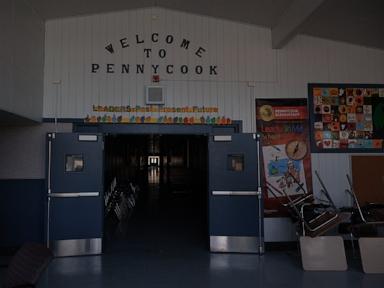
Walk down the third-floor hallway of an aging elementary school at ten in the morning, and you will hear the ghosts.
Your sneakers squeak against waxed linoleum that has survived forty winters of slush and salt. To your left, a row of metal lockers stands unopened, their combination dials frozen at zero. To your right, Room 304 is dark. The desks are stacked in the corner like forgotten cordwood. The chalkboard still holds a faint, powdery smudge from a lesson taught three years ago. Down the hall, inside Room 308, a third-grade teacher is trying to keep eighteen children focused on fractions while the radiator clanks like an iron pipe being struck with a wrench.
Silence.
That is what shrinking enrollment actually sounds like before it ever shows up on a municipal spreadsheet. It is not a dramatic collapse; it is a slow, creeping stillness that settles over neighborhoods one empty desk at a time. Across the United States, public school districts are waking up to a demographic reality they can no longer ignore. Fewer babies are being born. Families are moving away from high-cost cities or aging suburbs. Private options and homeschooling have siphoned off slices of the student body. Yet, in boardrooms from the Midwest to the Northeast, elected officials and superintendents are staring at widening budget deficits and choosing to do nothing at all.
They are delaying the inevitable. They are keeping half-empty buildings heated, lit, and staffed while the roofs leak and the books grow ragged. And in trying to spare communities the immediate heartbreak of a school closure, they are quietly starving the very classrooms that remain open.
The Arithmetic of the Empty Desk
To understand why a missing child costs a school district so much money, you have to understand how public education is funded.
Imagine a family running a neighborhood diner. Whether fifty customers walk through the door on a Tuesday or only twenty-five, the rent on the building stays the same. The walk-in freezer still hums twenty-four hours a day. The insurance bill arrives on the first of the month, indifferent to how many omelets were flipped. School districts operate under the exact same rigid geometry.
Most states distribute education funding on a per-pupil basis. When a family packs up a moving van and leaves town, the state aid tied to that child vanishes from the district’s ledger the following autumn. Lose three hundred students across a mid-sized district, and millions of dollars evaporate overnight.
Yet the expenses do not shrink in lockstep.
You cannot turn off the heat in half a building. You cannot pay a principal sixty percent of a salary because her hallways are forty percent emptier. A school bus still has to drive the same twelve-mile rural route to pick up three kids instead of nine, burning the exact same diesel and requiring the exact same driver behind the wheel. In the jargon of school finance, fixed overhead devours the budget while variable revenue disappears.
For several years, districts masked this structural cliff using temporary federal pandemic relief funds. That emergency money acted like a painkiller, numbing the ache of declining enrollment and allowing boards to hire extra counselors, launch summer programs, and keep under-enrolled neighborhood schools humming along. Now, that federal lifeline is gone. The anesthetic has worn off, and the underlying fracture is exposed to the bone.
A Tale of Two Boardrooms
Consider a hypothetical scenario that plays out every spring in towns across the country. Let us call the town Oakridge.
Oakridge has six elementary schools built during the baby boom of the 1950s and 1960s. Back then, each building burst at the seams with five hundred children. Today, three of those schools hold fewer than two hundred students each. Combined, the district has enough empty seats to fill an entire middle school.
In the superintendent’s office, the math is merciless. Closing two of those half-empty elementary schools and consolidating the students into the remaining four buildings would save roughly three million dollars a year in utilities, maintenance, administrative salaries, and custodial contracts. That money could fund updated science labs, hire reading specialists for struggling second graders, and give veteran teachers a raise that keeps them from defecting to neighboring districts.
Then comes the Tuesday night school board meeting.
The high school auditorium is packed. Parents wear matching t-shirts emblazoned with the mascot of the school slated for closure. A mother steps up to the microphone, her voice trembling as she describes how her grandmother attended this very school, how her autistic son finally found his footing in its quiet hallways, how walking three blocks to the front doors is the glue holding their working-class neighborhood together. A local realtor warns that closing the school will tank property values on the north side of town. Teachers hold signs reminding the board that smaller class sizes save lives.
Nobody in that room is wrong. Every single fear voiced at that microphone is rooted in real love and real vulnerability.
Faced with three hundred angry voters and an upcoming November election, the school board blinks. They vote to table the consolidation plan for another year. They decide to form a "blue-ribbon community task force" to study the issue further.
To the crowd, it feels like a victory. In reality, it is a slow-motion surrender.
The Invisible Tax on Every Remaining Child
When a district refuses to close an under-enrolled building, the money to keep its lights on has to come from somewhere. Since school boards cannot print currency, they pay for empty space by taking resources away from living, breathing students.
This is the hidden cost of political paralysis. It rarely makes the front page of the local paper because it happens in tiny, invisible increments.
It happens when a district quietly decides not to replace a retiring art teacher, forcing fourth graders to alternate between music and art every other semester. It happens when the high school drops three Advanced Placement courses because only eleven students signed up for each, depriving ambitious teenagers of college credit before they ever graduate. It happens when the maintenance crew stops fixing broken air conditioners in May and lets the roof leaks get patched with tarps instead of replaced, creating a mountain of deferred maintenance that will eventually cost taxpayers twice as much to fix.
I once sat in the back of a fifth-grade classroom in a district that had spent a decade refusing to consolidate its aging buildings. The building was sixty-five years old. Because the district was spreading its maintenance budget across too many roofs, the boiler system had failed in one wing. Twenty-two ten-year-olds sat in winter coats and mittens while trying to write essays about the American Revolution. Meanwhile, two miles away, a nearly identical elementary school sat at forty-eight percent capacity, its boiler roaring away to heat twelve empty rooms.
That is what delaying hard decisions looks like at ground level. It is a child shivering in a coat so an adult does not have to endure an uncomfortable public hearing.
Why Leaders Stall
If the financial logic is so obvious, why do smart, dedicated public servants keep kicking the can down the road?
Part of the answer is pure human psychology. Behavioral economists call it loss aversion—the well-documented tendency for humans to feel the pain of a loss roughly twice as intensely as the pleasure of an equivalent gain. Telling a parent that their neighborhood school is closing inflicts an immediate, visceral, unforgettable wound. Telling that same parent that closing the building will allow the district to hire four new interventionists and upgrade the middle school robotics lab offers an abstract, future benefit that feels pale by comparison.
There is also the haunting legacy of past closures. Over the last twenty years, urban districts in cities like Chicago, Detroit, and Philadelphia closed dozens of schools in rapid, top-down waves. In many cases, those closures disproportionately hit Black and brown neighborhoods, disrupted fragile community anchors, and failed to deliver the promised financial windfalls because the buildings sat vacant and blighted for years afterward. Suburban and rural leaders look at those painful chapters and resolve that they will never be the villains in a similar story.
So they wait. They hope for a miracle. They pray that a new housing development will magically fill the empty desks, or that the state legislature will suddenly rewrite the funding formula to bail them out.
Hope, however, is not a budget strategy. Birth rates have been trending downward for more than fifteen years. The children who would enter kindergarten five years from now have not even been born yet, and demographic projections suggest the enrollment trough has not hit bottom. Waiting another twelve months does not make the math kinder; it only shrinks the cash reserves needed to manage the transition gracefully.
The Courage to Shrink Well
There is a way out of this trap, though it requires a brand of civic courage that is increasingly rare. A handful of districts across the country have stopped treating right-sizing as an emergency amputation and started treating it as an act of renewal.
When districts succeed at this, they do not spring a list of doomed schools on a shocked public in February and vote on it in March. They start eighteen months out. They open the books completely. They put the actual utility bills, roof repair estimates, and per-pupil spending charts on tables in front of parents and let residents wrestle with the trade-offs themselves.
Imagine handing a group of parents a set of wooden blocks representing the district’s budget and saying, "Here is what we have. If we keep all six buildings open, we have to cut middle school sports, eliminate freshman band, and increase class sizes to thirty-two. If we close two buildings, we keep all the programs and give every elementary school a full-time nurse. You help us draw the map."
When ordinary people are trusted with the whole truth, something remarkable happens. The anger does not vanish, and the grief over losing a beloved neighborhood landmark remains real. Yet people begin to shift from defending a brick building to protecting the education happening inside it.
Smart districts also plan for the afterlife of the buildings they leave behind. Nothing destroys trust faster than chaining up a school and letting weeds grow through the playground asphalt. When districts partner early with city councils, nonprofits, or housing developers to turn shuttered schools into early childhood centers, community health clinics, or affordable housing for teachers, the building stops being a monument to decline and becomes a symbol of adaptation.
The Choice Before the Bell Rings
Every August, yellow buses roll out of depots across America, their amber lights flashing in the early morning mist. Inside those buses sit children who have no idea what a structural deficit is. They do not know about state foundation formulas, fixed overhead, or deferred capital maintenance. They only know whether their teacher has time to help them sound out a hard word, whether the science kit has enough batteries for everyone, and whether the room feels warm and alive.
A school is not the bricks, the mortar, or the year carved into the cornerstone above the front door. A school is the alchemy that happens when a prepared adult meets a curious child in a room equipped for wonder.
Right now, too many school boards are choosing to protect the bricks at the expense of the alchemy. They are preserving monuments to the past while mortgaging the daily experience of the children sitting in front of them today.
Walk back down that quiet third-floor hallway. Listen to the hum of the fluorescent lights illuminating rows of empty desks, paid for with dollars that could have bought books, hired tutors, or kept a struggling kid from slipping through the cracks. Somewhere down the corridor, a bell is about to ring, and the adults in charge have to decide whether they are running a real estate museum or a school system.


