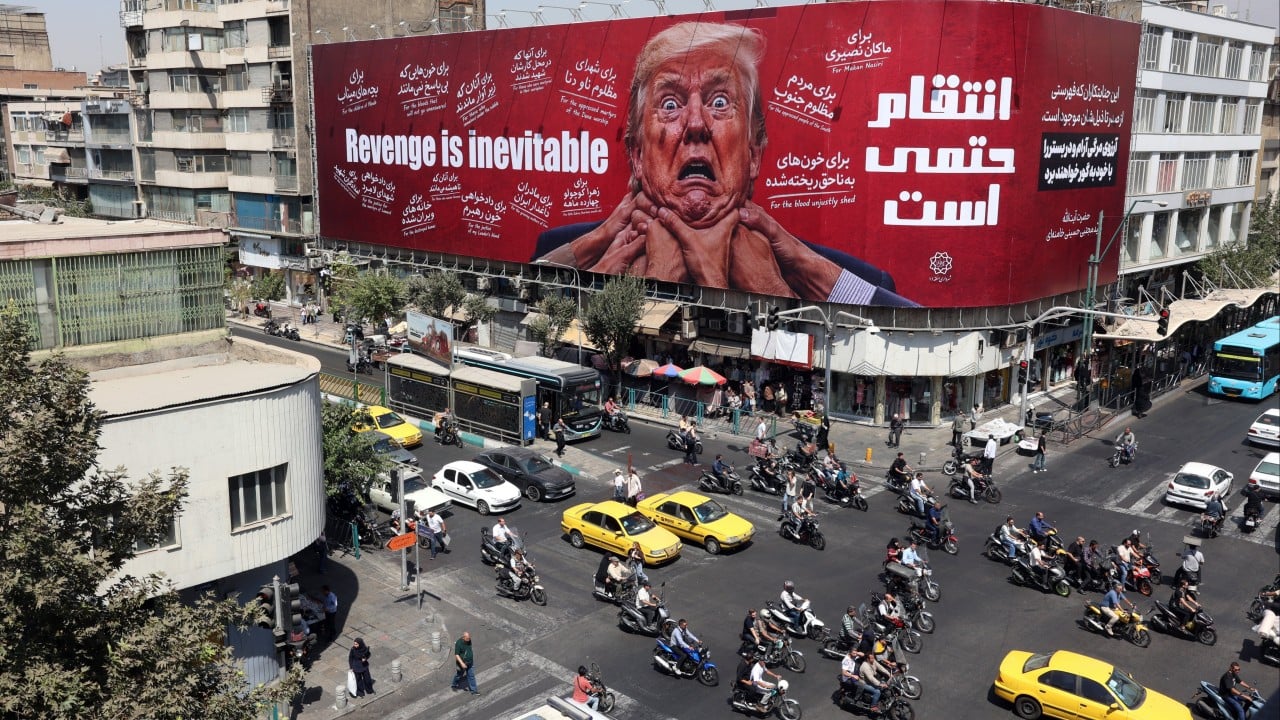
When the Islamic Republic needs to project defiance across the concrete arteries of Tehran, it does not rely solely on state broadcasts or Friday pulpit speeches. It commands the urban skyline.
The wartime billboard campaign targeting Washington and President Donald Trump is an exercise in state-crafted visual warfare. Managed behind the scenes by producers like Mostafa Kafaei, these massive displays transform Valiasr Square and Enghelab Square into open-air galleries of psychological confrontation.
To understand how Tehran communicates its strategic posture during active hostilities, one must look closely at the methodology of its propaganda architects.
The Anatomy of State Visuals
State-sponsored murals have anchored Iran's public spaces since the 1979 revolution. Yet, the current visual campaign operates with a different cadence. It reacts to real-time geopolitical friction with unprecedented speed.
When tensions spike over the Strait of Hormuz, the imagery changes within hours. A prominent installation depicted the American president with his mouth muzzled by a narrow waterway, visually translating the regime's threat to choke critical shipping lanes. Another installation placed him inside a catering container or behind bars.
These compositions are not random acts of vandalism or fringe expressions. They are meticulously designed propaganda products intended for domestic consumption and international signal intelligence alike.
For ordinary citizens navigating chronic economic hardship, the sprawling banners serve a dual purpose. As analysts note, many residents lack the time or resources to monitor rolling news cycles. The billboards act as an inescapable visual newspaper, dictating the official narrative of sovereignty, resistance, and external threat directly to the daily commuter.
The Bureaucracy of Defiance
Behind every canvas stretched across a Tehran high-rise lies a tightly controlled bureaucratic apparatus. The transition from a battlefield development to a towering public graphic involves coordinated efforts between state media planners, municipal authorities, and security organs.
This infrastructure treats public space as a strategic theater. When economic sanctions bite or military skirmishes flare in the Persian Gulf, the response is immediate. The messaging oscillates between dark humor—such as depicting adversaries in absurd scenarios—and grim warnings of protracted conflict.
By projecting absolute control over vital geopolitical flashpoints like Hormuz, the regime attempts to solidify internal cohesion. It creates a unified visual front, papering over domestic fissures with stylized bravado.
The billboard war remains a visible barometer of a deeper, unyielding standoff. As long as the diplomatic rupture persists, the scaffolding will go up, new canvas will unroll, and the concrete walls of Tehran will continue to speak for the state.
Inside Tehran: Iran's Bold Propaganda Billboards Mock Trump & Boast Control of Hormuz
This video provides a firsthand look at the wartime propaganda billboards erected across Tehran to project strength and mock American leadership.


