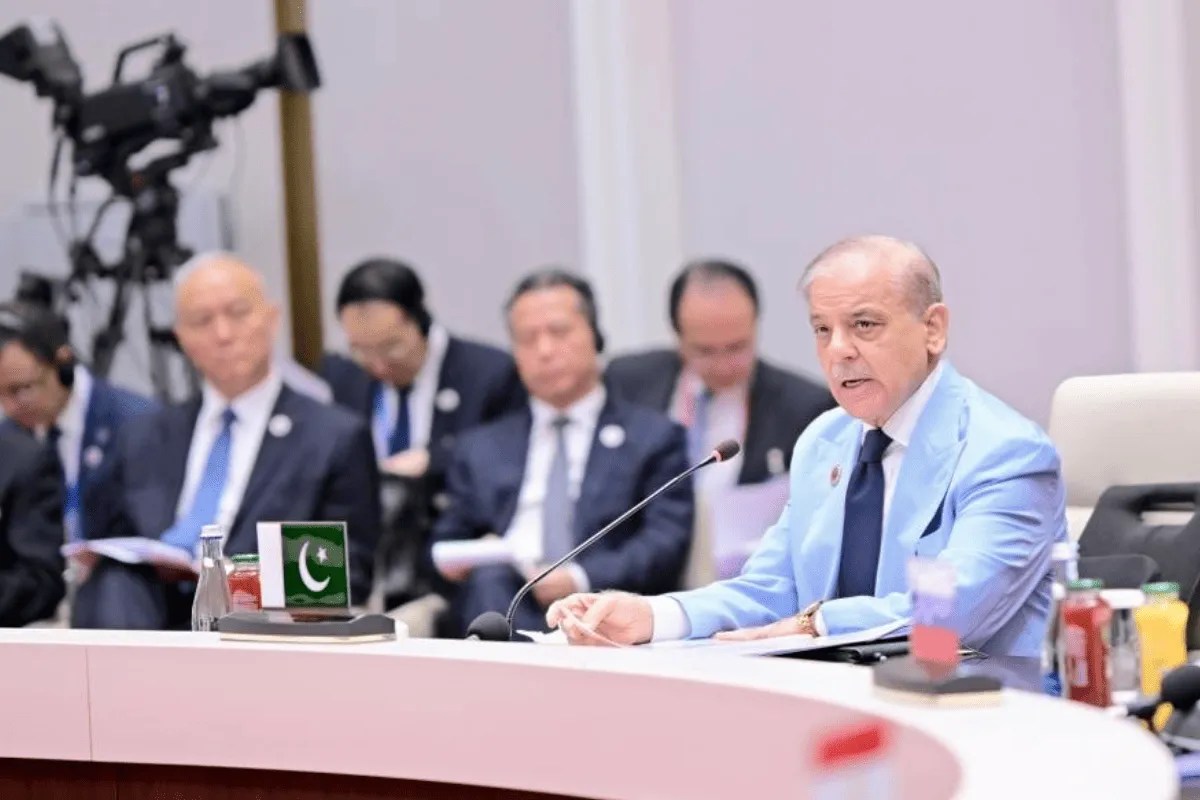
The air inside the grand conference hall hummed with the quiet, suffocating pressure of a room full of diplomats trying very hard not to look at the fire outside. Microphones caught the rustle of tailored wool, the precise click of a pen against polished mahogany, and the steady, measured cadence of a politician reading from a prepared script.
When Shahbaz Sharif stepped up to the podium at the Shanghai Cooperation Organisation summit, the weight of a staggering number hung in the air long before he spoke it. Ninety thousand.
Ninety thousand lives.
To the bureaucrats shuffling papers in Islamabad, it is a statistic etched into annual reports, budget allocations, and security memorandums. But numbers do not bleed. Numbers do not leave behind half-finished cups of chai on a dusty veranda in Peshawar, or a pair of school shoes waiting by a doorway in Quetta that will never be worn again. Statistics are a convenient armor used by states to sanitize catastrophe, wrapping raw human agony in the sterile language of geopolitical fallout.
Consider what happens when you strip away the podium and the diplomatic pleasantries. Imagine a quiet kitchen in the suburbs of Rawalpindi, a mother folding laundry while the television murmurs in the background. The news anchor speaks of counter-terrorism strategies, regional stability, and diplomatic alignments. The mother does not hear strategy. She hears the date her eldest son walked out the front door and never came back. She remembers the frantic phone calls, the hospital corridors smelling of antiseptic and rising panic, and the sudden, deafening silence that settles into a house when a vital piece of it is violently erased.
This is the human toll behind the grand declarations of international summits. For decades, the frontline of a shadow war has cut straight through the heart of ordinary neighborhoods, turning bustling markets into crime scenes and wedding halls into memorials. Every checkpoint, every reinforced concrete barrier, and every heavy-eyed soldier standing guard in the blistering afternoon heat is a physical manifestation of a society paying an installment on a debt it never asked to incur.
Yet, listening to the speeches, one is struck by a persistent irony. Security is discussed as if it were a commodity that can be imported, exported, or manufactured through joint communiqués. Leaders nod in agreement, pledging cooperation, sharing intelligence, and signing documents that smell fresh from the printer. They talk about stability as a finish line.
Stability is not a finish line. It is a fragile floorboards holding up a collapsing house.
The security apparatus of a nation like Pakistan has spent decades absorbing blow after devastating blow. Entire generations of law enforcement officers, intelligence personnel, and civilian volunteers have grown up knowing that a routine Tuesday commute could end in an explosion. They learned to check under their cars. They learned to memorize exit routes in crowded bazaars. This hyper-vigilance seeps into the national psyche, warping how a society breathes, moves, and dreams. When survival becomes your primary daily occupation, innovation stalls. Art stumbles. Education becomes a fortress with barbed wire on the perimeter walls.
And still, the political rhetoric tends to treat this suffering as currency. At international forums, casualty figures are sometimes deployed not as a testament to shared grief, but as leverage. Look at what we have endured. Look at the sacrifice we made on behalf of the global community. There is truth in the claim—porous borders and shifting regional dynamics meant that domestic instability had international ripples. But when suffering is leveraged for diplomatic leverage, the individual mourner is forgotten. The ninety thousand become a shield for the living rather than a monument to the fallen.
Let us walk down a narrow alley in Lahore as the evening call to prayer begins to echo across the rooftops. The air smells of frying oil, diesel exhaust, and blooming jasmine. Children chase a punctured football down the lane, their laughter bouncing off weathered brick walls. This is the Pakistan the textbooks miss. It is resilient, chaotic, relentlessly alive, and perpetually exhausted.
The people here do not care about the fine print of SCO declarations. They care about whether their children can walk to school without a guard carrying a rifle. They care about whether the price of flour will stabilize long enough for them to afford dinner. They care about a future where national security does not require a constant, agonizing blood tax.
When leaders gather in air-conditioned halls to trade talking points about terror and counter-measures, the disconnect is palpable. They speak of regional connectivity while citizens remain walled off by fear. They speak of economic integration while resources are perpetually diverted from classrooms and hospitals to fund the endless machinery of defense.
The tragic paradox of the modern security state is that the very measures taken to protect the population often isolate it from the world it desperately wants to join. Iron gates go up. Visas become harder to secure. Trust erodes, both internally between the citizen and the state, and externally between neighbors who view each other through the crosshairs of suspicion.
Shahbaz Sharif’s words at the summit were meant to project steadfast resolve, a reminder to the region that his country has bled enough to earn a seat at the table of peace. But a reminder whispered in a room full of peers does little to heal the fractures running deep through the social fabric back home.
The real battle against extremism was never fought merely with artillery and intelligence dossiers in the mountains along the border. It is fought in the minds of disillusioned youth. It is fought in the crumbling public school systems where critical thinking is starved of funding. It is fought in the courtrooms where justice moves at the speed of a glacier, leaving aggrieved communities vulnerable to the false promises of radical ideologies.
Until those foundational leaks are plugged, no amount of summit declarations will staunch the flow. Ninety thousand lives lost is not a milestone of endurance to be recited with bureaucratic pride. It is a catastrophic indictment of a regional order that failed its people, generation after generation, trading human futures for geopolitical chess moves.
The conference hall lights will eventually dim. The leaders will board their private jets, heading back to capitals cushioned by protocol and security details. The cameras will turn away.
Back in the alleyways of Lahore, the evening breeze will settle over the rooftops, carrying the distant murmur of traffic and the quiet, enduring hum of a people who have learned how to rebuild their lives out of the wreckage, waiting for a dawn that takes longer to arrive than anyone ever warned them it would.