The altitude in La Paz does not merely steal your breath; it forces you to weigh the value of every movement. At 3,600 meters above sea level, the air is thin, crisp, and perpetually sharp. But these days, the tightness in the chests of the paceños is not from the elevation. It is the suffocating stillness of a city cut off from the world.
Maria Elena adjusts the wool shawl around her shoulders as she stands in the pre-dawn freeze outside a bakery in the Sopocachi neighborhood. It is 4:30 AM. The cobblestones beneath her feet are slick with frost. Under normal circumstances, the smell of fresh marraquetas—the crusty bread that is the literal lifeblood of Bolivian mornings—would already be drifting through the alleyways. Today, there is only the scent of burning tires filtering down from the rim of the canyon, and the quiet, anxious murmuring of fifty people who arrived before her.
"There is no flour coming down from the Altiplano," the man ahead of her says, his breath blooming in the cold air. "The truckers have blocked the highways at Caracollo. Nothing moves."
This is how a political crisis tastes. It tastes like dry flour, missing yeast, and the bitter ash of barricades.
The Geography of a Chokehold
To understand how easily Bolivia’s capital can be brought to its knees, one must understand its impossible geography. La Paz sits inside a massive bowl, a volcanic crater gouged out of the high Andean plateau. Looming directly above it, like a sentinel on the edge of a cliff, is El Alto, a sprawling, chaotic metropolis born of indigenous migration and fierce political willpower.
Virtually every scrap of food, every gallon of gasoline, and every medical supply destined for La Paz must first pass through El Alto via a handful of steep, winding arteries. If El Alto closes its fist, La Paz starves.
Right now, that fist is clenched tight.
For President Paz, the view from the Palacio Quemado has grown terrifyingly narrow. A standard news dispatch would tell you that the administration is facing "deepening economic instability and widespread civil unrest due to structural deficits." But those words are too clean. They mask the grime of the reality. The reality is that the government has run out of US dollars, fuel subsidies are collapsing, and the transport unions—historically the kingmakers of Bolivian politics—have decided that the cost of compliance is higher than the cost of rebellion.
Consider the mechanics of a modern blockade. It is not just a crowd of angry citizens holding signs. It is an organized, heavily fortified infrastructure of resistance.
At the major transit hubs connecting La Paz to Oruro and Cochabamba, hundreds of heavy semi-trucks are parked bumper-to-bumper across the blacktop. Their drivers have deflated the tires. Between the trucks, mounds of earth have been dumped by trufi drivers, reinforced with jagged boulders and lengths of rusted rebar. Dynamite, a traditional tool of Bolivian miners used to punctuate political demands, echoes across the canyon walls at irregular intervals. Boom. A reminder of who holds the real leverage.
The Phantom Currency
The root of this paralysis lies in something invisible: the green pieces of paper printed thousands of miles away in Washington, D.C.
For years, Bolivia enjoyed an economic miracle fueled by natural gas exports. The state coffers were full, and the government maintained a fiercely defended, pegged exchange rate. A dollar was worth roughly 6.96 bolivianos. It felt permanent. It allowed street vendors to buy cheap imported electronics and farmers to purchase foreign fertilizers without a second thought.
But miracles have an expiration date. The gas fields began to dry up due to a lack of investment. The export revenues dwindled from a roaring river to a pathetic trickle.
When the dollars vanished from the central bank, a black market materialized overnight. Walk down the Calle Colón today, and you will see men standing on corners, casually whispering, "Dólares, dólares." But they aren’t selling at the official rate anymore. They are demanding nine, ten, eleven bolivianos for a single dollar.
For an economy that relies on imports for everything from tractor parts to medicine, this parallel exchange rate acts as a slow-motion demolition ball.
Let us look at a hypothetical example to understand how this destroys a kitchen table thousands of miles from the halls of parliament. Imagine Alejandro, a mechanic who runs a small repair shop near the General Cemetery. He needs to replace a fuel injector for a Toyota minibus—the primary mode of public transit in La Paz.
Three months ago, that part cost him 500 bolivianos. Now, because the importer had to buy black-market dollars to source the part from Japan, the price is 1,200 bolivianos. Alejandro cannot absorb that cost. He passes it on to the minibus driver. The driver, unable to pay for repairs, raises the fare for the commuters. The commuters, already squeezed by rising food prices, take to the streets in protest.
The cycle feeds on itself. The serpent eats its own tail.
Life in the Fractured Bowl
When the main arteries clog, the blood pressure of the city spikes. The most immediate casualty is transportation.
The Mi Teleférico cable car system—a brilliant, silent web of red, yellow, and silver lines that glides effortlessly over the city's chaotic topography—is currently the only way to move between La Paz and El Alto without running into a wall of rocks and angry men. Under normal conditions, the cable cars are a scenic marvel, offering breathtaking views of Mount Illimani. Today, they are a desperate lifeline.
The lines to board the cars stretch for blocks, snaking around plazas and down staircases. People stand for three hours just to get a ten-minute ride to work. Inside the cabins, the usual chatter has vanished. People stare out the windows at the gridlocked, empty avenues below, holding their breath every time the cabin sways past a tower.
On the ground, the city feels ancient and modern all at once. Without cars, the avenues belong to the pedestrians. Thousands of people are walking. Executives in polished leather shoes trek side-by-side with cholitas carrying massive, multicolored aguayos on their backs, filled with whatever produce they managed to salvage from the early-morning wholesale markets.
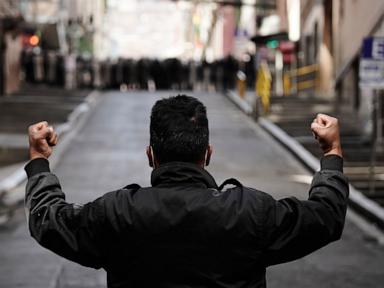
There is an eerie silence that settles over a blockaded city. The absence of engine noise allows you to hear the scraping of shoes on asphalt, the distant shouting of neighborhood defense committees, and the constant, rhythmic clapping of protesters marching through the Prado.
"We don't want to do this," says Jorge, a truck driver who has spent the last six nights sleeping in the cab of his Volvo semi on the highway near Achica Arriba. His hands are stained with grease and soot from the roadside fires. "My family is in Santa Cruz. I am losing money every day my wheels aren't turning. But if I accept the new taxes and the lack of diesel now, I will be bankrupt by the end of the year anyway. It is better to die fighting here than to starve slowly at home."
Jorge’s sentiment is the dangerous engine of Bolivian history. It is a culture of resistance that views compromise not as a diplomatic victory, but as a betrayal.
The Weight of the Palacio
Inside the government palace, President Paz faces an equation with no good variables. To clear the roads by force means deploying the police and the military. In Bolivia, that is a historical third rail. Every administration that has used lethal force against indigenous or labor blockades has found itself shortened, its leaders fleeing via helicopter from the roof of the palace as the crowds breached the gates. The memory of 2003, and more recently 2019, hangs like a shroud over every cabinet meeting.
Yet, to do nothing is to watch the state dissolve.
Hospitals are already reporting shortages of oxygen cylinders because the supply trucks are stuck in the lowlands. The state-owned meat distributors are attempting to fly beef into the military airports of La Paz, but a few cargo planes can never satisfy the hunger of a metropolitan area of two million people. The price of a single chicken has doubled in a week. Eggs are treated like luxury items.
The government maintains that the crisis is being manufactured by political rivals seeking to destabilize the presidency ahead of the upcoming elections. They point to hidden caches of fuel and accuse speculators of hoarding dollars to trigger panic.
There is undoubtedly truth to the claim that politicians are exploiting the misery. In the Altiplano, factional loyalties are deep, and old rivalries are being dusted off for a fresh fight. But blaming saboteurs does nothing to lower the temperature of a pot that is already boiling over. The structural reality remains: the money is gone, and the trust has followed it out the door.
The Unwritten Future
It is late afternoon now. The sun drops behind the jagged teeth of the cordillera, plunging La Paz into an immediate, bone-chilling shadow.
Maria Elena walked back up the steep hills to her home in Alto Sopocachi hours ago. Her plastic bag contained just three marraquetas—all the baker would allow her to buy. It is not enough for her children and grandchildren, but it will have to do. They will dip the stale pieces into a thin soup made from potatoes that are increasingly small and increasingly expensive.
Below her house, the lights of the city begin to blink on, filling the canyon with a brilliant constellation of gold and white. From this height, La Paz looks peaceful, almost sublime. The jagged lines of the topography soften in the twilight.
But if you listen closely, past the wind whistling through the eucalyptus trees, you can still hear it. The sharp, rhythmic clack-clack-clack of stones being struck together by the lookouts on the ridges above. The low, rumbling murmur of a population waiting for something to break.
The city is holding its breath, and nobody knows how long its lungs can last.