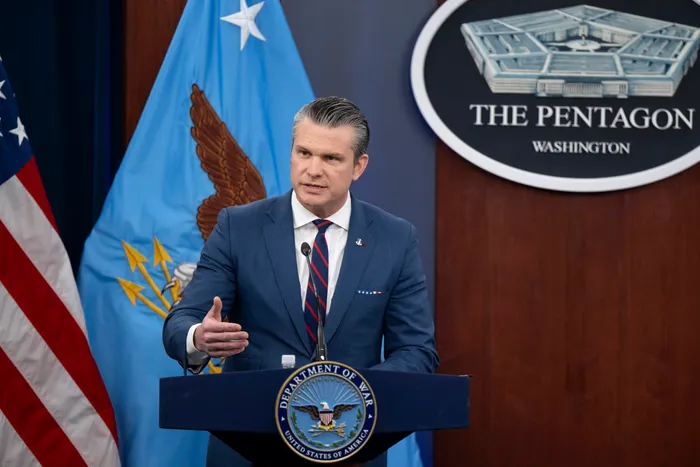
The lines between Hollywood fiction and American governance have blurred into a single, high-stakes performance. Pete Hegseth, the man tapped to lead the Pentagon, recently found himself at the center of a viral firestorm after a video emerged of him leading a prayer that sounded suspiciously like a biblical sermon. To the untrained ear, it was a moment of religious conviction. To anyone who has seen a Quentin Tarantino film, it was an unmistakable recitation of the "Ezekiel 25:17" monologue from Pulp Fiction. This incident is not merely a social media gaffe; it is a symptom of a deeper, more calculated shift in how political figures use media tropes to establish authority and signal loyalty to specific cultural tribes.
When a potential Secretary of Defense treats a scripted movie monologue written for a fictional hitman as a sacred text, the implications reach far beyond a simple case of mistaken identity. This wasn't an accidental slip of the tongue. It was a performance designed to evoke a specific kind of "tough-guy" spirituality that resonates with a base tired of traditional political rhetoric. However, the move backfires when the source material—a verse largely invented by Tarantino and inspired by 1970s martial arts films—replaces actual theological or policy-driven substance.
The Scripted Reality of the New Pentagon
Hegseth’s selection was always going to be a lightning rod for controversy. As a Fox News veteran and an Army National Guard officer, he represents a clean break from the "brass-heavy" leadership of the past. But the Pulp Fiction moment highlights a specific vulnerability: the reliance on curated optics over deep-seated institutional knowledge. In the film, Samuel L. Jackson’s character uses the verse as a chilling preamble to violence. In the political arena, Hegseth uses the same cadence to project a warrior-monk persona that fits perfectly into the aesthetic of the modern populist movement.
The problem is that the real Ezekiel 25:17 is much shorter and significantly less dramatic than the version Hegseth echoed. The cinematic version adds entire sentences about "the path of the righteous man" and "the shepherd" that do not exist in the King James Bible or any other standard translation. This creates a bizarre scenario where a top government official is inadvertently quoting a screenplay while his audience believes he is quoting the Word of God. It is a feedback loop of performative masculinity where the reference point isn't history or faith, but the 1994 Miramax film catalog.
Why the Pulp Fiction Trope Works for Hegseth
To understand why this happened, you have to look at Hegseth’s primary audience. He isn't speaking to the career bureaucrats at the Pentagon or the NATO allies in Brussels. He is speaking to a demographic that values "authenticity" as defined by cultural familiarity. In this world, the aesthetic of the warrior—marked by tattoos, bold rhetoric, and a disdain for political correctness—is more important than the nuances of logistics or procurement cycles.
The Pulp Fiction speech is one of the most recognizable pieces of dialogue in modern history. It carries a heavy, vengeful weight. By adopting that tone, Hegseth signals that he is not a "peace-time" administrator. He is positioning himself as a disruptor who views his role through a lens of righteous conflict. This is a deliberate branding exercise. The fact that the source is fictional doesn't matter to the base; what matters is how the words make them feel. It’s about the vibe, not the verification.
The Erosion of Expertise in Public Discourse
We are seeing a systemic replacement of expertise with entertainment value. Hegseth's rise is the culmination of a decade where "as seen on TV" became the ultimate credential. When a leader's frame of reference is primarily media-driven, policy begins to look like a series of "segments" designed to win a news cycle rather than long-term strategic goals.
The danger here is a disconnect from reality. If the person in charge of the world's most powerful military can't distinguish between a movie script and the scriptures he claims to uphold, what happens when he is faced with complex intelligence reports that don't fit a cinematic narrative? War is not a two-hour film with a satisfying third act. It is a messy, grinding process of attrition and diplomacy that rarely offers "cool" moments for the cameras.
The Counter Argument: Is it Just a Joke?
Defenders of Hegseth will argue that the media is overreacting. They will say it was a lighthearted moment, a cultural wink to an audience that grew up on the same films. They might even argue that the sentiment of the speech—justice and protection—is what matters, regardless of the source.
But this defense ignores the gravity of the office. The Secretary of Defense is the second most powerful person in the military chain of command. Every word they speak is scrutinized by allies and adversaries alike. When a Russian or Chinese analyst watches a future Pentagon head quote a fictional hitman in a religious setting, they don't see a "cool guy" making a joke. They see a lack of seriousness. They see an opening.
The Theological Mismatch
From a religious standpoint, the error is equally glaring. Conservative Christianity is a cornerstone of Hegseth’s political identity. For a movement that prides itself on "Biblical literacy," the failure to recognize a fake verse is a profound irony. It suggests that for some in the movement, the Bible has become a prop—a symbol of identity rather than a source of actual study. When the symbols of faith are swapped out for the symbols of pop culture, the underlying moral framework becomes hollow.
A Pattern of Performative Leadership
This isn't the first time Hegseth has used his platform to prioritize the aesthetic of the "crusader." His advocacy for service members accused of war crimes and his vocal criticism of "woke" military policies are all part of a larger effort to reshape the military in his own image. This image is heavily influenced by the "Spartan" subculture that has permeated certain circles of the American right—a subculture that often draws more from the movie 300 than from actual Greek history.
The Pulp Fiction incident is the latest data point in a trend where leadership is treated as a role to be played. If you look like the part and sound like the part, you get the part. The actual work of the Department of Defense—managing three million employees, overseeing a budget of nearly $900 billion, and maintaining global deterrence—is secondary to the performance of being the Secretary.
The Operational Risks of Cinematic Governance
The Pentagon is a massive, slow-moving machine that relies on precision. From the way orders are written to the way equipment is tested, there is no room for "creative interpretation." When the leadership at the top operates on a different frequency—one that prioritizes narrative over data—the friction can be catastrophic.
- Morale and Discipline: Career officers who have spent decades following strict protocols may find it difficult to respect a leader who confuses pop culture with doctrine.
- Global Perception: International partners rely on predictable communication. A Secretary who speaks in movie quotes is an unpredictable variable.
- Internal Vetting: The fact that this video surfaced and wasn't immediately flagged as a potential liability speaks to a breakdown in the vetting process. It suggests that those surrounding Hegseth are either equally unaware of the source material or too afraid to correct him.
[Image of the Department of Defense organizational chart]
The Spectacle is the Policy
We have entered an era where the spectacle is not a distraction from the policy; the spectacle is the policy. Hegseth’s appointment is a signal that the military will be used as a front in the ongoing cultural battles. Every memo, every promotion, and every prayer will be analyzed for its potential to go viral.
The Pulp Fiction prayer was a trial balloon for this new reality. It tested whether the public could distinguish between a sacred tradition and a cinematic pastiche. The results are in: for a large portion of the audience, the difference doesn't matter. As long as the delivery is confident and the message hits the right emotional beats, the facts are an afterthought.
This shift creates a vacuum where actual strategy should be. If the goal is to "own the narrative," then the nuances of geopolitical positioning in the South China Sea or the complexities of cyber-warfare are relegated to the background. They aren't "cinematic" enough to hold the attention of a base that has been conditioned to expect a show.
The Secretary of Defense is not a character in a Tarantino film. He is an official with the power to deploy nuclear weapons and send thousands of young men and women into harm's way. When the script of Hollywood becomes the blueprint for the Pentagon, the entire world is forced to watch a movie they never signed up for, hoping that the director knows when to stop the cameras before the real-world consequences become irreversible.
The focus must remain on the gap between the man and the myth. Hegseth has spent years honing his on-camera persona, but the walls of the E-Ring are thicker than a television studio. The performance might win a news cycle, but it won't win a war. The reliance on fictionalized versions of strength is a weakness that savvy actors on the global stage will eventually exploit. You cannot govern a nation with a screenplay.