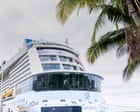
Falling off a massive ocean liner usually ends in tragedy. That's the cold, hard truth of maritime statistics. Yet every so often, a story breaks that defies every calculation search-and-rescue teams rely on—like the cruise ship pianist rescued after nine hours treading water miles from shore.
Most headlines treat these survivals like pure magic or divine intervention. They aren't. While luck plays a massive role in someone spotting a human head bobbing in open swells, staying alive for nine straight hours requires specific physical instincts, water temperature tolerances, and maritime safety protocols that most travelers completely misunderstand.
Let's strip away the sensationalism. When a crew member or passenger goes overboard, the clock starts ticking against hypothermia, exhaustion, and sheer invisibility.
Why Treading Water for Nine Hours Is Almost Impossible
You've probably tried treading water in a swimming pool for ten minutes. Your legs burn. Your shoulders ache. Now imagine doing that in saltwater swells with zero visual landmarks, darkness closing in, and currents pulling you sideways.
The human body simply isn't built to tread water continuously for nine hours. If you kick frantically the whole time, you'll burn through your glycogen stores in under ninety minutes. Once your muscles fail, panic sets in, and you aspirate water.
Survivors who make it past the two-hour mark do something entirely different. They stop fighting the ocean. Instead of violent kicking, they rely on drownproofing or minimal-effort floating techniques. Saltwater is roughly 2.5% denser than freshwater, which gives your body extra natural buoyancy. If you keep your lungs partially inflated and tilt your head back, you can float with barely a flick of your wrists.
Water temperature dictates everything else. In the North Atlantic, cold shock kills you in minutes. In tropical or subtropical waters—like the Caribbean or the Gulf of Mexico, where most cruise routes operate—surface temperatures hover between 75°F and 84°F (24°C to 29°C). Even in warm water, though, prolonged immersion drains body heat 25 times faster than air of the same temperature. After six to eight hours, mild hypothermia clouds your judgment, slurs your speech, and saps your grip strength. Making it to hour nine means fighting off both physical exhaustion and mental drift.
What Happens on the Bridge When Someone Goes Overboard
There's a massive misconception that cruise ships have automated nets or instant alarms that stop the vessel the second someone falls. They don't.
Modern cruise ships are floating cities carrying up to 8,000 people. When a crew member—whether a lounge pianist, an engineer, or a deckhand—goes missing, the alarm rarely sounds instantly unless someone physically witnesses the fall.
Here is how a real maritime search unfolds:
- The Missing Person Report: For crew members, alarms usually trigger when they miss a scheduled shift or safety drill. If a pianist doesn't show up for an evening set, supervisors check their cabin first. That delay alone can eat up two or three hours.
- CCTV Verification: Security officers scrub through hundreds of hours of deck camera footage to confirm the person didn't just fall asleep in a crew lounge. Once they spot the fall on video, they log the exact timestamp and GPS coordinates.
- The Williamson Turn: You can't slam the brakes on a 150,000-ton ship. The captain executes a specialized maneuver called a Williamson turn, swinging the bow hard to one side before reversing course to bring the vessel back along its exact previous wake.
- Coast Guard Coordination: The bridge contacts the nearest Maritime Rescue Coordination Center (MRCC). Agencies like the U.S. Coast Guard deploy HC-144 Ocean Sentry aircraft, MH-60 Jayhawk helicopters, and cutters, running computer drift models based on wind speed and ocean currents.
By the time search planes reach the grid, the survivor has often drifted miles from the original point of entry.
The Visibility Problem Nobody Talks About
Finding a person in the open ocean is harder than finding a needle in a haystack. Needles don't move.
From the deck of a cruise ship—or even from a Coast Guard helicopter flying at 500 feet—a human head looks identical to a whitecap, a floating coconut, or a patch of kelp. Even in calm two-foot swells, a swimmer disappears behind walls of water every few seconds.
Dr. Arthur Allen, a longtime physical oceanographer with the U.S. Coast Guard who helped develop their Search and Rescue Optimal Planning System (SAROPS), spent decades studying how human bodies drift at sea. His research showed that leeway—the way wind pushes a floating object—varies wildly depending on whether someone is wearing bulky clothes, holding onto debris, or floating flat on their back. A tiny miscalculation in wind direction shifts the search box by miles over a nine-hour window.
When rescuers finally pull someone out after nine hours, it's almost always because the survivor did two things right: they conserved energy by floating rather than swimming toward distant lights, and they waved or splashed only when a vessel or aircraft came within visual range. Swimming toward a ship's lights at night is a fatal mistake. Distances over water deceive your eyes; a ship that looks half a mile away is often five miles out, and you'll exhaust yourself long before closing the gap.
Cruise Ship Crew vs. Passengers in Overboard Scenarios
It's worth pointing out a stark difference between passengers and crew members when these incidents happen. According to data compiled by maritime safety consultants like G.P. Wild and reports submitted under the Cruise Vessel Security and Safety Act, roughly 20 to 25 people go overboard from cruise ships globally each year.
The survival rate hovers around 17% to 25%.
Why do crew members sometimes beat those brutal odds? Training and awareness. Every single person working on a cruise ship—including musicians, bartenders, and entertainers—undergoes mandatory STCW (Standards of Training, Certification, and Watchkeeping) basic safety training before they ever step foot on a vessel.
That certification includes live pool drills covering:
- Cold-water shock mitigation
- Heat Escape Lessening Posture (HELP)
- Group huddling techniques
- Proper use of immersion suits and life jackets
- Signal flares and whistle protocols
A cruise ship pianist isn't just an entertainer. Under maritime law, they're classified as seafarers with assigned emergency muster duties. Even without a life jacket, that baseline familiarity with survival floating gives a trained crew member a distinct psychological edge over a panicked vacationer.
Misconceptions About Cruise Line Safety Tech
Whenever an overboard rescue hits the news, comment sections immediately fill up with angry demands asking why ships don't have sensors on every railing.
Actually, many modern vessels do have radar and thermal-imaging Man Overboard (MOB) systems. Companies like PureTech Systems and Marisense build automated detection arrays that track objects breaking the plane of the ship's hull.
The catch? False positives.
Sea spray, flocks of seabirds, tossed napkins, and heavy rain trigger constant false alarms on thermal cameras. If a bridge crew stopped a 1,100-foot cruise ship every time a seagull flew past an infrared sensor, voyages would take weeks. Because automated systems still require human verification via CCTV, the human eye remains the primary detection tool.
Railings also get blamed unfairly. International maritime regulations set by the International Maritime Organization (IMO) mandate that passenger deck railings must be at least 42 inches (about 1.07 meters) high. You cannot accidentally trip over a 42-inch railing while walking down a deck. Almost every overboard incident involves someone climbing onto furniture, sitting on a balcony rail, or intentionally jumping.
What You Should Actually Do If You Ever Witness—or Experience—a Fall
Nobody books a vacation expecting to test their open-water survival skills, and most people never will. Still, knowing the exact protocol takes thirty seconds to learn and removes the guesswork if something goes wrong.
If you see someone go over the side of a ship:
- Never jump in after them. You won't save them. You'll just give the Coast Guard two invisible targets instead of one.
- Scream "Man Overboard!" immediately and point continuously at the person in the water. Do not take your eyes off them to look for a crew member. Keep pointing so others can lock onto your sightline.
- Throw anything that floats. Grab the nearest orange lifebuoy mounted along the deck railing. Even deck chairs, cushions, or plastic coolers help rescuers spot the drift path from the air.
- Have someone else hit the alarm. Let a bystander run to a deck phone or alert a crew member while you keep visual contact.
If you're the one in the water, drop every instinct telling you to swim. Kick off heavy shoes immediately, trap air inside your shirt or pants if you're wearing loose clothing, and roll onto your back. Focus entirely on slow breathing until the ship's wake settles. Save your energy for splashing and shouting only when you hear engine noise or spot searchlights sweeping the surface.